

Last verified: October 16, 2026. Proficiency rankings and survey figures change with each edition. I re-check every number on this page against the EF EPI, Eurobarometer, and INE sources and update the date above each time.
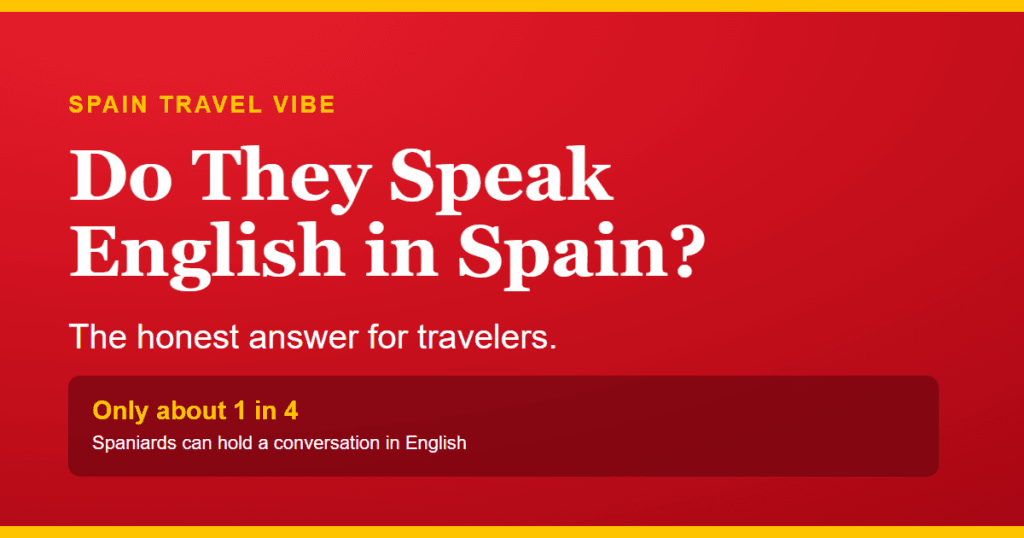
Do they speak English in Spain? Honest answer: less than you’d hope, and less than almost anywhere else you’d holiday in Western Europe. Spain welcomed a record 96.8 million foreign visitors in 2025 (INE, FRONTUR border survey, December 2025), yet only around a quarter of Spaniards can hold a conversation in English.
Disclosure: Some links in this guide may earn us a commission, at no extra cost to you. It never changes what we recommend.
That gap sounds scarier than it is. Millions of English-only travelers cross Spain every year without a single communication disaster, because the English that does exist is concentrated exactly where tourists go. The trick is knowing where the coverage ends, and what to carry for the stretches beyond it.
Here’s the data on who actually speaks English in Spain, city by city and situation by situation, plus the fifteen phrases and one app setting that close the rest of the gap.
Key Takeaways
- In 2025, Spain scored 540 (“moderate”) on the EF English Proficiency Index, ranking 36th of 123 countries (EF EPI, 2025).
- Roughly 1 in 4 Spaniards speak conversational English, versus 47% of Europeans overall (Eurobarometer, 2024).
- English works reliably in hotels, big-city tourist cores, and attractions. It thins out fast in taxis, pharmacies, local bars, and rural Spain. The same gap shows up city by city: across my list of underrated Spanish cities, foreign visitors book 13.8% of hotel nights in Cuenca against 87.7% in Barcelona.
- Age matters most: English has been a compulsory school subject since 1990, so under-40s usually understand some.
- Fifteen Spanish phrases plus an offline translation app cover essentially everything else.
New to planning a Spain trip? Start with my complete Spain travel planning guide.
Table of Contents
Do They Speak English in Spain? The Short Answer
Not widely, no. In 2025, Spain scored 540 on the EF English Proficiency Index, a “moderate” rating that ranks it 36th of 123 countries worldwide (EF EPI, 2025 edition). Eurobarometer surveys put conversational English at roughly 22-27% of the population, against an EU-wide average of 47% (European Commission, Special Eurobarometer 540, “Europeans and their languages”, 2024).
For comparison, that leaves Spain well behind the Netherlands, Scandinavia, Germany, and even neighboring Portugal. Among Western Europe’s big tourist destinations, only France and Italy keep it company near the bottom of the table. So the meme is basically true: do they speak English in Spain? As a population, mostly not.
But here’s the twist buried in EF’s own data. Spain’s problem isn’t understanding you, it’s answering you. Spaniards tested far higher in reading English (558) than in speaking it (462), a 96-point gap (EF EPI Spain fact sheet, 2025). Many people you meet will follow your slow, clear English yet reply in Spanish, gestures, or a shy word or two. That changes how you communicate: speak simply, and don’t mistake a hesitant answer for zero comprehension.
Where in Spain Is English Most Widely Spoken?
In the tourist cores of the big cities, and in one region you’d never guess. City-level EF testing puts Vigo (569), A Coruña (567), and Barcelona (566) at the top, with Valencia (564), Granada (562), and Madrid (560) close behind (EF EPI Spain fact sheet, 2025). Hotel desks, major attractions, and restaurants inside those tourist zones will nearly always manage English.
Now the counterintuitive part. Which region tops Spain’s English rankings? Not the Costa del Sol. It’s rainy, less-visited Galicia (563), while tourist-saturated Andalusia (526) sits near the bottom, above only Extremadura (514) and Castilla-La Mancha (509). Even Seville, Spain’s fourth tourist city, scores a modest 535, thirty-four points below Vigo.
Why doesn’t tourism translate into English? Because tourist-zone English is a job skill, not a neighborhood trait. EF’s occupational data makes the same point: customer-service workers score 570, thirty points above the national average (EF EPI Spain fact sheet, 2025). Step out of the service bubble, into a residential barrio, a village in Andalusia’s interior, a regional bus station, and you’re back among the three-quarters of Spain that doesn’t speak English.
One more wrinkle worth knowing: with overtourism protests pushing travelers toward less-visited Spain, the reward for going off the beaten path is real, but so is the language trade-off. The full story of Castilian, Catalan, Basque, and Galician deserves its own explainer, which is my guide to the languages spoken in Spain.
Who Speaks English? The Generational Divide
Age is the strongest single predictor. English became a compulsory school subject nationwide under Spain’s 1990 LOGSE education reform, so most Spaniards under 40 studied it for years, while their parents mostly studied French or nothing. Across the EU, 7 in 10 young people can now hold a conversation in English (European Commission, Special Eurobarometer 540, 2024), and Spain’s under-40s tested as its strongest age bands in 2025 (EF EPI, 2025).
The practical rule follows directly: need help on the street? Ask someone under 40, or duck into any shop with young staff. And remember the reading-versus-speaking gap. A grandmother in Cádiz likely speaks zero English; her granddaughter probably understands you fine, even if she answers in short, careful phrases.
Which Situations Trip Travelers Up?
The pattern is simple: anywhere built for tourists speaks English, anywhere built for locals doesn’t. Spain’s 96.8 million visitors funnel through a narrow corridor of hotels, attractions, and city centers, and Catalonia alone absorbed 20.1 million of them in 2025 (INE, FRONTUR, 2025). English availability tracks that corridor, not the map. Here’s how it breaks down in practice:
| Situation | English? |
|---|---|
| Hotel front desks, hostels | ✅ Nearly always |
| Major attractions, museums, guided tours | ✅ Nearly always |
| Restaurants in tourist zones | ✅ Usually, with English menus |
| Renfe app, ticket machines, airports | ✅ English-language option built in |
| Taxis and ride-hail drivers | ⚠️ Hit or miss; apps bridge the gap |
| Pharmacies, doctors, local services | ⚠️ Hit or miss; younger staff help |
| Neighborhood bars, menu del día spots | ❌ Unlikely; menus often Spanish-only |
| Rural Spain, villages, regional buses | ❌ Unlikely; assume none |
A few of those are worth testing before you fly. The Renfe app and website, Madrid and Barcelona metro machines, and Alhambra and Sagrada Família ticketing all have full English interfaces as of August 2026, so the booking layer of your trip is covered even where the human layer isn’t. My guide to getting around Spain walks through those booking screens step by step. The gaps that actually catch travelers are the chalkboard menu del día with no translation, the pharmacist miming dosage instructions, and the village bus driver who answers your question with a shrug and a smile.
Do You Need to Learn Spanish Before Visiting?
No, and let’s kill that worry with numbers: the UK sent 19 million visitors to Spain in 2025, more than any other country (INE, FRONTUR, 2025), and the overwhelming majority arrived with schoolbook Spanish at best. You will not be stranded. But about fifteen phrases transform how Spain treats you, because effort is the real currency here. Fumble a “buenos días” and you’ll usually get patience, warmth, and often someone’s best attempt at English in return.
The starter kit, in rough order of usefulness:
- Hola / Buenos días / Buenas tardes: hello / good morning / good afternoon. Greet first, always; walking up to someone without a greeting reads as rude.
- Por favor / Gracias: please / thank you.
- ¿Habla inglés?: do you speak English? Asking beats assuming.
- No entiendo: I don’t understand.
- ¿Dónde está…?: where is…? Add el baño (the bathroom) or la estación (the station).
- La cuenta, por favor: the bill, please. Waiters won’t bring it unasked; that’s politeness, not neglect.
- ¿Qué me recomienda?: what do you recommend? The single best phrase in any restaurant.
- Una mesa para dos: a table for two.
- Perdón / Disculpe: sorry / excuse me, for getting past or getting attention.
- Vale: okay. You’ll hear it forty times a day; saying it makes you sound half-local.
What about Catalonia, the Basque Country, and Galicia, where street signs suddenly stop looking like your phrasebook? Castilian Spanish works everywhere in Spain, the co-official languages notwithstanding, and English levels in those regions actually match or beat the national average. Nobody expects you to order in Catalan. From language to etiquette, the wider picture of Spanish culture is in my traveler’s guide.
What About Translation Apps?
One app, set up before you leave wifi, closes every remaining gap: Google Translate with the Spanish offline pack downloaded. Offline mode matters because rural Spain, where you’ll need translation most, is exactly where signal gets thin, though coverage is excellent by European standards. For data everywhere else, my Spain SIM card and eSIM guide covers the options. Camera mode reads chalkboard menus and pharmacy labels instantly, and conversation mode handles anything longer than a phrase.
That’s the whole toolkit: fifteen phrases, one offline download, and realistic expectations. Sorted, before your plane leaves the gate.
Frequently Asked Questions
Can you get by in Spain with only English?
Yes, on the main tourist trail. Spain hosted 96.8 million foreign visitors in 2025, led by 19 million Britons (INE, FRONTUR, 2025), and hotels, attractions, and tourist-zone restaurants serve them in English daily. Off that trail, in villages and local venues, pair basic phrases with a translation app.
Do they speak English in Barcelona?
Yes, more than almost anywhere in Spain. Barcelona tested at 566 in 2025, third among Spanish cities behind Vigo and A Coruña (EF EPI Spain fact sheet, 2025). Tourist-core hotels, attractions, and restaurants all manage English; you’ll see Catalan and Spanish on signs.
What percentage of Spain speaks English?
Roughly a quarter. Eurobarometer polling has put conversational English at 22% of Spaniards, with newer estimates near 27%, versus a 47% EU average (European Commission, Eurobarometer, 2024). On the EF index, Spain’s 540 score ranks 36th of 123 countries, a “moderate” rating (EF EPI, 2025).
Is Spanish or English more useful in Catalonia and the Basque Country?
Castilian Spanish works everywhere, co-official languages included. And English is no weaker there: Catalonia scored 547 and the Basque Country 550 in 2025, both above Spain’s 540 national average (EF EPI Spain fact sheet, 2025). Learn hola and gracias; nobody expects Catalan or Basque.
Do They Speak English in Spain? The Bottom Line
Do they speak English in Spain? Mostly not, and it mostly won’t matter. Here’s what’s real:
- Spain genuinely ranks low: 540 on the EF index, 36th of 123 countries, with only about 1 in 4 Spaniards conversational.
- But coverage follows tourists: hotels, attractions, and city tourist cores are reliably English-friendly; villages and local venues aren’t.
- They understand more than they speak: a 96-point reading-versus-speaking gap means slow, simple English often lands even when the reply comes in Spanish.
- Fifteen phrases plus one offline app close every gap that’s left, and the phrases buy goodwill no app can.
I re-verify the rankings and survey figures on this page against each new EF EPI edition, Eurobarometer wave, and INE tourism release. Language stats move slowly, but “last updated” still beats “trust me.”
Ready to put it to work? Start with the complete Spain travel planning guide to build the rest of your trip.
Planning the rest of your trip? My guides cover Spain’s entry requirements, trip costs, and getting around by train. Subscribe and we’ll send the update whenever a figure on this page changes.