

Last verified: October 16, 2026. This hub aggregates figures from my entry-requirements, tourist-tax, transportation, cost, and best-time guides, and is re-checked monthly alongside all five.
Spain welcomed a record 96.8 million international visitors in 2025, and 2026 is on pace to break 100 million (idealista/news, 2026). That alone would make this a big year to plan a first trip. It also happens to be the year the EU rebuilt how everyone crosses Spain’s border in the first place.
Disclosure: Some links in this guide may earn us a commission, at no extra cost to you. It never changes what we recommend.
Most “Spain travel guide” posts you’ll find are static: written once, updated rarely, and quietly out of date on the details that actually change a trip. Border checks, tourist taxes, hotel prices, and rail fares have all shifted in 2026, and a guide that doesn’t reflect that isn’t much use to someone booking flights next month.
First-time planners in 2026 are really dealing with three separate complications at once, and most guides only address one: record-level crowding, since Spain has never welcomed this many visitors in a single year; a genuinely new border process, since fingerprint-and-face-scan entry didn’t exist a year ago; and a patchwork of tourist taxes and prices that keeps expanding city by city. Treating those as one connected planning problem, instead of three unrelated footnotes, is the whole point of this hub.
This is the hub of your Spain travel guide. Ten things to sort out before you book, each with a real number behind it, and a link to a full, monthly-verified deep dive when you’re ready for more detail.
Key Takeaways
- Spain hit a record 96.8 million international visitors in 2025, on pace to pass 100 million in 2026 (idealista/news, 2026).
- Since April 10, 2026, the EU’s Entry/Exit System (EES) has replaced passport stamps with fingerprint and facial scans at Spain’s borders.
- A mid-range week in Spain runs roughly €700-1,050 per person, excluding flights.
- May and October give the best weather-to-crowd balance on the mainland; July and August are the most expensive and most crowded.
Before anything else, make sure you can actually get in: border rules changed for everyone in 2026, and that’s the logical place to start planning.
Table of Contents
Why This Spain Travel Guide Is Different in 2026
Most Spain travel guide posts recycle the same evergreen advice from a few years back. This one doesn’t: every figure below traces back to one of my own dated, sourced spoke guides, not a generic aggregation. Use this Spain travel guide as a checklist, working through the ten sections below in order, or jump straight to the one you need.
Do You Need a Visa? Spain Entry Requirements in 2026
US, UK, and Canadian travelers still enter Spain visa-free for up to 90 days in any 180-day period, and that hasn’t changed. What has changed is how the border processes you: since April 10, 2026, the EU’s Entry/Exit System (EES) has replaced passport stamps with fingerprint and facial scans for every non-EU arrival (European Commission, 2026).
First-time enrollment takes longer than a stamp used to, so build in extra time at the airport on your first Spain entry, especially in peak summer months. A new €20 ETIAS travel authorization is also on the way, though the EU hasn’t set a start date and it isn’t required yet, so don’t pay a third-party site to “process” it early.
A few other basics still apply: your passport needs to have been issued within the last 10 years and stay valid at least 3 months past your departure date, and border officers can (rarely) ask you to show proof of €121.10 per person per day for your stay, with a €1,098.90 minimum (Ministerio del Interior, 2026).
Is any of this actually likely to stop you at the gate? Rarely, for a well-prepared first-timer, but “rarely” isn’t “never,” and a passport that’s a few months short of the validity window is one of the few genuinely trip-ending mistakes on this whole list. Check the expiry date before you book anything else.
One more thing worth flagging now, even though it isn’t required yet: once ETIAS does launch, it will need to be tied to the same passport you fly on, so if you’re due for a renewal before your trip, get the new passport first and treat ETIAS as the very last box you check before departure.
For the full mechanics, including exactly what EES enrollment looks like at the airport and how to prepare for ETIAS once it launches, see my complete Spain entry requirements guide.
When Is the Best Time to Visit Spain?
May and October give the strongest all-around balance of weather, crowds, and price for mainland Spain, while the Canary Islands run the opposite calendar entirely, with winter as their actual peak season, a split my Mallorca and Canary Islands comparison prices out month by month. There isn’t one right answer here. It depends on which Spain you’re visiting.
2025 was Spain’s hottest summer since records began in 1961 (The Local, 2026), and heat-hit travelers report being noticeably less eager to repeat a July or August trip. Shoulder-season travel avoids that problem and comes with a real discount: stays typically run 20-35% below July-August rates (SmarterTravel, 2026).
That heat record matters for planning, not just for trivia. A July or August trip through interior cities like Madrid or Seville now regularly means afternoons too hot for sightseeing, pushing itineraries toward an early-morning-and-evening rhythm that first-timers rarely plan for in advance. Building siesta-hour downtime into a summer itinerary isn’t optional anymore; it’s the difference between an enjoyable afternoon and an uncomfortable one. For the habits behind that rhythm, from meal times to what actually closes, my Spanish culture guide tests the usual beliefs against the numbers.
If your dates are locked to summer, coastal and northern routes hold up far better than the interior. San Sebastián, Galicia, and the Canary Islands stay comfortable when Madrid and Seville are punishing, so shifting your route rather than your dates is a reasonable fallback.
No single competing guide scores every month on both weather and crowds in one place, so here’s my own editorial ranking, weighted from the region-by-region research behind my best-time guide:
Isn’t “best time” always going to be a moving target? A little, since it depends on which region you’re weighing. That’s exactly why I break it down by region rather than giving Spain a single verdict. See the full best-time-to-visit-spain guide for month-by-month detail on the Canaries, the north, and the interior.
How Many Days Do You Need in Spain?
A week is enough for Barcelona and Madrid with day trips built in; 10 days lets you add a third base, commonly Seville or Granada; two weeks is the first point where a first-timer can comfortably go beyond the golden triangle without rushing.
The consistent advice from experienced planners: favor fewer bases with more nights each over rapid city-hopping. Three nights per base is a reasonable floor. Anything less and you spend more time in transit and checking in than actually seeing the place.
That tradeoff compounds with how you get around. A 7-day trip built around two cities keeps transport simple; a 10-day trip adding a third base means at least one more intercity leg to plan and book. Full pricing for those legs, across three competing rail operators plus flights and driving, lives in my getting-around Spain guide.
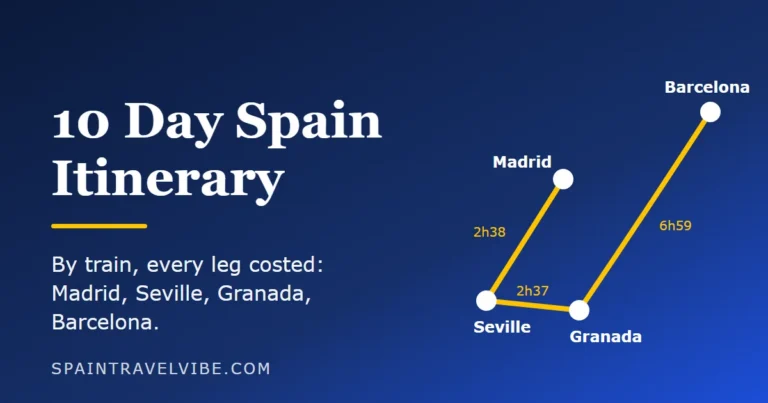
As a rough shape to plan around: 7 days works well as 3 nights in Barcelona plus 4 in Madrid, with a day trip layered into each, and my ranked day trips from Madrid covers which one is worth the day. 10 days adds Seville or Granada at 3 nights apiece. 14 days is where a first-timer can realistically fit a fourth stop, whether that’s a fourth golden-triangle city or a first taste of somewhere less obvious, like San Sebastián or the Basque coast. My 10 day Spain itinerary by train works a four-city version out day by day, with every train priced.
Should you cut a city instead of shortening every stop equally? Almost always, yes. Trimming Barcelona from 4 nights to 3 barely registers, but trimming it to 1 night just to squeeze in a fourth city usually means arriving tired and leaving having seen almost nothing. My dedicated itinerary-length guide breaks down exactly how to structure a 7, 10, or 14-day route, city by city, including the backtracking mistake that costs more time than most travelers budget for.
How Much Does a Trip to Spain Cost in 2026?
Budget travelers spend roughly €50-70 a day in Spain, mid-range travelers €100-150, and luxury travelers €200-350 or more, all excluding international flights. A one-week mid-range trip for one person runs roughly €700-1,050 before flights.
Those numbers are moving faster than most budget guides admit. Spanish hotels averaged €163.4 a night in the first half of 2026, up 4.9% year-over-year (Hotel Barometer, STR/Cushman & Wakefield, via Majorca Daily Bulletin, July 2026), nearly double the pace of the EU’s overall hotel-price inflation. A guide quoting 2023 or 2024 averages is already understating your real cost. One line you can mostly leave out of the arithmetic is the tip: tipping in Spain is optional and small, and rounding up covers it.
Tourist tax and the incoming €20 ETIAS fee both stack on top of the daily figures this Spain travel guide uses above, small individually but worth budgeting for. So do international flights, the single most variable line item in any Spain budget: round-trip fares average roughly €500-900 from the US and €120-250 from the UK (momondo; Skyscanner, 2026), with booking 2-4 months ahead consistently beating last-minute prices.
Where does most of that daily figure actually go? Hotels, by a wide margin, which is exactly why the category is worth watching closely this year. A three-star room that cost €70 a night in 2024 is more likely to run €80-90 now, and that gap compounds fast across a multi-night stay. The full category-by-category math, plus real totals for 3-day, 1-week, 10-day, and 2-week trips, is in my complete Spain trip cost breakdown.
How Do You Get Around Spain?
For any golden-triangle route, high-speed rail beats both flying and driving on door-to-door time and cost. Spain now has three competing operators, Renfe, Iryo, and Ouigo, running the same routes at different prices, with fares from roughly €9 on Ouigo’s cheapest advance tickets (Ouigo España, 2026) up to €95 for a full-fare Renfe AVE seat on Madrid-Barcelona.
Book your train 2-4 weeks ahead for the best fares; last-minute walk-up tickets cost noticeably more. A rental car only starts to make sense once you leave the golden triangle for regions the high-speed network doesn’t reach, think Green Spain, the white villages, or rural Andalusia.
Flying between Spanish cities rarely beats the train once you count airport transfers and check-in time, and it’s usually more expensive besides. The exception is longer hops, Madrid to the Canary Islands or the Balearics, where flying is the only practical option regardless of budget.
Local transit in Madrid and Barcelona is cheap and reliable, and ride-hailing apps typically undercut traditional taxis by 10-20%. For a full operator-by-operator price comparison across every route, see getting around Spain, the transportation spoke of this Spain travel guide.
Will You Pay a Tourist Tax in Spain?
There’s no single national tourist tax. Only Catalonia and the Balearic Islands run a full regional tax as of 2026, while Madrid, Málaga, Seville, and all of Valencia, including Benidorm, still charge nothing at all.
Barcelona sits at the top of the scale, charging up to €12 per person, per night at five-star hotels since April 1, 2026, the highest confirmed rate in the country (Ajuntament de Barcelona, 2026). Galicia became Spain’s newest tourist-tax region in 2025, with A Coruña and Santiago de Compostela both charging €1-2.50 a night (idealista, 2025). The Balearic ecotax adds another €1-4 a night on top of whatever your hotel charges (Ibiza Spotlight, 2026).
Booking sites don’t always show the tax up front, and some only add it as a separate line at checkout or, in a few cases, collect it in cash at the front desk when you arrive. Neither is a scam; it’s just how these municipal taxes are typically administered, so don’t be alarmed if the total on your confirmation email is slightly lower than what you actually pay.
The safest move is checking before you book, not at checkout. My full city-by-city tourist tax table covers every region, including which taxes are still just proposals, another piece of this Spain travel guide’s freshness commitment.
What Should You Pack for Spain?
Pack for heat first. Even shoulder-season Spain runs warmer than most first-timers expect, and the country’s regional split means one packing list rarely fits the whole trip: Madrid’s dry interior heat, coastal humidity, and northern Spain’s rain call for genuinely different kits.
Light layers and real sun protection cover most of May through October. If your route touches Galicia, Asturias, or the Basque Country, pack an actual rain layer regardless of season; that part of Spain doesn’t follow the mainland’s dry-summer pattern. Bring one smart-casual outfit for evenings, since dining out in Spain skews slightly more dressed-up than typical US or UK casual norms.
The one item first-timers most often forget: an adapter. Spain uses Type C/F plugs at 230V, different from North American, UK, and Australian standards. Bring comfortable walking shoes over anything else in your bag; Spanish city centers mean cobblestones, hills, and a lot more walking per day than most itineraries account for.
What actually gets left at home most often? Anything for rain, mostly because visitors assume all of Spain is sunny. That assumption holds for Andalusia in July and falls apart fast in Bilbao in November. I keep the full version in my season-by-region packing list for Spain.
How Do You Stay Connected in Spain?
An eSIM is the simplest option for most visitors, activated before you land, with Spain-specific data plans running roughly $4-26 depending on how much data you need (aggregated 2026 provider data from Saily, Simbye, and SimOptions).
A physical SIM from an airport kiosk or a Vodafone, Orange, or Movistar store works too, and can be cheaper for longer stays, but means one more errand on arrival. Roaming on a home plan is usually the priciest option by far for US, UK, and Canadian visitors, who typically get billed at international rates the moment they land.
Most 1-2 week trips comfortably fit inside a 10-20GB plan unless you’re streaming heavily. Navigation apps, translation tools, and booking confirmations are the real data draws on a Spain trip, not video, so most travelers overestimate how much they’ll actually use.
Set the eSIM up before you fly, not after landing; most providers activate on a timer from installation, not from first use, so installing at the gate wastes a chunk of your data window sitting in airport WiFi. I compare specific providers, carrier prices, and the passport rule for physical SIMs in my guide to getting a SIM card or eSIM for Spain.
Is Spain Safe for Tourists?
Spain is one of Europe’s safer countries for violent crime, ranking 27th of 163 on the 2026 Global Peace Index with a homicide rate of 0.68 per 100,000, among the lowest in Europe (OSAC, US Bureau of Diplomatic Security, 2026). Numbeo’s crowdsourced Safety Index puts Spain at 62.4 out of 100, squarely in the low-crime category (Numbeo, 2026). The real, common risk for visitors isn’t violence; it’s pickpocketing. For the full breakdown, see my guide to whether Spain is safe, with the scams and hotspots to watch by city.
Theft concentrates in predictable places: crowded metro lines, popular plazas, and tourist-heavy neighborhoods in Barcelona especially. A cross-body bag worn in front, a phone that never sits unattended on a café table, and a polite “no” to unsolicited “help” eliminate most of the risk without changing how you experience the trip.
Does that mean smaller cities are simply safer? Generally, yes, since pickpocket rings concentrate where the tourist density and foot traffic make the risk-reward worth it, and Barcelona, Madrid, and the busiest attraction queues see the bulk of it. Granada, Toledo, or Salamanca see meaningfully less of this problem just by virtue of having fewer crowds to disappear into.
Overtourism protests, which do happen in Barcelona, Mallorca, and parts of the Canaries, are a separate issue from crime and are generally not a safety threat to visitors, just an occasional inconvenience or an uncomfortable moment to walk past respectfully. Scams aimed at tourists, fake petition signers, rigged street games, overpriced “friendship bracelets,” are more of a nuisance than a danger; declining and walking on works every time. I break that risk down city by city in the safety guide linked above.
Do You Need to Speak Spanish to Visit?
No. English gets you through the golden triangle and major coastal areas without much friction, though Spain still ranks a moderate 36th globally for English proficiency, with an EF EPI score of 540 (EF English Proficiency Index, 2026), and fluency drops fast outside tourist zones.
Hotels, major attractions, and restaurants in Barcelona and Madrid handle English reliably. Small-town restaurants, regional transit staff, and rural areas are a different story, where a handful of Spanish phrases go a long way.
It’s also worth knowing Spain isn’t linguistically uniform even in Spanish. Six regions have a co-official language alongside Castilian Spanish: Catalonia, the Valencian Community, the Balearic Islands, Galicia, the Basque Country and the Basque-speaking north of Navarre. Street signs and menus in those regions often appear in the regional language first. That’s not a barrier for English speakers specifically; it’s simply a second layer of “not English” worth expecting outside Madrid and Andalusia. I cover exactly which phrases matter most, plus how far English gets you in Spain region by region, in my guide to traveling Spain without Spanish. My guide to the languages spoken in Spain shows which one you’ll meet where.
Beyond the Golden Triangle: Planning a Second (or Bigger First) Trip
If Barcelona-Madrid-Seville feels like everyone else’s itinerary, here’s the honest case for skipping it, or saving it for trip two.
2026 is shaping up as Spain’s most-visited year on record, and the golden triangle is also its most crowded corner. The Basque Country, Galicia, and cities like Valencia, Córdoba, and Ronda deliver comparable food, architecture, and history with meaningfully smaller crowds, and interior or southern Spain runs 20-40% cheaper than Barcelona or Madrid for equivalent quality (Radical Storage, 2026).
That’s not a reason to skip Barcelona and Madrid entirely; it’s a reason not to treat them as the whole trip. I organize my destination coverage by region rather than a fixed top-10 city list, specifically so a second-time (or ambitious first-time) traveler has somewhere concrete to go once the basics in this Spain travel guide are handled.
Even a first trip can borrow from this. Swapping one golden-triangle night for a detour to Córdoba or Ronda doesn’t cost much time, and it’s usually the part of the trip travelers remember most vividly precisely because it wasn’t on everyone else’s itinerary too. Start with my region-by-region guide to where to go in Spain once you’re ready to look past the big four.
Frequently Asked Questions
How far in advance should I plan a trip to Spain?
Three to six months out is comfortable for a first trip. Book Alhambra or Sagrada Família tickets and peak-season (June-August) hotels as early as possible, since both routinely sell out weeks ahead.
Do I need a visa to visit Spain in 2026?
No, not for US, UK, Canadian, or most Western passport holders staying under 90 days. You will go through biometric EES checks at the border since April 2026, and should budget for a €20 ETIAS fee once it launches; the EU hasn’t announced the date yet.
Is 7 days enough for a first trip to Spain?
Yes, for Barcelona and Madrid with day trips, but 10-14 days lets you add a third base like Seville or Granada without rushing between cities.
Is Spain expensive to visit in 2026?
It runs roughly €50-70 a day budget to €200-350+ a day luxury, still cheaper than France, Italy, or the UK for equivalent quality, though 2026 hotel inflation is narrowing that gap faster than the EU average.
Do I need to speak Spanish to travel in Spain?
No. English reliably covers the golden triangle and major tourist areas, though it thins out fast in small towns and rural regions, where a few Spanish phrases help considerably.
What’s the biggest mistake first-time Spain travelers make?
Packing too many cities into too few days. Both expert itinerary advice and this Spain travel guide’s own trip-length research favor fewer bases with three or more nights each over rapid city-hopping.
Planning Your First Spain Trip: Where to Start
2026 is a genuinely different year to plan a Spain trip than 2023 or 2024 was. Border checks, tourist taxes, and hotel prices have all moved, and a guide worth trusting has to reflect that, not recycle numbers from before any of it changed.
This Spain travel guide follows a deliberate order: start with entry rules, since they gate everything else. Let timing and trip length shape your route. Then work through cost, transport, tax, what to pack for Spain by season and region, connectivity, safety, and language as the practical layer that turns a plan into a booked trip. Once the dates are fixed, my guide to the best things to do in Spain covers what to reserve first, because the Alhambra and a handful of others close months ahead.
ETIAS’s still-unscheduled launch and the ongoing tourist-tax expansion mean parts of this guide will keep moving, which is exactly why this Spain travel guide is re-verified monthly alongside the five spokes it draws from.
Subscribe and we’ll send the one-page update whenever entry rules, taxes, or prices change before your trip.