

Last verified: September 20, 2026. Gaudí’s buildings don’t move, but the numbers around them do, and 2026 is his centenary year. I re-check the visitor counts against the Sagrada Família’s annual report and the published accounts of each house. I check the UNESCO listings against the World Heritage register, and the centenary programme against the Generalitat’s own releases. I update the date above each time.
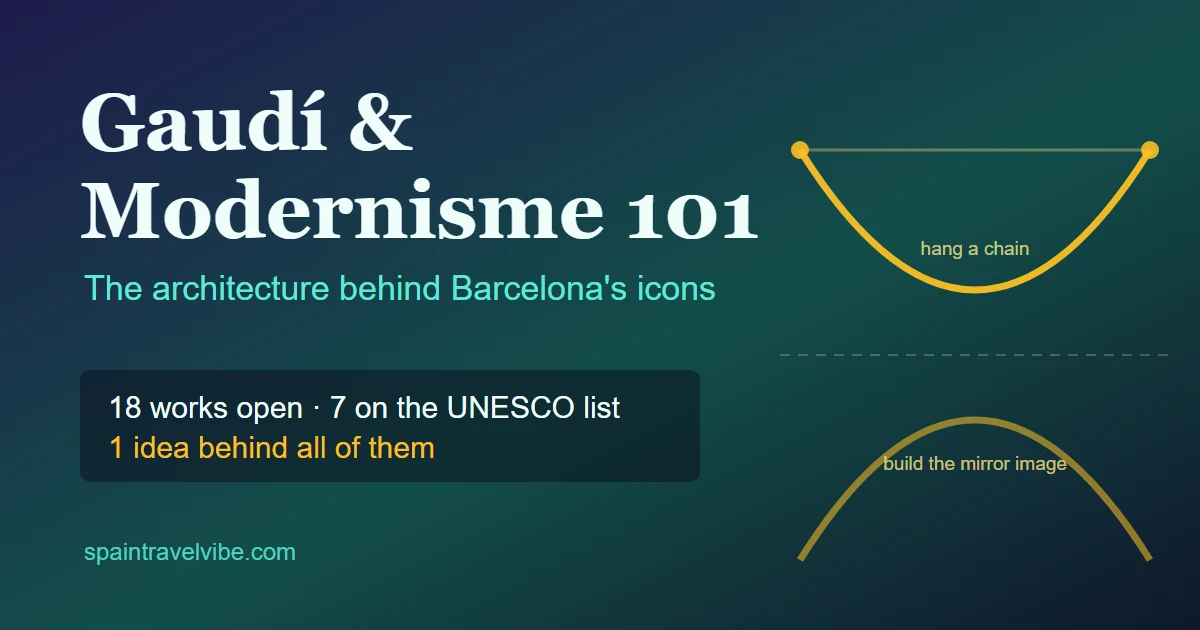
Gaudí architecture is easier to read than it looks, once you know the shapes were found by hanging weights on strings rather than drawn on paper. That one fact turns a row of famous buildings into a single argument you can follow from house to house.
Most guides won’t tell you that. They’ll call the buildings whimsical, organic and dreamlike. That’s useless the moment you’re standing in front of one with forty minutes and a tired six-year-old. You end up photographing a roof terrace without knowing why the chimneys are shaped like that.
Disclosure: Some links in this guide may earn us a commission, at no extra cost to you. It never changes what we recommend.
So this is the primer I wanted. What the word Modernisme actually covers, five things to look for on any of his buildings, and why none of it needs flying buttresses. Then the map nobody prints. Eighteen of his works can be visited. Almost everyone sees the same three.
Key Takeaways
- Gaudí architecture is a structural method before it is a style. He found his forms by hanging chains and weighted bags upside down, then read the result as compression. His columns lean the way the loads run.
- Five tells work on any of his buildings: the leaning column, the ruled surface, trencadís mosaic, hand-forged iron, and a symbolic programme meant to be read.
- UNESCO lists seven components under “Works of Antoni Gaudí”, inscribed in 1984 and extended in 2005. They are Park Güell, Palau Güell, Casa Milà, Casa Vicens, the Nativity façade and crypt of the Sagrada Família, Casa Batlló, and the Colònia Güell crypt.
- Eighteen of his works are open to visitors, fourteen in Catalonia and four beyond it. The traffic is wildly lopsided: 4,877,567 people at the Sagrada Família in 2025, against 59,762 at the Colònia Güell crypt in 2024.
- Modernisme was a Catalan movement, not a one-man style. Domènech i Montaner’s Palau de la Música Catalana and Hospital de Sant Pau carry their own 1997 World Heritage listing.
- 2026 is the centenary of Gaudí’s death, an official Generalitat commemoration with a €6.5 million budget, so there’s more to see and more competition for the same rooms.
Table of Contents
What Is Gaudí Architecture, in One Answer?
Gaudí architecture is the work of Antoni Gaudí i Cornet, who lived from 1852 to 1926. He was the leading figure of Catalan Modernisme, and he built almost entirely in and around Barcelona. Seven of his buildings carry a single UNESCO World Heritage listing, inscribed in 1984 and extended in 2005 (UNESCO).
Modernisme is the Catalan branch of the movement that English speakers file under Art Nouveau. It took shape around Barcelona’s 1888 Universal Exposition and had largely run its course by the 1910s. Three architects carried it above all: Gaudí, Lluís Domènech i Montaner and Josep Puig i Cadafalch (Gran Enciclopèdia Catalana).
Two things about it surprise most visitors. It’s regional, not national. This is Barcelona and Catalonia in the decades when the Renaixença was rebuilding a Catalan cultural identity. The language question that goes with it sits in my guide to the languages of Spain. And it was paid for by industrialists. Eusebi Güell made his money in textiles. The Batlló and Milà families were buying an address on the Passeig de Gràcia.
My Spanish culture guide files this under one region rather than one country, and that’s the correct filing. Nothing in Seville or Santiago looks remotely like this.
How Do You Read a Gaudí Building in Sixty Seconds?
Five tells will identify a Gaudí building without a plaque, and the two most reliable are structural rather than decorative. Look for a column that leans or an arch with a catenary profile, the curve a hanging chain makes. Then look for a surface that curves in two directions but is built from straight lines. The decorative three follow: broken tile laid as mosaic, forged iron, and a symbolic programme meant to be read like a text.
Here’s the short version, with the clearest example of each.
| The tell | What you’re looking at | Clearest example | Where I cover the visit |
|---|---|---|---|
| The leaning column | Columns and piers tilted off vertical, and catenary arches, both following the line of thrust instead of fighting it | Park Güell’s viaducts; the Sagrada Família nave | Barcelona guide |
| The ruled surface | A surface curving in two directions that’s generated entirely by straight lines | La Pedrera’s attic and roof; the basilica’s vaults | Which basilica ticket to buy |
| Trencadís | Broken tile, glass and crockery laid as mosaic over a curved form | Park Güell’s serpentine bench; Casa Batlló’s façade | Three days in Barcelona |
| Forged iron | Ironwork hammered into organic shapes, not cast in moulds | Casa Vicens’s palm-frond gate; Palau Güell’s entrance | Planning a Barcelona trip |
| The symbolic programme | Saints, the sea, dragons and the rosary, arranged to be read in order | The Nativity façade; Casa Batlló’s roofline | Which façade to book |
Casa Vicens is the one to start with if you want to see where the vocabulary came from. Built between 1883 and 1885 (Consell Antoni Gaudí), it’s tiled to the eyebrows. The style is usually called Orientalist or neo-Mudéjar, borrowing from the Islamic-derived building traditions of the peninsula. That’s a borrowing and not a bloodline. Mudéjar means Islamic technique working for Christian patrons, as I explain in my primer on Moorish Spain. It reached Gaudí through the 19th century, not directly from Al-Andalus.
Those five tells of Gaudí architecture hold up across four decades of his work. That’s the useful part. Once you have them, La Pedrera’s attic stops being a weird corridor and turns into the same idea as the nave he was building across town.
Why Does a Gaudí Building Stand Up Without Buttresses?
Because he inverted the problem. Hang a chain between two points and it falls into the shape that carries pure tension. Flip that shape and it carries pure compression, which is what masonry is good at. Gaudí built these models out of string and weighted bags, photographed them, and turned the photograph upside down to see the building.
The official description of the method is more literal than most people expect. On a board with the church’s floor plan drawn on it, strings were hung at the points where walls crossed or columns would rise. Bags of lead shot, loaded in proportion to the real weights, were tied to the other ends, and the curves that formed were the arches. The model was then draped in paper to give the vaults and walls (Colònia Güell).
He worked this out on a job almost nobody visits. Eusebi Güell commissioned a church for his textile colony at Santa Coloma de Cervelló in 1898. Gaudí spent the next decade on studies and that hanging model, in a shed on the hill where the church would stand. Construction only began in 1908. In 1914 the family stopped paying, he walked away, and the bishop blessed the lower nave in November 1915. It’s the only part that exists (Colònia Güell).
That crypt is the rehearsal for everything that followed. Its own official page calls it his laboratory, the first place he used his structural innovations together. Finished, it says, the church would have been a monumental model of the Sagrada Família (Cripta Gaudí).
The other half of the method is geometry. His surfaces are ruled surfaces: hyperboloids, hyperbolic paraboloids, helicoids and conoids. Each one can be generated by moving a straight line, which is exactly what makes them cuttable in stone. The basilica’s columns take this furthest. Gaudí gave them a star-shaped base that twists both left and right as it rises, until it’s almost a circle at the top. From there it branches like a tree into the vaults (Sagrada Família).
That geometry is also the reason a building begun in 1882 could ever be finished. Shapes defined by equations can be modelled on a computer and cut by machine, which is how the later phases were built.
Which raises the honest question of how much of it is his. In July 1936 the basilica’s workshop and crypt were burned, and the drawings and plaster models inside them were destroyed (eldiario.es). Of the basilica, what UNESCO lists is the part he built: the Nativity façade and the crypt beneath it. Everything above and behind them is later work, pieced back together from salvaged fragments, surviving photographs and his geometric rules.
One line on the building everyone asks about. The Tower of Jesus Christ was inaugurated on 10 June 2026, the centenary of Gaudí’s death. That took the basilica to 172.5 metres and the title of tallest church in the world. I tell that story properly in my Barcelona travel guide, and the booking mechanics live in my Sagrada Família ticket guide.
Which Gaudí Buildings Can You Visit, and Which Does Everyone Actually See?
Eighteen works make up the official map of Gaudí architecture. Fourteen sit in Catalonia, grouped under the Consell Antoni Gaudí, and four sit outside it (Generalitat de Catalunya, October 2025). All eighteen are open to visitors in some form. Across the seven with published figures, two of them account for about three quarters of the traffic. Casa Batlló makes it three, at about 88%.
| Work | Where | Built | What it is |
|---|---|---|---|
| Sagrada Família | Barcelona | 1882 to 2026 | The basilica. Nativity façade and crypt are the UNESCO-listed parts |
| Park Güell | Barcelona | 1900 to 1914 | A failed housing estate, now a municipal park with a ticketed core |
| Casa Batlló | Barcelona | 1904 to 1906 | A remodel of an existing block, and the most theatrical thing he did |
| Casa Milà (La Pedrera) | Barcelona | 1906 to 1912 | The stone apartment building with the warrior chimneys |
| Casa Vicens | Barcelona | 1883 to 1885 | His first house, a museum since 2017, tiled inside and out |
| Palau Güell | Barcelona | 1886 to 1890 | The Güell town house off the Rambla, and the first great commission |
| Colònia Güell crypt | Santa Coloma de Cervelló | 1908 to 1914 | The laboratory. Where the hanging model was worked out |
| Torre Bellesguard | Barcelona | 1900 to 1909 | A castle-shaped house on a medieval royal site, still family-owned |
| Casa Calvet | Barcelona | 1898 to 1900 | His most conventional block, and the only one awarded in his lifetime |
| Col·legi de les Teresianes | Barcelona | 1888 to 1890 | A school, with a corridor of parabolic arches |
| Finca Güell pavilions | Barcelona | 1883 to 1887 | The dragon gate, in Pedralbes |
| Finca Miralles gate | Barcelona | 1901 to 1902 | A wall and gate, free to walk past |
| Nau Gaudí | Mataró | 1878 to 1883 | A workers’ cooperative shed. The earliest thing he built |
| First Glorious Mystery | Montserrat | 1903 to 1907 | A rosary monument on the mountain path |
| El Capricho | Comillas, Cantabria | 1883 to 1885 | An early summer villa with a sunflower-tiled tower |
| Palacio Episcopal | Astorga, Castilla y León | 1887 to 1893 | A bishop’s palace he quit before it was finished |
| Casa Botines | León | 1891 to 1892 | A neo-Gothic bank and house, now the region’s busiest museum |
| Mallorca Cathedral | Palma | 1903 to 1914 | Not his building. His reordering of somebody else’s |
Dates in that table come from the Consell Antoni Gaudí‘s own building records.
One line deserves saying out loud. Casa Calvet is the most restrained thing on the list. It’s also the only building of his that won a prize in his lifetime: Barcelona City Council’s annual award for the best artistic building, in 1900 (Consell Antoni Gaudí).
A word of warning on access. Some are museums with daily opening. The Teresianes school and the Finca Güell pavilions run limited guided visits, and the Finca Miralles gate is simply a wall you walk past. Check each one before you build a day around it.
Now the numbers, which almost nobody puts on one axis. I charted the published visitor figures for seven works of Gaudí architecture, and the gap is absurd. The basilica alone took 4,877,567 visitors in 2025, a record.
Park Güell’s bar carries a footnote, because it counts something different from the others. Barcelona de Serveis Municipals has regulated access since 2013, on the city council’s behalf. In 2020 the regulated area was widened from the Monument Area to the whole park, and the maximum capacity dropped from 9 million visitors a year to 4.5 million. Those measures are still in force. The park took 4.4 million visitors in 2023, up 6% on the year before, and more than 500,000 residents entered separately on a neighbourhood card (Barcelona de Serveis Municipals, 2024).
Two things follow. Park Güell is running at about 98% of the ceiling the city set for it, which is about as close to a cap as a site can run. And its figure covers a whole regulated park, where the others are admissions to a single building.
The money follows the same curve. The Sagrada Família took €134.5 million in 2025, 96.9% of it from admissions, and put over half its spending back into construction. Casa Batlló, with 1.9 million visitors in 2024, earned €65.20 million. Park Güell earned €36.3 million in 2024 from a far larger crowd, and La Pedrera €29.59 million from one million (ON Economia, March 2026).
Prices and booking windows aren’t this page’s job. The caps, the fares and the three-day plan are in my Barcelona travel guide. The four basilica ticket types, the tower trap and the quiet hour are in my Sagrada Família ticket guide.
Is Modernisme Just Gaudí?
No. Gaudí architecture is the famous part of Modernisme, not the whole of it, and the World Heritage list says so plainly. A second Barcelona listing was inscribed in 1997. It covers the Palau de la Música Catalana and the Hospital de Sant Pau, both by Lluís Domènech i Montaner (UNESCO). Neither building is Gaudí’s, and neither is a footnote.
Domènech i Montaner was the movement’s other giant, and for a while the more decorated one. The Palau de la Música is his concert hall of stained glass and mosaic; Sant Pau is a hospital laid out as a village of pavilions. Puig i Cadafalch, the third name, worked in a more northern, stepped-gable register. His Casa Amatller sits directly next door to Casa Batlló, on the block everyone calls the Illa de la Discòrdia. The block of discord, because three houses argue with each other in three different styles.
The practical point is that the alternatives aren’t obscure. The Palau de la Música had its best year ever in 2025, with 953,049 people through the building. That breaks down as 555,750 at concerts, 358,519 on visits and 38,780 at other events (Palau de la Música Catalana). That’s half of Casa Batlló’s traffic in a building that’s arguably the more beautiful interior.
Are There Gaudí Buildings Outside Barcelona?
Four, in three other regions: El Capricho in Comillas, the Episcopal Palace in Astorga, Casa Botines in León, and his reordering of Mallorca Cathedral in Palma. All four joined the centenary programme alongside the fourteen Catalan works. Gaudí architecture is a Barcelona story, but it isn’t only a Barcelona story.
Casa Botines is the one that surprises people. In 2025 it drew 142,000 visitors, which makes it the most visited museum in Castilla y León. Its owners have announced a €7.5 million investment to finish the restoration (ON Economia, 2026). I already recommend León for its glass and its free tapas in my roundup of underrated Spanish cities. The Gaudí is a bonus on a city worth visiting for other reasons.
El Capricho, built 1883 to 1885, is the young, playful one. It sits on the coast route in my northern Spain itinerary, with a fraction of Barcelona’s queue. Astorga he quit in 1893, after his patron the bishop died (Consell Antoni Gaudí).
Mallorca is not a Gaudí building at all. The bishop there asked him to reorder the interior of a Gothic cathedral. The work ran from 1903 to 1914 and ended abruptly, when the contractor fell out with him and the bishop died. The canopy he designed for the altar with Jujol, in iron, glass and ceramic, was never manufactured, so what hangs there is its model (Casa Vicens museum, Gaudí’s works). If Mallorca is on your list, my comparison of Mallorca and the Canary Islands covers when the island is worth the flight.
The Colònia Güell crypt deserves its own line here, because it isn’t in Barcelona either. It’s a suburban train ride out, on the FGC line, which is the kind of local rail I explain in my guide to getting around Spain.
Does the 2026 Centenary Change How You Plan?
Yes, in both directions. 2026 is the official commemoration of the centenary of Gaudí’s death. The Generalitat declared it and the Ministry of Culture designated it an event of special public interest. The Department of Culture put €6.5 million behind it (Generalitat de Catalunya, October 2025).
The programme opened on 8 November 2025 in Reus and Riudoms, the towns of his birth and his family. An international congress ran at La Pedrera in June. An exhibition at the Museu d’Història de Catalunya covers the second half of the year. A closing event in Barcelona was still being shaped when the programme was announced.
What’s striking about the official framing is how closely it matches what this post argues. Its stated aims are to explain Gaudí’s scientific dimension rather than interpret his work as art history. The other is to explain him through the relationships between all his buildings, the lesser-known ones included.
There’s one more piece of 2026 context, reported plainly. On 14 April 2025 Pope Francis declared Gaudí venerable, a formal recognition of heroic virtue that is the first step in a beatification process (CNN). A recognised miracle would be required for the next one. Make of that what you like; it explains some of the crowds this year.
For once, the practical advice is simple. Book earlier than you normally would, and if your dates are flexible, look at the months either side of summer. My guide to the best time to visit Spain breaks Barcelona’s calendar out from the rest of the country, because the coastal shoulder season behaves differently.
Where Are the Crowds, and What Is the Quiet Swap?
The crowding in Gaudí architecture isn’t evenly spread. On the published figures, the Sagrada Família and Park Güell take about 73% of the visits across the seven sites I could find numbers for. Casa Batlló takes it to 88%. The Colònia Güell crypt runs at roughly 1.2% of the basilica’s traffic.
So here’s how I’d actually spend a day on Gaudí architecture. Keep the basilica, because nothing substitutes for it, then treat the rest as choices rather than a checklist. If you want the interior spectacle without the queue, Casa Vicens instead of a second paid house. If you want to understand what he was doing, the crypt at Santa Coloma instead of a third. One recent change to know about: the Gaudí House Museum inside Park Güell has reopened after restoration works. He lived in it from 1906 to 1925, and it’s now sold on a combined ticket (Park Güell).
Should you skip Park Güell? Not necessarily, but know what you’re buying. The ticketed Monument Area is the postcard, and it’s a small part of the grounds. Access to the park as a whole is regulated, but its own site is clear that the rest of it is nature and leisure space, open to anyone for nothing (Park Güell). The sights across Spain that sell out months ahead, and the ones that don’t, are ranked in my guide to the best things to do in Spain.
Frequently Asked Questions
What is Gaudí’s architectural style called?
Catalan Modernisme, the local branch of the turn-of-the-century movement English speakers usually file under Art Nouveau. Within it, Gaudí architecture stands apart for being structural in origin rather than decorative. The ornament follows from forms he found by hanging weighted models, not the other way round.
What are the seven UNESCO Gaudí buildings?
Park Güell, Palau Güell, Casa Milà, Casa Vicens, the Nativity façade and crypt of the Sagrada Família, Casa Batlló, and the crypt of the Colònia Güell. The property was inscribed in 1984 and extended in 2005 (UNESCO).
Why do Gaudí’s buildings have so few straight lines?
They have plenty, just not where you expect. His curved surfaces are ruled surfaces, generated by moving a straight line through space, which is what made them possible to cut in stone. The overall shapes came from hanging models that follow the load path rather than from drawing.
Is Modernisme the same as Art Nouveau?
They overlap in date and spirit, but Modernisme is the Catalan movement specifically, with its own patrons and its own cultural politics. It also has a second UNESCO listing, from 1997, for Domènech i Montaner’s Palau de la Música Catalana and Hospital de Sant Pau.
Which Gaudí building is worth visiting if I only have time for one?
For the spectacle, the basilica. To understand Gaudí architecture, the Colònia Güell crypt, which took 59,762 visitors in 2024 against nearly 4.9 million at the Sagrada Família. It’s the building where he worked out the method that everything else depends on.
The One Thing Worth Remembering
Gaudí architecture stops being a mood board the moment you know the curves were calculated by gravity. A chain finds the line of thrust on its own; he hung the chain, turned the photograph upside down, and built that. Everything else, the tile, the iron, the saints on the façade, sits on top of a structural argument.
And the map is bigger than the queue suggests. Eighteen of his works can be visited, and the same three absorb almost everyone. Plan the city with my Barcelona travel guide, and sort the basilica with my ticket guide. If you want to see where Modernisme sits among Spain’s other regional traditions, my Spanish culture guide has the rest of them.