

Last verified: September 22, 2026. Bullfighting in Spain is a moving story: a bill to end its protected status is back before Congress, and new counts arrive every spring. I check the event numbers against the Ministry of Culture’s annual taurine statistics. I check the law against the Boletín Oficial del Estado and the Congress record, and opinion against the Fundación BBVA’s yearly survey. I update the date above each time one of them moves.
Bullfighting in Spain is legal almost everywhere, attended in some form by about one Spaniard in twelve, and mostly not what travelers picture. Most bull events in Spain aren’t in a bullring at all. They happen in the streets during small-town fiestas, and a lot of visitors meet one without meaning to.
Most of what’s written in English on the subject is either selling tickets or campaigning against them. Neither side tends to mention that the law has changed repeatedly since 2010. Neither mentions that a bill to strip bullfighting of its heritage protection is back before Congress this autumn.
Disclosure: Some links in this guide may earn us a commission, at no extra cost to you. It never changes what we recommend.
So I’ve kept this to what can be counted. Where it’s legal, who actually goes, what you’d see, when the season runs, and how to decide for yourself. I’m not going to tell you whether to go. I will tell you exactly what you’d be deciding.
Key Takeaways
- Bullfighting in Spain is legal nationally, but none is held in the Canary Islands (since 1984) or Catalonia (since 2011).
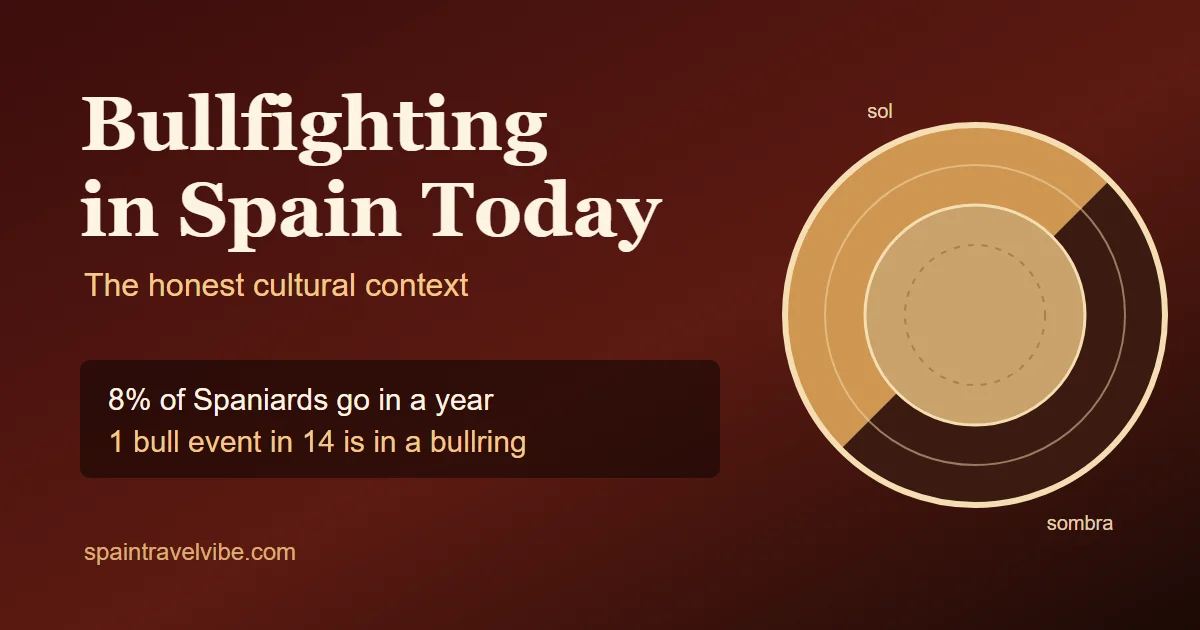
- In 2024-25, 8.0% of Spaniards went to a bull event of some kind; teenagers went most.
- Acceptability scores 2.1 out of 10 (Fundación BBVA, 2026), yet Las Ventas drew over a million spectators in 2025.
- Spain held 1,480 bullring events in 2025 and 19,807 street bull events.
- A standard corrida kills six bulls in about two hours.
Table of Contents
Is Bullfighting in Spain Still Legal?
Yes. Since 2013, a national law, Ley 18/2013, has protected bullfighting in Spain as part of the country’s cultural heritage, and it is still in force unamended. The Constitutional Court has struck down the core of both regional laws it has ruled on, in Catalonia and the Balearics. In practice, though, two regions hold none.
That’s the short answer on bullfighting in Spain, and it hides a messy map. Here’s the region-by-region picture, the same regional test my guide to Spanish culture runs on every tradition.
| Region | Legal status | Bullfights in practice | Key law or ruling |
|---|---|---|---|
| Spain as a whole | Legal and protected as cultural heritage | About 1,500 bullring events a year | Ley 18/2013 and Ley 10/2015 |
| Catalonia | Legal again since the 2010 ban was annulled | None since 25 September 2011 | STC 177/2016 |
| Canary Islands | Treated as closed by a 1991 animal law, which never names bullfighting | None since January 1984 | Ley 8/1991 |
| Balearic Islands | The 2017 no-kill law was largely struck down | 5 bullring events in 2025, 2 of them corridas; no street events | STC 134/2018 |
| Madrid, Murcia, Castilla-La Mancha, Castilla y León | Declared a protected cultural asset by the region, 2011 to 2014 | Three of the four busiest regions for bullring events | Junta de Castilla y León |
| Everywhere else | Legal under national law | Varies, from 230 bullring events in Andalusia to 4 in Galicia in 2025 | Ley 18/2013 |
Catalonia is the most misreported case. Its parliament banned bullfights in 2010, the ban took effect in 2012, and the Constitutional Court annulled it in October 2016. Legally, they could return tomorrow. They haven’t. The last corrida at Barcelona’s La Monumental was on 25 September 2011, and none has been staged since. Catalonia’s street bull events, the correbous, were never banned. A separate 2010 law regulates them as events in which the animal isn’t killed (Llei 34/2010, BOE).
The Canary Islands are the mirror image. No bullfight has been held since January 1984, in Santa Cruz de Tenerife (Ayuntamiento de Santa Cruz de Tenerife, 2018). The islands’ 1991 animal-protection law is generally read as closing the door, though it never names bullfighting. If you’re choosing between Mallorca and the Canaries, that’s one real difference between the two island groups.
Towns can’t opt out on their own, either. Calvià, in Mallorca, declared itself an “anti-bullfighting” municipality in 2015. The Balearic high court annulled the declaration in 2022 for lack of competence (Fundación Democracia y Gobierno Local, 2023).
How Many Spaniards Actually Go to Bullfights?
About one in twelve go to a bull event of some kind, and about one in seventeen to a bullfight in a ring. The Ministry of Culture’s 2024-25 survey of cultural habits asked Spaniards aged 15 and over. Of them, 8.0% said they’d attended a bull event of some kind in the past year. That’s exactly the share recorded in 2018-19, before the pandemic (Servimedia, October 2025).
Men go more than women, at 9.8% against 6.3%. Where you live matters enormously: 33.4% of people in La Rioja went to a bull event, against 0.4% in the Canary Islands. For a formal bullfight in a ring, whether a corrida, a novillada with younger bulls or rejoneo on horseback, the figure falls to 5.9%.
Then there’s the age split, which surprised me. It’s the youngest group surveyed that goes most. In 2024-25, 13.6% of people aged 15 to 19 attended, against 5.2% of people aged 75 and over. That doesn’t fit the story that bullfighting is dying with its audience. It doesn’t show that young Spaniards approve of it, either. The age breakdown covers any bull event, so a village street event counts.
Bullfighting in Spain still has a loyal audience, and it packs the major ferias. Las Ventas in Madrid passed a million spectators in 2025, with 1,008,226 across 62 events and 18 sell-outs (Las Ventas, October 2025). Its San Isidro fair in 2026 drew 611,818 people over 28 afternoons, with 19 sell-outs (Cultoro, June 2026).
So is the disapproving majority. In September 2026 the Fundación BBVA’s annual survey of attitudes to animals put the acceptability of bullfighting at 2.1 out of 10 (Telecinco, September 2026). A year earlier, the 2025 edition had put it at 1.8 (Fundación BBVA, 2025). A small, committed audience that sells out the big fairs, inside a public that mostly disapproves: that’s the picture the numbers give.
Are There Fewer Bullfights Than There Used to Be?
Far fewer, but the fall has stopped. Bullfighting in Spain has shrunk by more than half since 2007, when the country’s bullrings held 3,651 events, according to the Ministry of Culture. In 2025 they held 1,480, a drop of 59%, although the figure has barely moved for four seasons (Ministerio de Cultura, Estadística de Asuntos Taurinos 2025, May 2026).
I pieced that line together from five editions of the ministry’s annual report, because no single edition runs from 2007 to 2025. The full corrida, the event most travelers mean by “a bullfight”, fell by almost exactly the same share as the total. There were 953 in 2007 and 389 in 2025, down 59%. In 2025 corridas made up 26.3% of bullring events. Novilladas with and without picadors, festivales, rejoneo and mixed events made up most of the rest.
Spain’s official register listed 866 matadors in 2025. Only 520 of them held a licence that was valid at some point in the year, which gives a better idea of how many are working. Four regions held more than three quarters of all bullring events in 2025: Castilla y León (310), Castilla-La Mancha (301), Madrid (283) and Andalusia (230). If you’re traveling anywhere else, you’d have to go looking for one.
What Counts as a “Bull Event” in Spain?
Mostly not a bullfight. In 2025 the Ministry of Culture counted 19,807 festejos populares, street and village events with bulls. They range from a single encierro to an evening of young cows let loose in a square. That’s more than thirteen for every event held in a bullring. The Valencian Community alone held 9,542 of them, almost half (Ministerio de Cultura, Annex 1, May 2026).
The industry’s own association, ANOET, counts the two together and arrives at 21,569 events for 2025, across more than 2,100 municipalities (Cultoro, April 2026). That’s the number you’ll see in headlines about bullfighting in Spain “growing”. Almost all of it is street events. They’re a different thing, and the table below says how.
| Event | What happens | Is the bull killed? | Where you’ll meet it |
|---|---|---|---|
| Corrida de toros | Three matadors, six adult bulls, in a ring | Yes, in the ring | City ferias, spring to autumn |
| Novillada | The same format with younger bulls and novice bullfighters | Yes, in the ring | Smaller rings and fair undercards |
| Rejoneo | Bullfighting on horseback | Usually, in the ring | Most big ferias include a day |
| Encierro | Bulls run through fenced streets to the ring, with runners ahead | Not in the street; in Pamplona they’re fought that afternoon, elsewhere it varies | Pamplona and many towns in Navarre, Castile and Madrid |
| Bous al carrer and correbous | Bulls or cows let loose in closed-off streets | Not in the street | Valencian and Catalan towns, mostly in summer |
| Bou embolat | Balls of tow fixed to the horns and set alight | Not in the street | Parts of Valencia, Catalonia and Aragón |
| Rope bull (toro enmaromado) | A bull led through the streets on a long rope | Not in the street | Benavente, and other Castilian towns |
| Portuguese-style bullfight | Horseback and a team that grabs the bull by hand | Not in the ring, except in the Portuguese towns of Barrancos and Monsaraz | Portugal, not Spain; the contrast travelers ask about |
A few terms need precision. In the Valencian Community, the 2015 decree that governs bous al carrer defines them as events without a formal fight. Any animal slaughtered afterwards has to go to an authorised slaughterhouse (Decreto 31/2015 of the Generalitat Valenciana). The bou embolat sets tow balls alight on the horns before the bull is released (3Cat, 2023). Benavente’s rope bull has been a regional festival of tourist interest since 1991 (Turismo Castilla y León).
Look at the bottom of that chart. The Balearics, the Canaries, Asturias and Galicia held no street bull events at all in 2025, and Catalonia held 53. If you’re spending the summer in a small town inland from Valencia or Castellón, by contrast, you’re likely to find one on the programme. My Valencia travel guide covers the city itself, where Las Fallas in March is also a bullfighting week.
What Happens at a Corrida, and Does the Bull Die?
Yes. At a standard corrida, three matadors each fight two bulls, and each of the six is killed in the ring. That format is custom rather than law, but the three stages of each fight are laid down in the national regulation for bullfighting (Real Decreto 145/1996, BOE). An afternoon usually runs about two hours, often a little more.
Each bull’s fight is divided into three tercios, or thirds. In the first, the matador’s team tests the bull with large capes, and mounted picadores drive a lance into the muscle of its neck. In the second, banderilleros place pairs of barbed sticks in the same area. In the third, the matador works with the smaller red muleta and then kills the bull with a sword.
You’ll hear the crowd judge all of it. Spectators ask for a trophy by waving white handkerchiefs. The president of the ring grants the first ear if a majority asks, and the second ear is the president’s call alone. And for the record, the red of the muleta isn’t what the bull reacts to. Bulls have two-colour vision without red-sensitive cones. It’s the movement of the cloth that provokes the charge (West Texas A&M University, 2012).
Can a bull be spared? Rarely. Under the national regulation, a pardon, the indulto, is possible only in first and second category rings. A majority of the public has to ask for it, the matador has to request it, and the breeder has to agree. The matador then mimes the kill with a banderilla instead of a sword, and the bull goes back to the pens to be treated and kept for breeding.
What do supporters see in it? In their own terms, it’s a ritual with fixed rules, judged on skill, composure and the risk the matador takes. It’s also bound up with the fighting-bull breed and the pastureland it’s raised on. Critics see an animal wounded and killed for an audience. Both describe the same afternoon, which is why the argument doesn’t end.
Where and When Can You See Bullfighting in Spain?
Bullfighting in Spain runs roughly from March to October, clustered around the big city fairs. Madrid’s San Isidro fair is widely regarded as the most important, with 28 afternoons from 8 May to 7 June in 2026 (Las Ventas, 2026). Outside the ferias, most bullrings sit empty for weeks at a time.
| City and bullring | Fair | Usual timing |
|---|---|---|
| Valencia | Fallas | Mid-March |
| Seville, Real Maestranza | Easter Sunday, then the Feria de Abril | Easter to late April or May |
| Madrid, Las Ventas | San Isidro | May into early June |
| Pamplona | San Fermín, Feria del Toro | 7 to 14 July |
| Bilbao | Corridas Generales, Aste Nagusia | Late August |
| Málaga | Feria de Málaga | Mid-August |
| Ronda, Real Maestranza | Corrida Goyesca | Early September |
| Madrid, Las Ventas | Feria de Otoño | Early October |
| Zaragoza | Fiestas del Pilar | Mid-October |
Madrid’s ring is the one most visitors see from the outside. Las Ventas opened in 1931 on Calle de Alcalá in the Salamanca district, with almost 24,000 seats. It runs guided tours that don’t involve watching a fight (Las Ventas Tour). My Madrid travel guide has the rest of the city.
Seville’s season opens on Easter Sunday, at the end of the Holy Week I describe in my guide to what travelers are actually seeing at Semana Santa. The Real Maestranza, on the river, opens for guided visits too (Spain.info), and my Seville travel guide covers the neighbourhood around it. Ronda’s ring, built in the 1780s, is a museum visit most of the year; its current prices are in my Andalusia road trip.
Planning to avoid bullfighting in Spain rather than find it? Feria weeks also fill hotels and push up prices, so they’re worth knowing either way. My guide to the best time to visit Spain sets them against the weather and the crowds.
Why Hasn’t Spain Banned Bullfighting?
Spain hasn’t banned bullfighting because national law protects it, the courts have enforced that protection, and Congress has so far declined to change it. On 7 October 2025, Congress rejected a citizens’ bill to remove bullfighting’s heritage status. It lost 169 to 57, with 118 abstentions, the Socialists among them (elDiario.es, October 2025).
That bill had arrived with 664,777 validated signatures, under the banner “No es mi cultura”, “It’s not my culture”. It didn’t stay dead. On 14 July 2026, about fifty deputies filed the same text as a bill of their own. They come from Sumar, ERC, Junts, EH Bildu, Podemos and the BNG (Público, July 2026). It was published in Congress’s official gazette on 11 September, and the government has until 17 October 2026 to give its view (El Mercurio Digital, September 2026).
Meanwhile the pull runs both ways. In 2023 the Supreme Court overturned the government’s exclusion of bullfighting from the youth culture voucher, the Bono Cultural Joven (Poder Judicial, 2023). In 2024 the Culture Ministry abolished the National Bullfighting Prize. The Senate and ten regions recreated it. And in 2026 Extremadura raised its bullfighting budget to €1.78 million, from €297,500 the year before (El Salto, June 2026).
Public money is hard to total, because it’s spread across ministries, regions, provinces and town halls. One line is visible. The Fundación Toro de Lidia, the sector’s foundation, received €2,325,000 from public bodies between 2020 and 2024. That figure is the animal-rights party PACMA’s reading of the national subsidies database (Público, March 2026).
Bullfighting in Spain isn’t changing in isolation. Mexico City banned the killing of bulls, and the use of lances, banderillas and swords, by 61 votes to 1 in March 2025 (Infobae, 2025). Colombia’s ban takes full effect on 22 July 2027 (Radio Nacional de Colombia, 2025). France allows corridas only where a local tradition is unbroken (Conseil constitutionnel, 2012).
Should You Go to a Bullfight in Spain?
That’s your decision. I’d rather you made it with the facts about bullfighting in Spain than with a slogan. You’d be watching six bulls killed over about two hours. You’d be sitting among an audience that comes to judge the craft, in a country where most people disapprove. And you can see the rings and the art that grew around them without a ticket to a fight.
A few questions help. Would you be comfortable watching an animal wounded and killed in front of you? Is it the event you want to see, or the building and its history? Would you be as happy with the ring tour and the museum?
If you go, buy from the bullring’s own box office, arrive before the opening parade, the paseíllo, and expect to stay a while. You can leave between bulls; leaving mid-fight disturbs the rows around you. Take your cue from the crowd on when to applaud. Many regulars cheer a brave bull as loudly as a good matador, and whistle at what they see as bad work.
If you don’t go, the rings themselves are still open to you. The Las Ventas tour and the Maestranza visit show you the arenas, the chapels and the museum rooms without a fight. And much of what draws people to Andalusia’s bullrings (the music, the dress, the formality) is also in flamenco. My Flamenco 101 explains that other ritual and how to watch it properly.
What About the Running of the Bulls and Village Festivals?
For many visitors, the only bulls they meet in Spain are in the street, at a fiesta they didn’t plan around. San Fermín’s eight runs in Pamplona in 2026 left five people gored and no one dead (OKDiario Navarra, July 2026). The bulls that run each morning are fought in the ring that same afternoon.
The dates and the rules for runners are in my Spain festivals calendar, which puts San Fermín alongside the year’s other big events. Pamplona’s eight runs are the famous ones, but they’re just eight of the 1,510 street bull events Navarre held in 2025.
Village bull events are the hardest to see coming. Across much of eastern and central Spain, a town’s summer fiesta often includes an afternoon or evening of bulls in the streets. Once you know the clues, they’re easy to spot. Heavy wooden or metal barriers go up across side streets, and the programme poster lists bous, vaquillas or toros. If that’s not for you, check the programme on arrival and plan around those hours. If it is, watch from behind the barriers, where the locals do.
Frequently Asked Questions
Is bullfighting still legal in Spain?
Yes. Bullfighting in Spain has been protected nationally as cultural heritage since Ley 18/2013. Catalonia’s ban was annulled in 2016, though no corrida has been held there since 2011. Since 1984 the Canary Islands have had none. A bill to end the protection awaits the government’s response, due 17 October 2026.
Do they kill the bull in Spanish bullfighting?
At a standard corrida, yes. Six bulls are fought and each is killed in the ring. A pardon, the indulto, is rare and allowed only in first and second category rings. Street events such as bous al carrer don’t kill the animal in the street, and Portuguese-style bullfights don’t kill it in the ring, except in two Portuguese towns.
How many Spaniards still go to bullfights?
About one in twelve go to a bull event of some kind, and one in seventeen to a bullfight in a ring. The Ministry of Culture’s 2024-25 survey found 8.0% and 5.9% respectively, the first unchanged since 2018-19. The Fundación BBVA’s 2026 survey rates bullfighting’s acceptability at 2.1 out of 10.
When is bullfighting season in Spain?
Bullfighting in Spain runs roughly from March to October, around city fairs. Valencia’s Fallas open it in March, then Seville’s Feria de Abril in April and Madrid’s San Isidro in May and June. Pamplona follows in July, Bilbao and Málaga in August and Ronda in September. Madrid’s autumn fair and Zaragoza’s Pilar close it in October.
Is bullfighting banned in Barcelona?
Not legally. Catalonia’s 2010 ban was annulled by the Constitutional Court in 2016. But La Monumental held its last corrida on 25 September 2011, and none has been staged in Catalonia since. So bullfighting is legal in Barcelona but absent from it. Catalan street bull events, the correbous, remain legal.
What It Adds Up To
Bullfighting in Spain is legal, protected by law and defended in the courts. A steady one in twelve people go to a bull event of some kind, and most Spaniards disapprove. Neither side’s favourite statistic tells the whole story.
For a traveler, the practical facts are simpler than the argument. Bullfights happen on fair days between March and October, three quarters of them in four regions. Street bull events happen in more than two thousand towns, mostly in the east. You can see the rings, their museums and their history without watching a fight, and you can plan around both if you’d rather not meet either.
Where the tradition sits among Spain’s other regional customs is the subject of my guide to understanding Spanish culture. And if you’re choosing dates, check my Spain festivals calendar first, because the fairs that fill the bullrings fill the hotels too.