
Last verified: September 18, 2026. The answer to what is flamenco changes slowly, but the numbers around it don’t. I check the UNESCO file and Andalusia’s two flamenco laws against their official texts, and the peña counts against the Junta de Andalucía’s yearly peña circuit. I re-check every autumn, when the next circuit publishes.
What is flamenco? It’s the song, guitar and dance of Andalusia, shaped in large part by its Gitano (Spanish Roma) families, and since 2010 it has been on UNESCO’s list of humanity’s intangible heritage. That’s the one-line answer. The useful answer is shorter still: most of it counts to 12.
Picture a tablao during a soleá, the slow one. The room is silent. Then, at the end of a sung line, someone near the back says “olé” at exactly the right moment, and the singer nods. That person wasn’t braver than you. They knew where beat 12 was.
Disclosure: Some links in this guide may earn us a commission, at no extra cost to you. It never changes what we recommend.
This guide gets you there. It covers what flamenco is, where it comes from, and the handful of styles you’ll actually hear in one evening. Then it covers how to watch without getting in the performers’ way. For where to go and what it costs, I’ve written a separate roundup.
Key Takeaways
- What is flamenco? The song (cante), guitar (toque) and dance (baile) of Andalusia, shaped in large part by its Gitano (Spanish Roma) families. UNESCO inscribed it on 16 November 2010.
- Andalusia has held exclusive legal competence over flamenco since 2007. A 2023 regional law provides for teaching it in Andalusian schools.
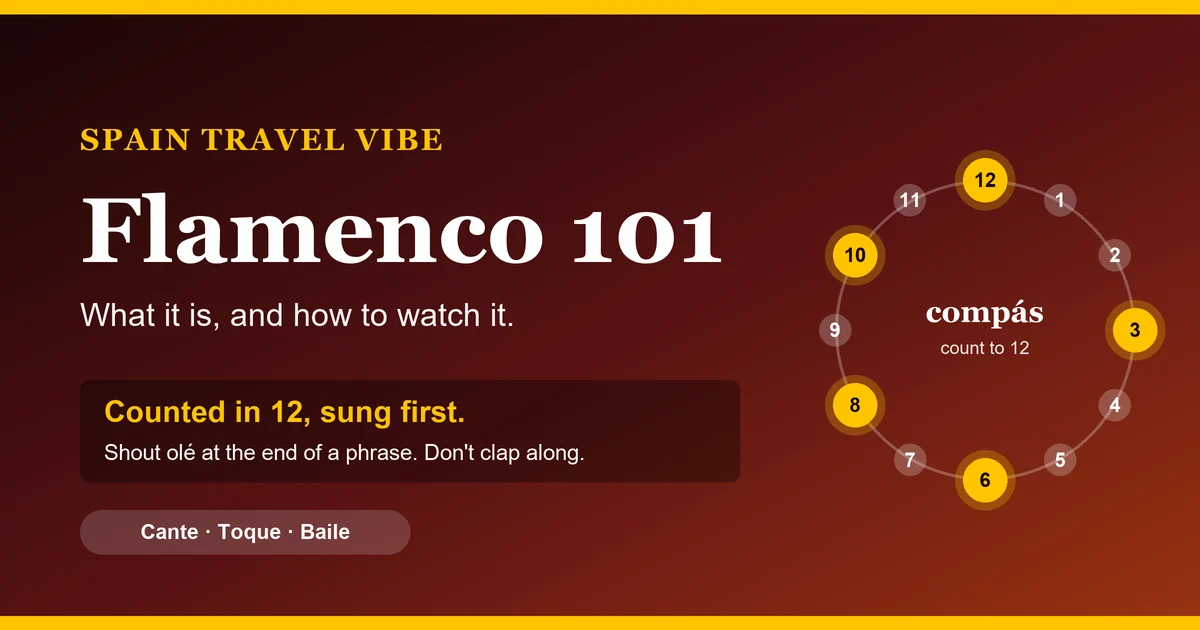
- Most flamenco counts to 12, with accents on 3, 6, 8, 10 and 12. Count along silently and a soleá stops sounding like noise.
- The singer leads. Of 225 peña recitals the Junta funded for 2026, 181 were singing.
- Shout “olé” when something lands. Don’t clap along. The palmas are an instrument.
Table of Contents
What Is Flamenco, in One Answer?
In 2010 UNESCO defined flamenco as “an artistic expression fusing song (cante), dance (baile) and musicianship (toque)”, with Andalusia as its heartland (UNESCO, Flamenco, nomination file 00363, 2010). That’s the cleanest answer to what is flamenco. The same file names Murcia and Extremadura too, and says the Gitano community “played an essential role in its development”.
The inscription came on 16 November 2010, by decision 5.COM 6.39 of UNESCO’s intergovernmental committee (UNESCO, Decision 5.COM 6.39). Andalusia now marks 16 November as its flamenco day. The order of those three words matters. Song comes first. The guitar grew up accompanying the singer, and the dance grew up interpreting the song. A dancer in a tablao is listening, not leading.
Most dance-school definitions skip one thing: flamenco has a legal address. Andalusia’s Statute of Autonomy, reformed in 2007, gives the region “exclusive competence” over flamenco “as a singular element of Andalusian cultural heritage” (BOE, Ley Orgánica 2/2007, article 68). In 2023 Andalusia went further. Its flamenco law, Ley 4/2023 of 18 April, declares flamenco a Bien de Interés Cultural, as an activity of ethnological interest, provides for its teaching in schools and recognises the peñas, the clubs where aficionados meet (BOE, Ley 4/2023 Andaluza del Flamenco). That law also gives the best short definition I’ve found. Flamenco is a “genuine artistic language of popular roots, with an important contribution from the Gitano people” (Ley 4/2023, article 3, my translation).
So flamenco isn’t “Spain’s national dance”. It’s southern Spain’s art, Andalusia’s above all, protected by that region’s laws and performed everywhere tourists go. My guide to Spanish culture makes the same point about Spain’s other famous traditions: nearly all of them have an address.
Where Does Flamenco Come From?
The earliest written account usually cited dates to around 1774. José Cadalso described a Gitano party at the house of one “Tío Gregorio” in his Cartas marruecas (Alberto Romero Ferrer, Cuadernos de Ilustración y Romanticismo, Universidad de Cádiz, 2024). From there, the record places flamenco in lower Andalusia: Seville, Cádiz, Jerez and the farm towns between them. The name came later: only in the 1800s did “flamenco” come to mean the music. Nobody agrees why. One theory ties it to Spanish soldiers returning from Flanders. There are several others, and none is proven.
What turned a family art into a profession was the café cantante, the paid music café. By 1881, when the singer Silverio Franconetti opened his own in Seville’s Calle Rosario, cafés like it were the art’s main stage (Expoflamenco archive, Silverio Franconetti). Paid performers meant polished performers, and the forms settled into shapes you’d recognise today.
Not everyone liked the polish. On the nights of 13 and 14 June 1922, the composer Manuel de Falla and the poet Federico García Lorca staged a Concurso de Cante Jondo in Granada. They wanted to rescue the older, deeper song from the cafés. A 13-year-old Manolo Caracol was among the winners (The Conversation, Ana Vega Toscano, June 2022). The contest was held in the Alhambra’s Plaza de los Aljibes, which is worth knowing when you book your Alhambra tickets and walk across it.
Then there’s what isn’t proven. You’ll read that flamenco is a fusion of Gitano, Moorish, Jewish and Andalusian music. The Gitano part is documented, and UNESCO says so. Moorish and Sephardic influence is plausible, and scholars argue about it, but nobody has a paper trail. My primer on Moorish Spain covers what Al-Andalus did leave behind.
What Are Cante, Toque and Baile?
Cante is the song, toque the guitar and baile the dance, and the singer leads the other two. The numbers agree. In 2026 the Junta de Andalucía funded 225 peña recitals for its autumn circuit, and 181 of them were cante, or singing. Only 31 were dance and 13 guitar (Junta de Andalucía, Circuito Andaluz de Peñas, September 2026). Among aficionados, flamenco is a singer’s art first.
That’s the reverse of what visitors expect. Tourist posters show a dancer. The peñas book singers. A tablao shows you all three, but watch who the others take their cues from.
Cante splits roughly by weight. Cante jondo, “deep song”, is the serious end: slow, grave, often about death or loss. Cante chico is lighter, faster and often funny. Everything else sits between.
Toque is the guitar. A flamenco guitar is built lighter than a classical one, with a brighter, snappier sound and a tap plate on the top for rhythm. The tocaor sets the key and the compás, then follows the singer’s breathing.
Baile is the dance. Footwork carries the rhythm, while arms and hands carry the feeling. A good bailaora will sometimes stand almost still through a sung verse, then answer it with her feet.
Two more members complete the stage. The palmas are the hand-clappers, one of flamenco’s oldest accompaniments, and they’re playing an instrument, not keeping you company. The cajón, the box drum and the newest member, came from Peru. Paco de Lucía first heard it at a reception in Lima in 1977, and his 1981 album Solo quiero caminar was the first flamenco record to use it (El Comercio, Peru). Today it’s in almost every show you’ll see.
And duende? Lorca defined it in his lecture Juego y teoría del duende, given in Buenos Aires on 20 October 1933: a dark, sudden force that takes hold of the performer (Instituto Cervantes, Cayetano Aranda Torres on Lorca’s duende). Aficionados use the word sparingly. You’ll know it if it happens.
What Is Compás, and How Do You Count Flamenco?
Compás is flamenco’s rhythmic cycle, and for the best-known styles it’s 12 beats long, with accents on beats 3, 6, 8, 10 and 12 (Cante y Toque, El compás flamenco). Everything the singer, guitarist and dancer do fits inside that cycle. Count it, and the performance stops being a wall of sound.
Here’s how to use the chart in a seat. Pick the guitarist’s strongest strums and quietly count “1, 2, 3, 4, 5, 6, 7, 8, 9, 10, 11, 12“. Tap a finger on 12. Within a minute you’ll notice that in a soleá, dancers often close their footwork phrases on 10, and that the whole group lands together at the end of a cycle. That landing is called a remate, and it’s often where the olés come from. Once you can hear a remate coming, you’ll feel it before anyone shouts, and that’s the moment the room starts to make sense.
Bulería uses the same accents as soleá, only faster, and musicians count it from 12. That’s why it sounds as if it starts on the last beat. Seguiriya is the odd one. It’s the same 12 beats started from a different point, so it feels like five uneven steps: short, short, long, long, short. It’s the limping pulse behind flamenco’s darkest songs.
Not everything counts to 12. Tangos and tientos run in fours, like most pop music, and fandangos in threes. If your counting stops working, you haven’t failed. You’ve probably changed palo.
Which Palos Will You Actually Hear?
Flamenco has dozens of palos, or styles, and they fall into a few compás families (Cante y Toque, El compás flamenco). A one-hour tablao show tends to draw on a handful of them. Each palo has its own compás, mood and verse forms. Learn to spot the six below, and you can follow most shows in Seville or Madrid.
| Palo | Count | Mood | Listen for |
|---|---|---|---|
| Soleá (soleares) | 12 | Grave, stately | Slow singing, long silences, the dancer’s big solo |
| Alegrías | 12 | Bright, celebratory | A major key and “tiriti tran” syllables. It comes from Cádiz |
| Bulerías | 12, fast | Playful, showy | Often the finale. Everyone takes a turn, jokes included |
| Seguiriya | 12, felt as 5 | The darkest | An uneven, limping pulse. No one smiles |
| Tangos | 4 | Swinging, earthy | A steady four you can nod along to |
| Fandangos | 3 | Open, lyrical | Free-sounding verses. Huelva’s are the best known |
Many shows open with something medium, put a soleá or seguiriya in the middle, and end with bulerías. So when the jokes start and the performers begin taking turns to dance, the show’s nearly over.
There’s one more form visitors hear, often without a stage at all. The saeta is a sung prayer, performed unaccompanied from a balcony to a passing image during Holy Week. Flamenco singers made it their own, and theirs is the version you’ll mostly hear in Seville. If you’re there for Semana Santa, that’s the moment a street of thousands goes quiet.
What Does “Olé” Mean, and When Should You Say It?
Olé is jaleo, the shouts of encouragement that belong inside a flamenco performance, not after it. The UNESCO file describes flamenco at religious festivals, rituals and private celebrations (UNESCO, 2010). My reading is that the habit comes from there. The audience is part of the room, and a well-timed shout is part of the music.
Ask a Sevillano “what is flamenco?” and you may get a shrug and an olé, which is an answer of sorts. The trick is the timing. Shout at the end of a sung line or a footwork phrase, never over a quiet passage. If you’re unsure, wait for someone local to go first.
| What you hear or want to do | What it means | OK for a visitor? |
|---|---|---|
| “¡Olé!” | “Yes, that’s it” | Yes, at the end of a phrase |
| “¡Eso es!” | “That’s it!” | Yes |
| “¡Así se canta!” / “¡Así se baila!” | “That’s how you sing / dance it” | Yes, if you mean it |
| Clapping along | Adds a second rhythm the dancer has to work against | No. Leave palmas to the palmeros |
| Applauding a finished piece | Normal thanks | Yes, at the end of each piece |
| Talking during a soleá or seguiriya | Breaks the one thing these songs need | No |
| Filming the whole show | Varies by venue | Check the rules first. Many allow photos only at the curtain call |
The singing is in Andalusian Spanish, dropped consonants and all, so don’t worry if you can’t follow the words. Most locals judge a verse by its delivery, not its lyrics. My guide to the languages of Spain covers what you’ll hear on the streets outside.
How Do You Watch Flamenco Respectfully?
Buy a ticket, stay quiet through the slow palos and keep your hands out of the rhythm. Spain’s tablaos are the livelihood of about 90% of working flamenco artists, according to their national association, ANTFES. In 2020 it counted around 100 tablaos, 3,400 direct jobs and 6 million spectators a year (DeFlamenco, reporting ANTFES, June 2020). So the first respectful act really is the ticket.
That runs against most travel advice. The internet loves to call tablaos tourist traps and send you hunting for “authentic” flamenco instead. But the tablao is where most professionals earn a living, night after night, 365 days a year. The better question isn’t “tablao or authentic?” It’s which room, which night, and whether you’ll sit still.
Sitting still is the second act. Knowing the answer to “what is flamenco?” on paper only gets you so far in a small, quiet room. This is what I’d tell anyone before their first show:
- Arrive on time. Late arrivals cross a small room in front of the dancer.
- Keep your hands still. Applaud between pieces, not during them.
- Stay quiet in the slow palos.
- Put the phone down. Rules vary from room to room, so check them at the door. Many venues allow photos only at the curtain call, and a screen held up during a soleá lights up the dark for everyone behind you.
- Say olé only if you feel it. A fake one is worse than none.
Timing matters too. The early shows end just as Spanish kitchens open, which makes a show-then-dinner evening easy. My guide to the Spanish eating schedule explains why dinner starts late.
Where to See Flamenco: Tablaos, Peñas and Caves
See it in a tablao for your first night, and in a peña if you can. In 2026 Andalusia had 329 federated peñas, the aficionado clubs, and Seville province alone had 80 of them (Teleprensa, reporting the Junta de Andalucía, September 2026). Tablaos are easier to book. Peñas are where the local audience sits. Both are real flamenco.
The best answer to what is flamenco is still a live one. For a first show, Seville and Madrid have the most choice. My roundup of which tablaos are worth it compares them on price, length and seating, and covers the free peña night too. In Seville, cross the river to Triana, which my Seville travel guide covers.
Granada has its own form. The zambra of Sacromonte is danced in cave houses, with the audience along the walls, and my Granada travel guide explains how it differs from a tablao. For flamenco towns rather than cities, put Jerez and Cádiz on an Andalusia road trip.
Then there’s the festival. Seville’s Bienal de Flamenco is held in even years. The 2026 edition runs from 9 September to 3 October, and the one after that is in 2028. My Spain festival calendar tracks it with the rest of the year’s big dates.
Frequently Asked Questions
What is flamenco in simple terms?
What is flamenco, in a sentence? It’s the song, guitar and dance of Andalusia, with Gitano families playing an essential role, and inscribed by UNESCO as intangible heritage on 16 November 2010. Singing is its centre. The guitar and dance follow the singer, and most of it counts in a 12-beat cycle.
Is flamenco Spanish or Gitano?
Both. UNESCO ties it to Andalusia, Murcia and Extremadura, and says the Gitano community “played an essential role in its development”. Andalusia’s 2023 flamenco law says the same, describing a “genuine artistic language of popular roots” with an important Gitano contribution. It’s southern and regional rather than national, with Andalusia as its heartland.
What is the difference between flamenco and sevillanas?
Sevillanas is a partner folk dance, danced by thousands at Seville’s Feria each spring. If a whole marquee is dancing in pairs to the same steps, that’s sevillanas, not flamenco. Flamenco is an art built on improvisation within compás, with dozens of palos. Many Andalusians can dance sevillanas. Few could perform a soleá.
Should you clap at a flamenco show?
Applaud at the end of each piece, but don’t clap along during it. The palmas are an instrument playing patterns across 12 beats, and a room clapping a straight four gives the dancer a second rhythm to fight. Shout olé at the end of a phrase instead, if you mean it.
Do you need to speak Spanish to enjoy flamenco?
No. The verses are short and sung in Andalusian Spanish, which even Spanish learners find hard to follow. The compás, the dancer and the room carry the meaning. Learn three shouts of jaleo, count to 12, and you’ll follow more than most first-timers in the room.
The Short Version: Count to 12, Then Sit Still
So what is flamenco? It’s Andalusia’s art above all, with a legal address, a Gitano backbone and a 12-beat pulse. It’s a singer’s art first, which is why the dancer waits and the peñas book singers. You don’t need to understand the words. You need to hear where 12 falls, keep your hands still and buy the ticket.
If you’re choosing a show, start with my comparison of the tablaos worth your evening. Then read my guide to understanding Spanish culture for the rest of Andalusia’s traditions. That way you’ll know which of them travel with you and which stay home.