

Last verified: August 23, 2026. Hotel rates, access rules, permit fees, tax rates and temperature normals on this page are checked monthly against official sources (INE, AEMET, the BOE, the Consell de Mallorca and the Cabildo de Tenerife), and the date above is updated each time.
Ask which of Spain’s two great island groups is cheaper and you’ll get an answer with no number attached. Usually it’s the Canaries. That answer is wrong for roughly half the year, and the size of the error is startling.
Disclosure: Some links in this guide may earn us a commission, at no extra cost to you. It never changes what we recommend.
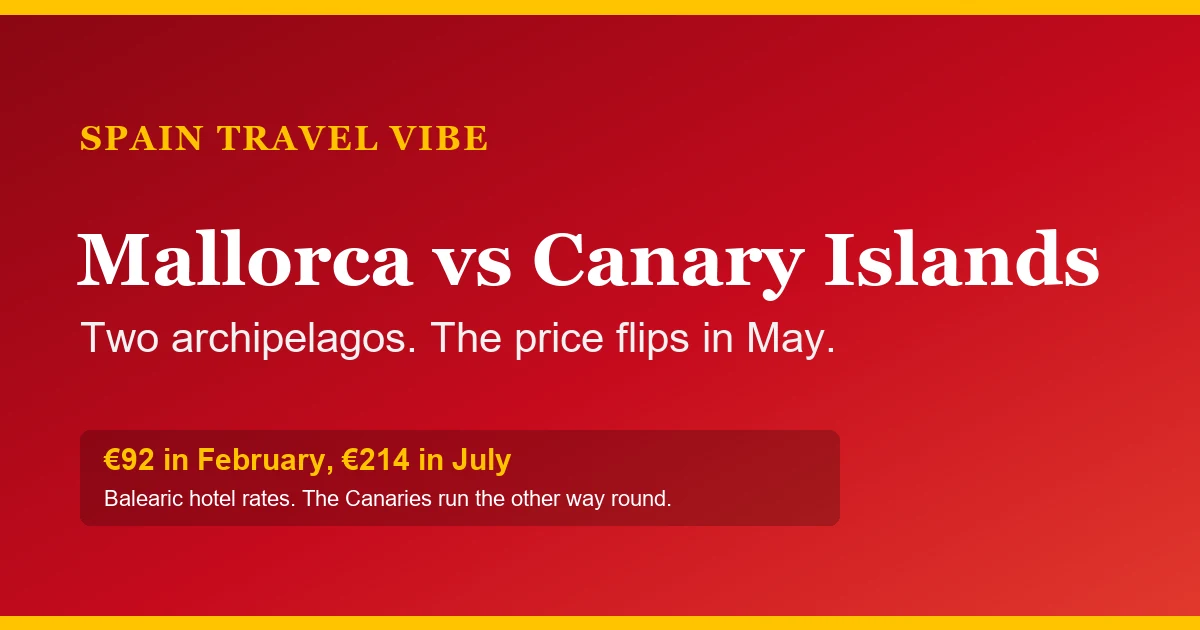
In February 2026, the average hotel room in the Canary Islands cost €156.99 a night. The same month in the Balearics: €92.20 (INE, provisional). By July the figures had swapped ends, with the Balearics at €213.68 and the Canaries at €146.38.
So there isn’t a cheap archipelago and an expensive one. There’s an in-season one and an out-of-season one, and they trade places in May. Everything else in this comparison follows from that, including the parts nobody warns you about, like the three quarters of Mallorca that’s shut in January.
Key Takeaways
- Neither island group is cheaper. Whichever is out of season is. Balearic hotel rates ran €92.20 in February against the Canaries’ €156.99, then reversed in July to €213.68 against €146.38 (INE, 2026, provisional).
- The two price curves cross in May, €2.23 apart. That month is the switchover point for the whole decision.
- Mallorca’s cheap winter is a supply signal, not value. Only 23.7% of the island’s hotels were open in January 2026 (FEHM).
- The Canaries are the flatter product in every sense. Their hotel rate moves 26% across the year against the Balearics’ 133%, and their temperature range is half as wide.
- Budget an extra two hours each way in the air for the Canaries, and pick a specific island before you book anything.
Table of Contents
Which Is Cheaper, Mallorca or the Canary Islands?
Neither, permanently. In February 2026 a Canary hotel room averaged €156.99 a night against €92.20 in the Balearics, making the Canaries 70% more expensive. In July the same INE series reads €213.68 for the Balearics and €146.38 for the Canaries, a 46% premium the other way (INE, provisional).
Both numbers come from one table, so they’re directly comparable. I pulled the whole run of months rather than the two convenient ones, and the shape is the actual answer to the question:
The lines cross between April and May. In May the gap is €2.23, with the Balearics at €128.33 and the Canaries at €126.10. That is as close to a tie as two destinations get.
Look at what each curve does either side of it. The Balearic rate moves from €91.74 in March to €213.68 in July, a swing of 133%. The Canary rate travels from €124.56 in June to €156.99 in February, a swing of 26%. One archipelago is a season. The other is a climate, and it prices like one.
There’s a neat symmetry in the peaks, too. In July the Balearics ran 36% above the Spanish national average of €156.92. In February the Canaries ran 35% above a national average of €116.32. Each group commands almost exactly the same premium when it’s the one everybody wants.
Two honest caveats before you build a budget on this. An average daily rate isn’t a package price, and most people reach both islands on packages. And the Balearic winter figure is dragged down by which hotels are open, which is the subject of the next section and matters more than the number itself.
Why Does the Price Flip?
Supply, mostly. Only 23.7% of Mallorca’s hotels were open in January 2026, rising to 38.7% in February and 70.6% by March (FEHM, via Última Hora, February 2026). A February room on Mallorca is cheap because most of the island isn’t trading, not because the island is good value in February.
That distinction changes what you should do with the cheap number. Here’s the island’s supply curve, which is the missing half of every price comparison you’ll read:
The Canaries have the opposite problem, which is to say no problem. Canarias posted the highest bed occupancy of any Spanish region in January 2026, at 73.1%, in a month when the national total reached 17.3 million hotel nights (INE, provisional). Six months later the roles reversed exactly: Illes Balears led the country in July at 87.4% (INE, provisional). Each archipelago tops the national table in the other’s off-season.
Mallorca is slowly closing the gap. The share of its hotels trading all twelve months has climbed from 12.7% in 2019 to 20.4% in 2026, according to the same hotel federation figures. That’s real progress, and it’s still one hotel in five.
What does this mean if you’re looking at a €60 room in a Mallorcan resort town in February? Probably that the restaurants around it are shut, the bus runs four times a day, and the pool is drained. Palma is the exception. The capital has pushed hard on year-round trade and stays properly open. That makes a winter city break there a genuinely good idea, and a winter beach holiday there a bad one.
Is This Even the Right Comparison?
Not quite, and the mismatch matters. Mallorca is a single island of 3,640 km². The Canary Islands are eight inhabited islands spread across hundreds of kilometres of Atlantic, since La Graciosa was formally recognised as the eighth in 2018 (Hello Canary Islands, the islands’ official tourism board). You’re comparing a place with a category. Most guides still say seven.
The practical version of that is simple. Mallorca is one airport, one hire car, one base if you want. The Canaries make you choose, and the islands are far less alike than the brochures suggest.
Tenerife and Gran Canaria are the big two, with the infrastructure, the resorts, the flight choice and the crowds to match. Tenerife adds the highest mountain in Spain and a genuinely dramatic interior. Lanzarote and Fuerteventura are the volcanic and windswept pair, thinner on trees and much better on beaches and watersports. La Palma, La Gomera and El Hierro are the quiet ones, green and steep and short on nightlife. La Graciosa has sand tracks instead of roads.
If you want the island that behaves most like Mallorca, it’s Gran Canaria. It has the same combination the Balearic island trades on. A real capital city with a historic quarter, a working port, a mountainous middle, and a heavily developed southern coast you can ignore or aim for. Tenerife is bigger and more spectacular but less balanced. Lanzarote is a different holiday altogether.
Island-hopping is easy but not free. Ferries between the main islands start around €30 one way and take anywhere from half an hour to six hours, depending on the crossing. Binter’s inter-island flights cover Tenerife to Gran Canaria in about thirty minutes. Both are frequent, and prices move, so treat those as orders of magnitude rather than quotes. If you want two islands in a week, budget the best part of a day for the switch.
How Much Longer Is the Flight?
About two hours each way from northern Europe. London to Palma is roughly 2 hours 25 minutes nonstop; London to Tenerife is roughly 4 hours 30 minutes. From Madrid the same gap holds in miniature, at about 1 hour 30 minutes to Palma against just under 3 hours to Tenerife (scheduled nonstop times, which vary by carrier and season).
That difference decides more trips than the price does. Four extra hours in the air, plus the longer airport margins that go with a long-haul-feeling flight, is most of a travel day burned at each end. Mallorca survives a long weekend. The Canaries really don’t. If you have four nights, the arithmetic makes the choice for you regardless of what the weather is doing.
It also changes what a cheap fare is worth. A €40 flight to Tenerife that costs you two days of a seven-day holiday is not cheaper than a €90 flight to Palma that costs you two half-mornings. Our guide to getting around Spain covers the domestic side of this in more detail, including when a flight beats the train on the mainland.
One thing that does favour the Canaries here: because winter is their high season, the winter flight schedule is dense rather than skeletal. Mallorca’s winter route map is much thinner than its summer one, so a January trip there may need a connection that a July trip wouldn’t.
Which Has the Better Weather and Water?
The Canaries in winter, Mallorca in summer, and the margin is bigger than most people expect. AEMET’s long-term normals put Palma airport’s January mean daily maximum at 15.2°C. Santa Cruz de Tenerife records 21.0°C and Gran Canaria airport 20.8°C for the same month (AEMET, 1981-2010 normals).
Nearly six degrees is the difference between a coat and a t-shirt. It’s also why the Canaries are Europe’s default midwinter beach destination. Our month-by-month guide to the best time to visit Spain treats them as running on a separate calendar from the rest of the country, and this is the reason.
Summer inverts it, and here’s the part that surprises people: the Canaries are the cooler option in August.
Palma’s thermometer travels 16.1 degrees between January and August. Santa Cruz de Tenerife’s travels 8.0, and Gran Canaria’s 6.7. It’s the hotel-rate chart again, drawn in a completely different unit, which is about as good a confirmation of a pattern as travel data offers.
The sea is a different story, and one I can’t pin down as precisely. Broadly, Mallorca’s water is cold in winter, somewhere in the low to mid teens, and genuinely warm by late August. Canary water sits in a narrower band, roughly 18°C to 24°C, warmer than the Mediterranean from about November to May and cooler at the height of summer. Why a range rather than a table? Because I could not find monthly sea-temperature climatology for both places from an official source. The aggregator sites that publish precise-looking figures don’t say where the numbers come from.
The coastlines differ in character as much as temperature. Balearic beaches are pale limestone coves and long shallow bays. Canary beaches run from black volcanic sand through to the imported golden sand of the big southern resorts. Neither is better. They photograph very differently.
What Do You Have to Book Before You Arrive?
Two access systems, both easy to miss, both capable of writing off a day. Cap de Formentor is shut to private vehicles from 10:00 to 22:00 between 15 May and 18 October 2026 (Consell de Mallorca). The summit cone of Teide has needed a paid, dated permit since 19 January 2026 (Cabildo de Tenerife). Neither has anything to do with your cable car ticket.
| What | Where | The rule | Cost | How to book |
|---|---|---|---|---|
| Cap de Formentor road (Ma-2210) | Mallorca | Private cars, motorbikes and trucks barred 10:00 to 22:00, 15 May to 18 October 2026. Lighthouse section closed both ways; beach section limited until parking fills | Free. Fines of €100 to €200 for entering without authorisation | No booking. Take TIB bus line 334 from Alcúdia via Port de Pollença, or go before 10:00 |
| Teide summit trail, PNT 10 Telesforo Bravo | Tenerife | Dated, time-slotted permit required for the final cone. Charged to non-residents since 19 January 2026 | €15 for visitors, €6 for other Canary residents, free for Tenerife residents and under-14s | Tenerife ON platform, web only. Book months ahead |
| Montaña Blanca trail, PNT 07 | Tenerife | Same charging regime, different band | €6 weekdays, €10 weekends and holidays for visitors | Tenerife ON |
Sources: Consell de Mallorca and Cabildo de Tenerife, both read on 23 August 2026.
Both rules are new enough that most guides still describe the old situation. The Teide charge is seven months old, and the Formentor dates shift most years. Anything written before this season is likely to send you up a road that’s closed, or to a summit you can no longer walk onto for free.
Two practical notes. The Formentor bus takes about an hour from Alcúdia and gets very busy in August, so the genuine workaround is to drive out before ten in the morning. And the Teide permit is separate from the cable car, which is ticketed on its own and doesn’t get you onto the summit cone by itself.
Which One Is More Crowded?
Almost identically busy in absolute terms, and not remotely comparable in pressure. Both archipelagos took roughly 15.7 million international visitors in 2025 (INE). The Balearics absorb that with 1,266,279 residents against the Canaries’ 2,277,705 (INE, 1 July 2026, provisional).
Same visitors, roughly half the people. Our region-by-region guide to where to go in Spain works that ratio out across all seventeen communities. It puts the Balearics at 12.6 international visitors per resident against the Canaries’ 6.9, in a country averaging 2.0. Mainland alternatives sit far below both, which is the case our roundup of underrated Spanish cities makes with city-level hotel data. Those two island groups are first and second, and neither is close to third.
That’s why Mallorca, not Tenerife, is where Spain’s overtourism argument is loudest. Around 25,000 people marched through Palma on 26 July 2026 by police count, with organisers claiming 70,000, backed by 134 social organisations (The Local).
Should that change your plans? Not in the way people assume. These are protests about housing costs, wages and infrastructure, aimed at policy rather than at visitors, and they haven’t made the island unwelcoming. The Canaries have their own version of the same movement with its own slogan and the same grievances. What both are usefully telling you is where the pressure has concentrated, which is a nudge towards Menorca over Mallorca, or La Palma over Tenerife, if quiet is what you’re buying. If you want that without an island at all, Galicia, Asturias and Cantabria run at a fraction of the density.
Which Costs Less Once You Are There?
The Canaries, structurally, and it applies to almost everything you buy. The islands sit outside Spain’s VAT area and levy IGIC instead, at a general rate of 7% against the mainland’s 21% (Ley 4/2012, article 51, consolidated text). That 14-point gap shows up in restaurant bills, fuel and electronics, and it doesn’t switch off in high season.
Then there’s the tourist tax, which runs the other way. The Balearic sustainable tourism tax charges roughly €1 to €4 per person per night in high season, from 1 May to 31 October, scaled by accommodation category. Low season costs about a quarter of that. There’s a 50% discount after the eighth night, and under-16s are exempt. The Canaries have no general regional tourist tax at all. Our city-by-city guide to tourist taxes in Spain has the full band structure. It also has the tangled story of the one Canary municipality that tried to charge one and ended up in court.
Put numbers on it. Two adults in a four-star Mallorcan hotel in August pay €3 each per night, halving from the ninth night. Over a fortnight that’s about €70 once the 10% VAT on the tax is added. Children under 16 pay nothing. It’s not the deciding factor. It’s worth knowing about, because it’s usually collected at the hotel rather than folded into the price you booked.
Car hire swings with the season on both islands, so I track it rather than quote one figure. In my October 19, 2026 sample, a November week in a small manual car had a median price of €129 at Palma and €200 at Tenerife South, and my guide to hiring a car in Spain has the deposits and ferry rules behind those prices. Book early either way. For the wider picture on what a Spanish trip costs, my 2026 budget breakdown works through the categories properly.
Who Should Choose Mallorca
Anyone travelling between May and October, on a short trip, from anywhere in northern Europe. The two-and-a-half-hour flight is the single strongest argument for the island, and it’s what makes a four-night trip viable in a way it simply isn’t for the Atlantic.
Choose it if you want a proper city alongside the coast. Palma has a cathedral worth crossing the island for, with an interior Gaudí reordered between 1903 and 1914, a serious food scene, and enough of a winter life to sustain a January weekend on its own terms. Choose it if you cycle, because the Serra de Tramuntana is one of the best road-riding regions in Europe and the island knows it. Choose it if the trip is part of a longer Spanish route. Palma connects to the mainland in under ninety minutes and slots neatly into the kind of itinerary our complete Spain travel guide sets out.
The honest counter-signal: July and August on Mallorca are expensive by any Spanish standard, at €213.68 a night against a €156.92 national average. The island is also the loudest front in the country’s overtourism argument. And if you’re picturing a beach holiday in February, look at the supply chart again.
Who Should Choose the Canary Islands
Anyone travelling between November and April, and anyone who needs a guaranteed temperature rather than a likely one. That’s the whole product. A 21°C January daily maximum with hotels, buses and restaurants all running normal schedules is something no Mediterranean island can offer at any price.
Choose the Canaries if you have ten days or more, because the flight is only worth it at that length and because two islands beat one. Choose them if you walk, since Teide, the Anaga ridges, La Palma’s calderas and La Gomera’s laurel forest are a different order of landscape from anything in the Balearics. Choose them for young families, where a sea that’s swimmable in February counts for more than scenery. And choose them if you’re pricing everything, not just the room, because the 7% IGIC quietly discounts the whole trip.
The honest counter-signal: winter is their high season and priced accordingly, at €156.99 in February against a €116.32 national average. The flight costs you two extra hours each way. And “the Canaries” isn’t a destination until you’ve picked an island, which is a decision the table below makes for you.
| If you’re going… | And you want… | Go to |
|---|---|---|
| November to April | Reliable heat, short flights secondary | Any Canary island |
| November to April | A winter city break, not a beach | Palma de Mallorca |
| May to October, short trip | Coast plus a real city | Mallorca |
| May to October, two weeks | Coast plus a mountain | Tenerife or Mallorca |
| Any month, first Canary trip | Balance of city, mountains and resorts | Gran Canaria |
| Any month, beaches and wind | Dunes, watersports, volcanic landscape | Fuerteventura or Lanzarote |
| Any month, quiet | Hiking, forest, almost no nightlife | La Palma, La Gomera, El Hierro |
| May to October, quiet | Mediterranean calm, small scale | Menorca |
| Long weekend, northern Europe | Anything at all | Mallorca, by default |
Frequently Asked Questions
Is Mallorca or the Canary Islands cheaper?
It depends entirely on the month. In February 2026 the average Canary hotel room cost €156.99 a night against the Balearics’ €92.20. By July the Balearics had climbed to €213.68 and the Canaries had fallen to €146.38 (INE, provisional). The two curves cross in May.
Is Mallorca worth visiting in winter?
Palma is; the resort coast mostly isn’t. Only 23.7% of the island’s hotels were open in January 2026, and just 20.4% trade all twelve months (FEHM, 2026). The capital has pushed hard on year-round trade and works well as a winter city break. A beach holiday on the resort coast does not.
Which Canary island is most like Mallorca?
Gran Canaria. It shares Mallorca’s structure more closely than any of the others. You get a historic capital with a working port, a mountainous interior, and a developed southern coast you can aim for or avoid. Tenerife is larger and more dramatic but less balanced. Lanzarote and Fuerteventura are a different kind of holiday entirely.
Are the Canary Islands warmer than Mallorca in winter?
By nearly six degrees. AEMET’s normals give Palma airport a January mean daily maximum of 15.2°C against 21.0°C at Santa Cruz de Tenerife and 20.8°C at Gran Canaria airport (1981-2010 normals). In August the ranking reverses, with Palma at 31.3°C and the Canary stations between 27.5°C and 29.0°C.
Do you pay a tourist tax in the Canary Islands?
There’s no general regional tourist tax in the Canaries, unlike the Balearics, where the sustainable tourism tax runs €1 to €4 per person per night in high season. One Canary municipality introduced a small charge, had it annulled in court, and is still collecting it pending appeal. Our tourist tax guide tracks the current position.
Mallorca vs Canary Islands: What Actually Decides It
The month decides it, and almost nothing else does. From November to April the Canaries are the only one of the two that’s fully open, fully warm and fully staffed, and you pay a premium for that. From May to October the Balearics take over on every measure and charge their own premium. In May the two are within a couple of euros of each other and you should pick on flight time.
Everything else is a tiebreak. Short trip, take Mallorca. Ten days or more, take the Canaries and take two islands. Hiking, take the Canaries, and see where Teide sits among Spain’s best trails. A city as well as a coast, take Palma or Las Palmas. Watching every euro on the ground rather than just the room rate, the 7% IGIC quietly tips it Atlantic.
Language isn’t the tiebreak most people assume. On the EF proficiency index the Canaries score 539 and the Balearics 534, either side of a Spanish average of 540. Neither archipelago is the English-speaking outlier its tourist numbers suggest. Resort staff are a different matter from the rest of the island, which our guide to how far English gets you in Spain works through properly.
Still not sure islands are the answer at all? Our region-by-region guide to where to go in Spain covers all seventeen communities. The month-by-month timing guide will tell you what the mainland is doing while you decide. If it’s your first trip to the country, start with our complete Spain travel guide. Then pack for the island you actually chose, using our season and region packing list. A January suitcase for Tenerife and a January suitcase for Mallorca are not the same suitcase.