

Last verified: October 19, 2026. The prices in this guide to renting a car in Spain come from my own sample of 10,715 Discover Cars offers, run on October 19, 2026. I priced 7-day hires collected on November 16 and December 21, 2026 at Madrid, Barcelona, Málaga, Seville, Palma and Tenerife South airports, for a US driver aged 35. The toll list comes from Spain’s Ministerio de Transportes, and the traffic rules from the DGT and the BOE. I re-run the sample every month and update this date when anything moves.
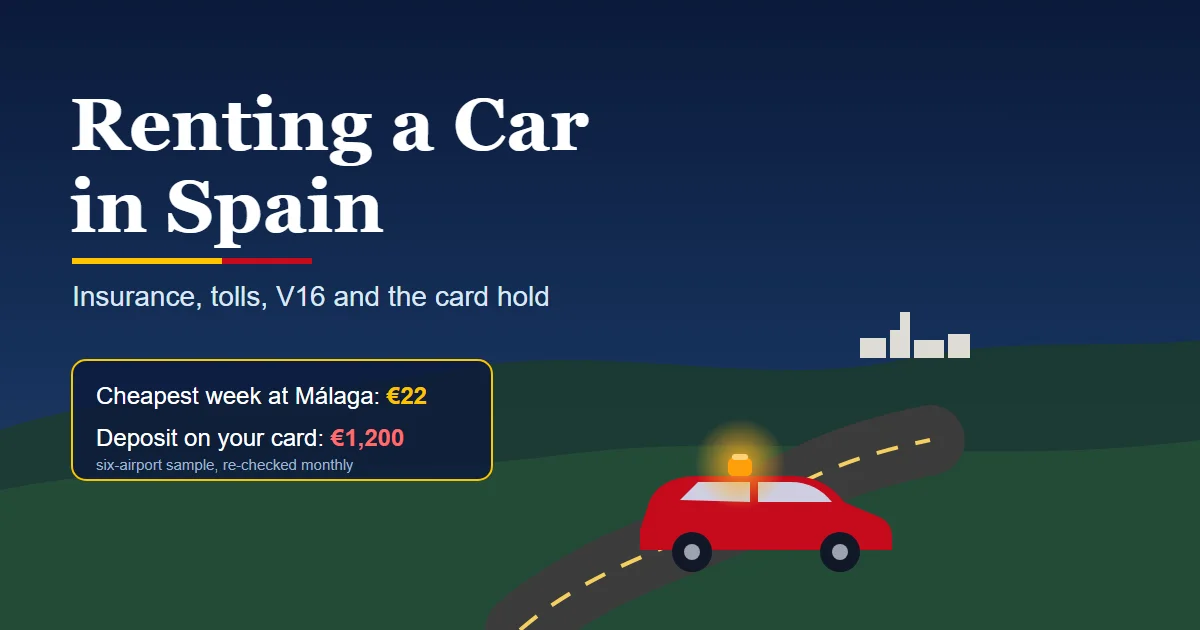
Renting a car in Spain is cheap and easy outside the big cities. Before you book, though, read three numbers: the excess, the deposit, and the tolls on your route. The daily rate matters less than any of them. In my sample, the cheapest week at Málaga airport cost €22, and it came with a €1,200 hold on the driver’s credit card.
Spain had 96.8 million international arrivals in 2025, and 14.0 million of them came by road (INE Frontur, table 23982, 2026). Rental firms bought 190,434 new cars that year, about one in six sold in Spain (ANFAC via Interempresas, January 2026). So there’s no shortage of cars. What catches visitors is the paperwork, a new safety rule, and roads that charged a toll years ago and no longer do.
Disclosure: Some links in this guide may earn us a commission, at no extra cost to you. It never changes what we recommend.
This guide follows the order you’ll meet each problem, with nine tips along the way. If you’re still deciding between trains, planes and a car, start with my comparison of trains, flights, buses and driving.
Key Takeaways
- Rent a car for rural Andalusia, the north coast, wine country and the islands. Between Madrid, Barcelona, Seville and Valencia, the train is faster.
- Non-EU licences must follow the Geneva or Vienna model or be translated, and the DGT recommends an International Driving Permit. The US State Department says Americans need one.
- In my October 19 sample, the 10 cheapest small manual cars at each airport for a November week carried a median card hold of €725 to €1,100 and an excess of €1,000 to €1,700.
- Since January 1, 2026, every Spanish-registered car must carry a connected V16 beacon instead of warning triangles. Check it’s in the car.
- Only 1,435 km of the 12,091 km of state motorways and dual carriageways still charge a toll, and the AP-68 concession ends on November 10, 2026.
Table of Contents
Do You Actually Need a Car in Spain?
Renting a car in Spain makes no sense for Madrid, Barcelona, Seville or Valencia. It makes every sense for the places the train skips, and Spain has a lot of them.
The high-speed network links the big cities faster than you could drive, and their centres punish cars with one-way mazes, residents-only streets and low-emission zones.
Once you leave the AVE lines, it flips. Santander to Oviedo is 165 km and about five hours by train, twice a day. That’s why the north coast route where the train gives up is a driving trip. The same goes for Andalusia’s white villages, the trailheads in the Picos and Sierra Nevada, and Rioja and Ribera del Duero by car.
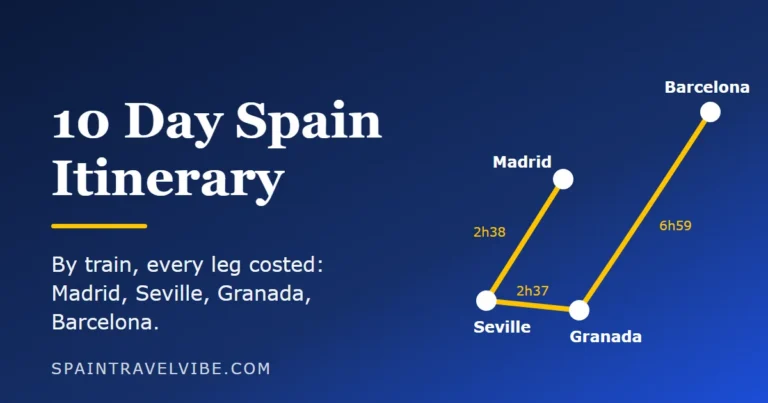
A split trip often works best. Take the train between cities, then rent for the rural stretch only. The costed rail route that needs no car covers Madrid, Seville, Granada and Barcelona without one.
Tip 1. Collect the car at the airport or at a station office, not in an old town. You avoid driving into a centre on your first day. Airports also have plenty of stock: my sample found 588 offers in all classes at Seville and 1,245 at Málaga for the November week.
What Do You Need for Renting a Car in Spain?
You need a valid licence, a passport, and a credit card in the main driver’s name. Non-EU drivers usually need an International Driving Permit (IDP) as well.
Spain’s traffic authority, the DGT, accepts a non-EU licence if it’s written in Spanish, comes with an official translation, or follows the Geneva or Vienna convention model. It recommends an IDP, which lasts one year and only counts alongside your passport and home licence. A foreign licence stops being valid six months after you become a resident (DGT, 2020). Each government words its advice a little differently:
| Licence from | What its government says | Source |
|---|---|---|
| EU or EEA | Your licence alone | DGT |
| United Kingdom | Photocard licence accepted; provisional licences are not | gov.uk |
| United States | Get an IDP before you arrive; rental firms and police can ask for it | US State Department |
| Canada | Canadian licence plus an IDP | Travel.gc.ca, August 2026 |
| Australia | Physical licence plus an IDP; digital licences not accepted | Australian Embassy Madrid |
The card matters as much as the licence. Most firms block a deposit on it at the desk. In my sample, only 13% to 60% of small-car offers at each airport took a debit card for that.
If you’ll be renting a car in Spain under 25, budget for a young-driver surcharge too. At Málaga, the median small manual for the November week rose from €134 at age 35 to €242 at age 23. On identical cars from the same supplier, the gap was mostly €90 to €210 for the week.
Tip 2. Get the IDP even where it’s only advised. It costs little at home, and it ends any argument at the desk or at a Guardia Civil checkpoint. Bring your passport too, since EES and passport checks at the airport come first, as my guide to passport and EES rules at the airport explains.
How Much Does Renting a Car in Spain Cost?
A week in a small manual car cost a median €129 to €200 at the six airports I sampled, for a pickup on Monday, November 16. Book the same week over Christmas and it rose to between €260 and €437.
I sampled every small car (mini, economy and compact) on offer for a 7-day hire at each airport: 10,715 offers in all classes across 12 searches. The medians tell you what an ordinary booking costs. The floor was far lower. The cheapest November week was €10 at Palma, €22 at Málaga and €27 at Seville. Madrid was the dearest airport at Christmas, with a median of €437.
Automatics cost a little more and there are fewer of them. At Málaga in November the median automatic was €140 against €134 for a manual, but there were 155 automatic offers to 220 manual ones. At Madrid at Christmas, the median automatic was €483. To compare suppliers, excess and deposits side by side, search the airport offers on Discover Cars. It shows the hold and the excess before you pay, and those matter more than the price.
Tip 3. Book an automatic as early as you can. At Málaga there were 155 automatic offers to 220 manual ones, so the cheap ones go first.
For the rest of the budget, here’s where a rental fits in a full trip budget.
How Do Excess, Deposits and the Insurance Upsell Work?
Every quote you see when renting a car in Spain includes third-party cover and a collision damage waiver, but with an excess. That excess is what you owe if the car is damaged, and the deposit is how the firm makes sure you can pay it.
The cheapest offers carry the biggest holds. Across the six airports, the 10 cheapest small manual cars in November had a median deposit of €725 to €1,100 and a median excess of €1,000 to €1,700. Across all small manual offers, the split is by supplier type:
| Supplier type (small manual cars, six airports) | Median deposit | Median excess | Zero-excess offers | Full-to-full fuel |
|---|---|---|---|---|
| Big international groups (Avis, Hertz, Europcar, SIXT, Enterprise, Budget and their budget brands) | €350 | €1,940 | 10% | 82% |
| Spanish and other brands (Record go, OK Mobility, Centauro, Click&Rent, GoByCar and others) | €300 | €300 to €350 | 46% | 88% |
Source: my Discover Cars sample, October 19, 2026.
That gives you three routes. You can buy the desk’s excess waiver, which ends the hold or shrinks it but often costs more per day than the car. You can buy a broker’s full coverage before you travel. On Discover Cars that cost a median €48 to €122 for the week, depending on airport and date. It reimburses you after a claim, though, so the firm still blocks the deposit. Or you can accept the excess and drive carefully.
The difference is starkest at Málaga. The €22 week came with a €1,200 hold and a €1,600 excess. For €98, another supplier offered a car in the terminal with a €150 hold and no excess at all.
Tip 4. Compare total exposure, not the daily rate. Add the price, the excess and the hold, and ask whether your card’s limit can carry the hold for your whole trip.
Tip 5. Choose full-to-full fuel. You pick the car up full and return it full. “Same to same” leaves you guessing at a quarter tank, and full-to-empty policies charge for fuel you may never burn. EU consumer authorities have pressed the big firms on fuel, insurance and damage terms since 2016. A 2025 sweep made two brokers rewrite theirs (CCPC, 2025).
What Should You Check at Pickup, From the V16 to the Scratches?
The five minutes at the bay matter more than anything else about renting a car in Spain. Before you leave, find three things: the V16 beacon, the reflective vest, and the environmental sticker on the windscreen.
Since January 1, 2026, a connected V16 beacon is the only legal way to signal a broken-down Spanish-registered car. It replaces the two warning triangles and must be kept inside the cabin (DGT note via the Ministerio de Asuntos Exteriores/NP%20UTILIZACION%20DEL%20DISPOSITIVO%20DE%20PRESE%c3%91ALIZACI%c3%93N%20DE%20PELIGRO%20V-16%20EN%20CIRCULACI%c3%93N%20INTERNACIONAL%20def.doc), 2025). Almost every car rented in Spain carries Spanish plates, so yours should have one.
If you break down, put the hazards on, reach out of the window and stick the beacon on the roof. It flashes orange and sends your position to the DGT 3.0 platform, which passes it to navigation apps (DGT, 2026). Keep the vest in the cabin too, and put it on before you step out (Travel.gc.ca, 2026).
The round sticker on the windscreen is the DGT environmental label. A C or ECO label passes the low-emission zones that matter to visitors. A B label is restricted in some of them, so ask for another car if you’re heading into a city.
My pickup checklist: V16 beacon in the glovebox or door pocket. Reflective vest in the cabin. Environmental sticker on the windscreen. Fuel gauge at full. A walk-round video of every panel, wheel and the windscreen, timed and dated. The damage form signed only once it matches what you filmed.
Tip 6. Don’t drive off without the V16, the vest and the sticker. They’re the rental firm’s job to supply, but they’re your problem at a roadside check.
Which Spanish Motorways Still Charge Tolls?
Very few, and tolls are a smaller part of renting a car in Spain than most guides suggest. Of the 12,091 km of motorways and dual carriageways on the state network, only 1,435 km still charge a direct toll (Ministerio de Transportes, 2026).
The big change came between 2018 and 2021, when Spain let its oldest concessions expire. The AP-1 went free in 2018. The AP-4 from Seville to Cádiz and the AP-7 from Alicante to Tarragona followed when their concessions ended on December 31, 2019. The AP-7 from Tarragona to the French border and the AP-2 to Zaragoza went free on September 1, 2021 (La Moncloa, 2021). Driving from Madrid to Barcelona by road is now toll-free.
These are the state toll motorways still charging in 2026 (Ministerio de Transportes, current toll motorways, 2026):
| Toll road | Where | Free road alongside |
|---|---|---|
| AP-7 Málaga to Estepona to Guadiaro | Costa del Sol | A-7 |
| AP-46 Alto de las Pedrizas to Málaga | Málaga, inland | A-45 |
| AP-7 Alicante to Cartagena | Murcia coast | A-7, N-332 |
| AP-6, AP-51, AP-61 | Madrid to Segovia and Ávila | N-VI over the Alto del León, N-110, N-603 |
| AP-68 Bilbao to Zaragoza | Basque Country, La Rioja, Navarra, Aragón | AP-68 goes free for cars after November 10, 2026, except in Álava |
| AP-9 Ferrol to the Portuguese border | Galicia | N-550, A-52 in parts |
| AP-53, AP-66, AP-71 | Galicia, Asturias, León | N-525, N-630, N-120 |
Tolls rose between 3.64% and 4.68% on January 1, 2026 (Europa Press via Bolsamanía, December 2025). The state-run SEITT motorways around Madrid and beyond (the R-2 to R-5, M-12, AP-36 and AP-41) also charge, but they’re free from midnight to 6 a.m.
The AP-68 is the one to watch. Its concession ends on November 10, 2026 and cars stop paying in La Rioja, Navarra and Aragón. Álava has backed a barrier-free toll of about €0.06 per km on its 55 km stretch, though its law isn’t final yet (Noticias de Álava, October 2026). Booths take cards. You only need a Via-T transponder if your rental includes one.
Tip 7. On the Costa del Sol, take the free A-7 unless it’s high summer. The AP-7 from Málaga to Guadiaro costs €12 end to end for most of the year. From June to September and over Easter it’s €19.55 (El Debate, June 2026). The AP-7 earns its €19.55 only in July and August, when the A-7 jams.
Can You Drive a Rental Car Into Spanish Cities?
Yes, legally. But renting a car in Spain doesn’t mean driving it everywhere, and the cities are where that matters.
Spain’s climate law requires every municipality of over 50,000 people, and the island territories, to run a low-emission zone, or ZBE (BOE, Ley 7/2021, article 14.3). Cameras read the plate and check the DGT environmental label against it. A Spanish rental car with a C or ECO label passes most of them.
Foreign-plated cars can’t get a label at all, and Barcelona’s metropolitan zone makes them register in advance (AMB, ZBE Rondes de Barcelona). That’s one more reason to rent in Spain rather than drive in from France.
The bigger trap is the old town. Córdoba, Seville and Granada control their historic centres with cameras and bollards that ignore stickers entirely. How the Andalusian zones and Córdoba’s bollards work is covered in my road trip guide, including where to park in Málaga and Granada.
There’s one more cost behind any camera. The fine goes to the rental firm, which passes it on with an admin fee. Spain’s consumer ministry fined Avis €1 million in August 2026 for charging €33.88 to €45 to handle customers’ traffic fines, calling the clause abusive (Ministerio de Consumo, 2026). Avis can still appeal in court.
Tip 8. Park at the edge and walk in. A bollard doesn’t care which sticker you have, and a camera fine reaches you weeks later with a fee attached.
Which Driving Rules Cost Tourists Money?
The rules are familiar, but the fines for breaking them are the costliest surprise of renting a car in Spain. Speed limits are 120 km/h on motorways and dual carriageways and 90 km/h on other roads. In towns the limit is 50, 30 or 20 km/h, depending on how many lanes the street has (DGT, August 2026).
The alcohol limit is 0.5 grams per litre of blood, or 0.25 mg per litre of breath. For drivers in their first two years and professional drivers it’s 0.3 and 0.15 (BOE, General Traffic Regulation, article 20). A plan to cut it to 0.2 lapsed when parliament was dissolved for the November 29 election (Infobae, October 2026). The safe rule is simple: if you’re driving, don’t drink.
Fines come in three bands: up to €100 for minor offences, €200 for serious ones and €500 for very serious ones. Speeding has its own scale, shown in the chart above, from €100 to €600. Most fines are halved if you pay within 20 days. If you have no residence in Spain, officers can ask you to pay on the spot, discount included, or leave a deposit. If you can’t, they can immobilise the car (BOE, RDL 6/2015, articles 80, 87 and 94).
The roads themselves are good. The DGT counted 1,119 deaths on interurban roads in 2025, the second-lowest figure since 1960, on a record 478.6 million long-distance trips (DGT, January 2026). For the wider picture, see how safe Spain is for visitors.
Can You Take a Rental Car to Portugal, Gibraltar or the Islands?
Renting a car in Spain for a Portugal leg or an island hop depends on the supplier, not the law, so check before you book.
On the mainland, cross-border travel was allowed on 56% to 85% of the small-car offers in my sample. It usually costs a fee, and Portugal needs a device or a registration for its electronic tolls. Gibraltar is often excluded, and the border can queue in either direction (Travel.gc.ca, 2026).
The islands are a different market. Only 6% of offers at Palma allowed a ferry crossing, against 41% at Tenerife South, where inter-island ferries are common. Almost every island offer came with unlimited mileage. If you’re choosing between the two island groups, here’s which island group suits a hire car.
Tip 9. Rent on the island, and book any Portugal fee in advance. In my sample, a November week started at €10 at Palma airport on Discover Cars and €67 at Tenerife South. Only 6% of Palma offers allow a ferry crossing anyway.
FAQ
Do I need an International Driving Permit to rent a car in Spain?
If your licence is from outside the EU, get one. The DGT recommends an IDP for non-EU licences, the US State Department says Americans need one, and Canada and Australia advise one. UK photocard licences are accepted on their own.
How much is the deposit when renting a car in Spain?
It depends on the offer. In my October 19, 2026 sample, the median deposit across all small cars was €200 to €700 per airport. The 10 cheapest small manual offers at each airport held a median €725 to €1,100 for the November week. Most firms need a credit card for it, and only 13% to 60% of offers took a debit card.
Are Spanish motorways free?
Mostly. Only 1,435 km of the state’s 12,091 km of high-capacity roads still charge a direct toll (Ministerio de Transportes, 2026). A few regional motorways in the Basque Country, Catalonia and Galicia also charge. The AP-7 north of Alicante and the AP-2 are free. The AP-68 goes free for cars after November 10, 2026, except in Álava.
What is the V16 beacon, and does my rental car have one?
It’s a flashing orange light you put on the roof after a breakdown, connected to the DGT. It replaced warning triangles for Spanish-registered cars on January 1, 2026, so a Spanish-plated rental car must carry one. Check the cabin before you drive off.
Can I drive a rental car into Madrid or Barcelona’s low-emission zone?
Yes, if it has a C or ECO environmental sticker, as most Spanish rental cars do. In Madrid’s Distrito Centro, non-resident C and ECO cars may enter only to park in a public car park. Foreign-plated cars can’t get a sticker, and Barcelona makes them register in advance. Historic centres with bollards are off limits whatever the sticker.
How much does renting a car in Spain cost per day?
For a small manual car collected on November 16, 2026, the median week cost €129 to €200 at six major airports, roughly €18 to €29 a day. For the Christmas week it rose to €260 to €437 (my Discover Cars sample, October 19, 2026).
Renting a Car in Spain, in Short
Decide by region first: trains between the big cities, a car for the countryside and the islands. Book an automatic early if you need one. Judge offers by the price, the excess and the hold together, because the cheapest week often blocks €1,000 or more on your card.
At the bay, find the V16, the vest and the sticker, and film the car. On the road, the free autovía usually runs alongside the toll motorway, and the old towns are for walking. Renting a car in Spain is the best way to see the half of the country the AVE never reaches. For the rest of the trip, my complete Spain travel planning guide picks up where this leaves off.