

Last verified: October 16, 2026. The 2026 Global Peace Index, the UK government’s Spain travel advice and Barcelona’s 2025 crime figures were checked on October 16, 2026; the US advisory levels are as reported in August 2026. Advisory levels change without notice, so I re-check them monthly and update the date above each time.
Is Spain safe? Yes, more so than most of the places its visitors fly in from. Spain welcomed a record 96.8 million foreign tourists in 2025 (INE, FRONTUR, 2026), and the overwhelming majority went home with nothing worse than a lighter wallet from too many good dinners.
But “is Spain safe?” deserves a better answer than “generally” when you’re standing on La Rambla with a backpack. Headlines about pickpockets, overtourism protests and a US travel advisory make Spain sound edgier than the numbers say it is. So I’ve separated the real risks from the noise.
Disclosure: Some links in this guide may earn us a commission, at no extra cost to you. It never changes what we recommend.
This guide ranks each risk by how likely it is to touch your trip, then covers Barcelona, the three classic scams, solo travel and the one habit that removes most of the danger.
Key Takeaways
- Spain ranks 27th of 163 countries on the 2026 Global Peace Index, ahead of Germany (28th), the UK (39th) and the US (134th) (Institute for Economics & Peace).
- Violent crime against tourists is rare. The real risk is pickpocketing and distraction scams, concentrated in a few known hotspots.
- Thefts were about half of all recorded crime in Barcelona in 2025, and fell to their lowest level since 2015.
- The US rates mainland Spain Level 2, the same as France, Italy and Germany; only the Ceuta enclave in North Africa is at Level 3.
- One zipped cross-body bag worn in front, plus ignoring street approaches, defeats most of the risk.
Table of Contents
New to planning a Spain trip? Start with my complete Spain travel planning guide.
Is Spain Safe for Tourists in 2026?
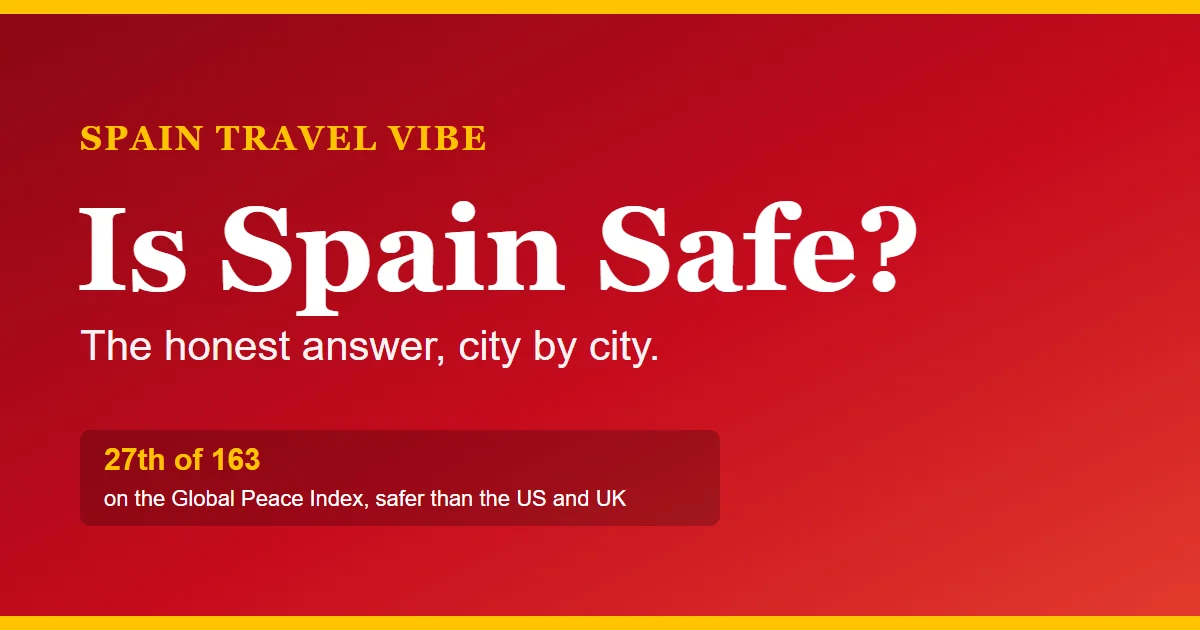
Yes. Spain ranks 27th out of 163 countries on the 2026 Global Peace Index, with a score of 1.654, just ahead of Germany and well ahead of Italy (35th), the United Kingdom (39th), France (99th) and the United States (134th) (Institute for Economics & Peace, Global Peace Index 2026, 2026). For most readers, Spain is statistically more peaceful than home.
The US travel advisory sounds worse than it is. The State Department lists mainland Spain at Level 2, “Exercise Increased Caution” (U.S. Department of State, 2026). France, Italy and Germany sit at the same level (Euronews, 2026). Level 2 is common across Western Europe, not a red flag.
Terrorism worries deserve a plain answer too. Incidents affecting tourists are rare, and the risk in Spain is a background one, the same as in any major European country, not a reason to change your plans. The Institute for Economics & Peace tracks it country by country in its Global Terrorism Index.
What Are the Real Risks: Fear vs. Reality?
When people ask me “is Spain safe?”, they usually picture violence, terrorism or being targeted, and the gap between that fear and what actually happens is wide. In reality, the crime tourists meet is almost entirely non-violent petty theft: pickpocketing and distraction scams. In 2025, Barcelona recorded 87,321 thefts out of 169,022 offences, about half of all recorded crime (Ara, 2026).
The two risks call for different responses. Violent crime, the thing people fear, is rare and largely outside your control. Petty theft, the thing that actually happens, is common but almost entirely preventable with a few habits. You’re preparing for a lost phone, not a dangerous confrontation.
I think of Spain’s risk like weather, not warfare. You wouldn’t cancel a trip because it might rain, but you’d pack a jacket. A little preparation, and the worst case for the typical visitor shrinks to an annoyance.
Is Barcelona Safe? Spain’s Pickpocketing Hotspot Explained
Is Spain safe in its biggest tourist city? Barcelona is safe to walk, day and night, but its pickpocket reputation is earned: theft is the most common crime in the city by a wide margin. The good news is the trend. Recorded crime fell 6.1% in 2025, and thefts fell 7.6% to their lowest level since 2015, about 239 a day (Ara, 2026).
The key detail is that the theft isn’t spread evenly. Visitors are most often warned about the places tourists funnel through:
- La Rambla, especially the lower stretch toward the port
- The Gothic Quarter (Barri Gòtic), in the dense pedestrian lanes
- Metro Lines 1 and 3, and busy interchange stations
- The escalators up to Montjuïc and the streets climbing to Park Güell
The UK Foreign Office notes that thieves often work in teams, so this is an organized nuisance rather than a random danger, which is exactly why predictable habits beat it. My full Barcelona travel guide breaks the city down neighborhood by neighborhood, and my guide to getting around Spain covers using the Metro without becoming a target.
What Are the Most Common Scams in Spain?
Three distraction scams account for most of the tourist losses I hear about in Spain, and all three work the same way: they get you to stop, look and engage while someone else works your bag. The UK government’s advice for Spain puts it plainly: thieves use distraction techniques and often work in teams (UK Foreign Office, 2026). Recognize the setup and you defeat every one of them.
- The friendship bracelet. Someone grabs your wrist and starts tying a “gift” bracelet, then demands payment while a partner moves in. Counter: keep your hands to yourself and don’t let anyone touch you. Common near Sagrada Família and busy plazas.
- The petition / clipboard. A person with a clipboard asks you to sign for a “deaf charity” or similar cause; while you read, your bag is opened. Counter: a firm “no,” keep walking. Common on the Montjuïc escalators and routes to Park Güell.
- The dropped ring. A stranger “finds” a gold ring near you and offers to share the luck, a distraction and a slow con. Counter: don’t engage.
Notice the pattern? Every one of these needs your cooperation. They’re social engineering, not smash-and-grab. The single most effective anti-scam move in Spain isn’t a gadget or a money belt. It’s the willingness to be a little rude to a stranger who approaches you unprompted.
Watch for a few others too. The UK Foreign Office also warns about fake police officers asking to see your wallet. Add ATM shoulder-surfing, taxi drivers who skip the meter and restaurants with no prices on the menu. An undisclosed charge on the bill belongs in the same family, and my guide to tipping in Spain explains which ones you can ask to have removed. None are dangerous, and all are avoidable.
Is Spain Safe for Solo Female Travelers?
Yes. Solo female travel is normal and visible across Spain, from big cities to small towns, and the country’s top-30 place on the Global Peace Index reflects a low-conflict, low-violence society overall. The precautions are the same pickpocketing habits everyone should follow, plus ordinary night-out common sense: stick to busy, well-lit streets, and use licensed taxis or ride apps late at night.
One quirk works in your favor here. Spanish cities stay lively until well past midnight, so streets that would feel empty at 11 p.m. elsewhere are still full of families and diners.
Smaller cities can feel even easier than the headliners. Places like San Sebastián, Valencia and Granada combine walkable centers with a relaxed late-night street culture, so a solo dinner or an after-dark stroll rarely feels like a calculated risk. If Barcelona’s crowds make you tense, they’re a gentler introduction. For budget and solo-friendly beds, my guide to the best hostels in Spain compares nine award winners.
Which Places Should Travelers Actually Be Cautious About?
The honest cautions are narrow and specific. Stay alert in the busiest tourist-transit zones: Barcelona’s La Rambla and Metro, and Madrid’s Sol, Gran Vía and Metro interchanges. That’s where pickpockets concentrate. Violent crime against visitors is rare across the mainland tourist trail.
There is one real exception, and it’s geographic. On August 1, 2026, the US raised its advisory for Ceuta, a small Spanish enclave on the North African coast, to Level 3, “Reconsider Travel,” after a mass migrant arrival from Morocco (U.S. Department of State, 2026). The higher level applies only to Ceuta, not to Melilla. Ceuta is nowhere near Barcelona, Madrid, Andalusia or the islands, and almost no leisure itinerary includes it.
Two more things make headlines without making Spain dangerous. Overtourism protests in Barcelona, Mallorca and the Canaries are disruptive and occasionally target tourist areas, but they aren’t violent threats to visitors. Summer heat is a genuine health risk in July and August; plan around it with my guide to the best time to visit Spain.
How to Stay Safe in Spain: A Traveler’s Checklist
My single most useful habit is a zipped, cross-body bag worn on your front in any crowd. Combined with declining street approaches and keeping your phone off the café table, it removes the large majority of realistic risk. Everything else is a small refinement on those basics.
- Wear a zipped cross-body bag in front in crowds, Metro and markets.
- No wallet or phone in a back pocket, ever, and not on the restaurant table.
- Split your cash and cards between two places, so one loss isn’t total.
- Photograph your passport and store a copy in your email or phone.
- Decline unsolicited street approaches politely but firmly.
- Stay alert on Barcelona’s Metro Lines 1 and 3 and along La Rambla.
- Use licensed taxis or ride apps late at night.
- Save 112, the EU-wide emergency number, which works across Spain.
One practical note on insurance: if something is stolen, you’ll need a police report (a denuncia) to make a claim, so file one promptly. Travel insurance that covers electronics is worth it precisely because petty theft, not disaster, is the realistic risk here. The bag itself does just as much work, which is why my guide to what to pack for Spain starts with a zipped cross-body rather than a money belt.
Frequently Asked Questions
Is Spain safe to travel to right now?
Yes. Mainland Spain is at US State Department Level 2, “Exercise Increased Caution”, the same level as France, Italy and Germany (U.S. Department of State, 2026). Only the small Ceuta enclave in North Africa has been at Level 3 since August 1, 2026. The tourist mainland is not affected.
Is Barcelona safe?
Yes, it’s safe to walk day and night, but theft is common: 87,321 thefts were recorded in 2025, the lowest since 2015 (Ara, 2026). The risk clusters on La Rambla and Metro Lines 1 and 3, and simple precautions defeat it.
Is Spain safe for solo female travelers?
Yes. Spain sits in the top 30 of the 2026 Global Peace Index (Institute for Economics & Peace, 2026), solo travel is common, and Spain’s late street culture keeps central areas busy well past midnight. Standard night-out precautions apply.
What’s the most common crime against tourists in Spain?
Pickpocketing and distraction scams, not violent crime. In Barcelona, thefts made up about half of all recorded crime in 2025 (Ara, 2026). The friendship-bracelet, fake-petition and dropped-ring tricks are the classics, and all rely on getting you to stop and engage.
Do the overtourism protests make Spain unsafe?
No. The protests in Barcelona, Mallorca and the Canary Islands are disruptive and occasionally target tourist areas, but they are not violent threats to visitors. They don’t change Spain’s low violent-crime picture or its top-30 Global Peace Index standing (Institute for Economics & Peace, 2026).
Is Spain Safe? The Bottom Line
Is Spain safe? For the traveler who prepares even a little, comfortably so. What holds up:
- Spain is more peaceful than home for most visitors: top 30 on the 2026 Global Peace Index, ahead of the UK and US.
- The risk is petty theft, not violence: pickpocketing and distraction scams, rarely anything worse.
- It concentrates in known spots: La Rambla, Barcelona’s Metro Lines 1 and 3, Madrid’s Sol and Gran Vía.
- One bag habit fixes most of it: a zipped cross-body bag worn in front, and a firm “no” to street approaches.
Before you fly, run through the entry rules and passport requirements for Spain so nothing trips you up at the border.
Subscribe and we’ll send the update whenever an advisory or a figure on this page changes.