

Last verified: July 30, 2026. Rail fares shift monthly on Spain’s liberalized network. I re-check every price and route claim on this page against operator and industry data monthly, and update the date above each time.
Getting around Spain in 2026 means picking between three competing high-speed rail operators, budget flights, a rental car, or the bus, and the right choice changes by route. Spain runs the largest high-speed rail network in Europe, nearly 4,000 kilometers of dedicated track, and the second-largest in the world after China (Adif, 2026). Since 2021, three separate companies sell tickets on that same network, which means the question “how do I get from Madrid to Barcelona” no longer has one answer.
Disclosure: Some links in this guide may earn us a commission, at no extra cost to you. It never changes what we recommend.
It has at least six, once you count flights, driving, and the bus. Renfe, Iryo, and Ouigo now run near-identical routes at wildly different prices on any given day, and most existing guides still describe this as a straightforward price war. It isn’t, not anymore.
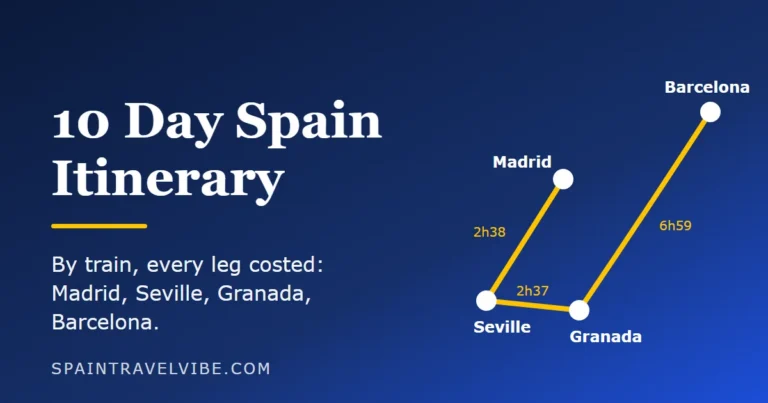
Here’s what’s actually happening on each route, what it costs to fly or drive instead, and how to decide which option is worth booking for your trip. For a worked example, my 10 day Spain itinerary prices every leg of the Madrid, Seville, Granada and Barcelona route.
Key Takeaways
- Spain has three competing high-speed rail operators: Renfe, Iryo, and Ouigo, all running Madrid’s radial routes at different prices (Railway Gazette, 2026).
- Madrid-Barcelona fares are rising again in 2025-2026 after two years of falling, while Madrid-Seville and Madrid-Valencia keep getting cheaper (Xataka, 2025).
- For any golden-triangle leg, book the cheapest available high-speed train 2-4 weeks ahead. It beats flying on door-to-door time and beats driving on cost.
- Renting a car only pays off once you leave the golden triangle for regions the high-speed network doesn’t reach.
Before you book any of these routes, it’s worth confirming you can actually cross Spain’s border in the first place: border rules changed for everyone in 2026, with fingerprint scans replacing passport stamps since April.
Getting Around Spain
How Do Spain’s Transportation Options Compare at a Glance?
Scanning for the short version? Here’s how the six main ways of getting around Spain stack up on the Madrid-Barcelona corridor, the busiest route in the country.
| Option | Typical one-way price | Journey time | Best for |
|---|---|---|---|
| Ouigo | From €19 | ~3h | Absolute cheapest advance fare |
| Iryo | From ~€21 | ~3h | Premium seating at a mid-range price |
| Renfe AVE | From €31.15 (Oct 16 sample), €94.90 full fare | ~3h | Most departures, easiest to book direct |
| Domestic flight | €30-50 | ~1h15m air time | Longer hauls beyond the golden triangle |
| Rental car | €35-70/day all-in | ~6 hours driving | Rural regions, not city-to-city hops |
| ALSA bus | From €5 | 7h20m-11h55m | Rock-bottom budget, time isn’t tight |
The rest of this guide walks through why those numbers look the way they do, route by route.
Why Does Spain Have Three High-Speed Rail Companies?
Getting around Spain wasn’t always this competitive. Spain became the first country in the European Union to fully liberalize its high-speed rail network in 2021, opening state-owned Renfe’s own AVE tracks to competitors for the first time. Iryo, backed by Italy’s Trenitalia and running Frecciarossa-style trains, launched in November 2022. Ouigo España, backed by France’s SNCF, had already launched in May 2021 (Railway Gazette International, March 2026).
The tracks themselves belong to Adif, Spain’s rail infrastructure administrator, a separate entity from Renfe. That separation is exactly what makes three-way competition possible: Iryo and Ouigo pay Adif for track access rather than leasing trains from Renfe. It’s an arrangement Iryo and Ouigo have publicly called unfair, arguing Spain’s dual-gauge network still favors Renfe’s older rolling stock on certain lines.
By 2024, that competition had genuinely reshaped the market. Iryo reached roughly 21% market share and Ouigo around 13%, cutting nearly 30 percentage points out of Renfe’s former monopoly position (Railway Gazette International, March 2026). No single guide currently tracks that shift alongside what it’s actually done to prices, which is the gap the rest of this post fills.
How Much Do Renfe, Iryo, and Ouigo Actually Cost by Route?
On Madrid-Barcelona, Ouigo’s own route page advertises fares from €19 per adult (€7 for children), Iryo’s start from around €21, and the cheapest Renfe seat on any direct train for Tuesday, November 10 was €31.15 when I checked renfe.com on October 16 (Ouigo España, 2026). All three cover the same 621 kilometers in about three hours since speed limits were imposed in February 2026; the fastest nonstop in Renfe’s November timetable takes 3h02. Renfe’s full flexible tourist fare, by contrast, runs €94.90, about five times Ouigo’s advertised floor for the identical seat-to-seat journey.
That gap holds up, roughly, across the other Madrid-radial routes too, though the cheapest operator changes route by route:
One honest caveat: this three-way competition isn’t universal. Barcelona-Valencia, for instance, is still largely Renfe and Euromed territory, with limited Iryo or Ouigo service as of this verification. Check your specific route before assuming all three operators serve it.
Madrid-Valencia is also the fastest of the bunch on paper. Renfe’s AVE and Avlo services cover roughly 300 kilometers in under 2 hours, genuinely competitive with driving even before you factor in city-center-to-city-center convenience.
Is the Renfe/Iryo/Ouigo Price War Over?
On Madrid-Barcelona specifically, no, it’s reversing. In Q2 2025, average one-way fares climbed to €63.14, up from roughly €40 in early 2024 (Xataka, 2025). Broken down by operator, year-over-year fares rose 18.7% for Ouigo, 14.5% for Renfe’s Avlo, 22.5% for Iryo, and 13.1% for Renfe’s full AVE service.
That reversal hasn’t reached most existing coverage of Spain’s rail competition, which still frames this purely as an ongoing price war. It’s more accurate to say the price war ended on the golden triangle’s flagship route while it kept going everywhere else. In the same Q2 2025 window, Madrid-Seville fares fell 8.6% year-over-year, Madrid-Valencia fell 8.3%, and Madrid-Alicante fell 8.7% (Xataka, 2025).
None of this has slowed ridership down. High-speed rail travel across Spain is up 77.2% since 2019, an additional 17.2 million annual passengers (Railway Gazette International, October 2025). Roughly 40 million total high-speed trips ran in 2024 alone. Whether that growth survives Madrid-Barcelona’s price rebound is the thing worth watching over the next year or two.
Worth noting too: competition hasn’t been free for the operators either. Spain’s National Commission on Markets and Competition (CNMC) found liberalization added a net €578 million in economic benefit in 2023 alone (CNMC liberalization report, via Mediarail, 2024). That came even as Renfe’s own combined AVE and Avlo market share fell to roughly 66%, down from near-total dominance just a few years earlier.
Lower fares haven’t come without a trade-off, either. Spanish tech and economics commentator Enrique Dans has argued that liberalization has coincided with declining reliability on the network (Enrique Dans, Medium, July 2025). More delays, equipment failures, and even copper-theft incidents have eroded trust the old Renfe monopoly took decades to build. Cheaper tickets are the headline. Whether the trains still run on time as reliably as they used to is the quieter question that gets less coverage.
Should You Fly Instead? Domestic Flights Compared
Flying is one more way of getting around Spain worth pricing out. Budget carriers like Vueling and Ryanair typically price a Madrid-Barcelona one-way flight around €30-50 (Vueling, fares checked July 2026). That can undercut Renfe’s full AVE fare, but it rarely beats Iryo’s or Ouigo’s advance prices. Once you count airport transfers on both ends, the total door-to-door time usually lands close to the train’s 2-hour-30-minute city-center-to-city-center run anyway.
That’s the trap first-time planners fall into: comparing a €35 flight fare against a €95 train fare and assuming flying wins outright. It doesn’t, once you add the hour getting to and from each airport, security, and boarding buffer. Air time on Madrid-Barcelona runs about 1 hour 15 minutes, but total travel time from hotel to hotel rarely beats the train by much, if at all.
Where flying does make sense: hops that trains can’t realistically cover, like Madrid to the Canary Islands, or when your itinerary skips the golden triangle entirely for a single distant city. That extra flight time is also what separates the two island groups, as my comparison of Mallorca and the Canaries sets out. For anything inside the Madrid-Barcelona-Seville-Valencia core, flying is rarely the smart default.
Isn’t it a little strange that the fastest-sounding option often isn’t the fastest one door to door? That’s the whole case for checking total travel time, not just the number on the ticket, before booking.
Is Renting a Car Worth It in Spain?
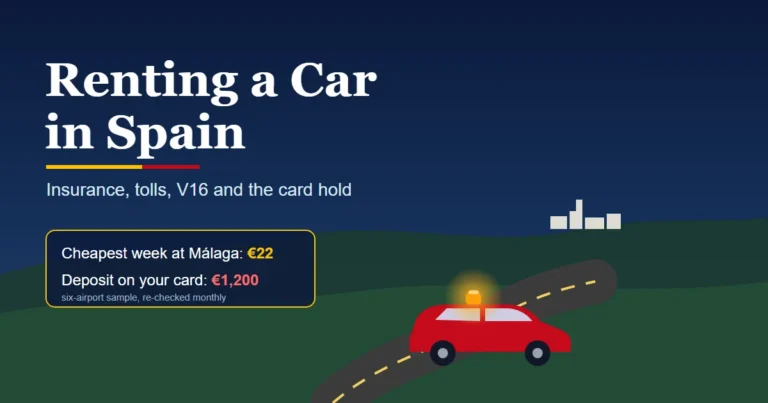
Renting a car is rarely the fastest way between big cities, but it costs less than most people expect. My own sample of 10,715 offers on October 19, 2026 put the median week in a small manual car at €129 to €200 at six airports for a November pickup, and €260 to €437 over Christmas. Full excess cover added a median €48 to €122 a week. My guide to renting a car in Spain breaks down the deposits and card holds behind those prices.
Tolls are lighter than they used to be. Spain’s 2020-2021 reforms converted several former toll motorways into free autovías. The AP-7 corridor north of Valencia, including the stretch up to the French border, now runs toll-free for most of its length. Driving Madrid to Barcelona is now toll-free, since the AP-2 and the AP-7 north of Tarragona stopped charging on September 1, 2021 (La Moncloa, 2021). A Via T electronic transponder shaves off queuing at booths and is worth it for any multi-day driving itinerary. Also budget for city low-emission-zone (ZBE) restrictions, which increasingly fine or block older rental vehicles from entering central Madrid and Barcelona without the right sticker.
Here’s where the math actually flips in the car’s favor: the golden triangle almost never justifies a rental, but the regions between and beyond it do. Basque Country’s coastal towns, Andalusia’s white villages, and the Rioja and Ribera del Duero wine regions all sit thin on rail service and thick on places worth a slow, unscheduled detour. That’s a driving trip, not a train trip.
Quote-shop rather than trust any single “average” daily rate. The spread between low-season and peak-August pricing is wide enough that booking two weeks apart can change your total by 50% or more.
What About the Bus? ALSA and the Budget Option
The bus is the cheapest way of getting around Spain: ALSA’s Madrid-Barcelona coaches start around €5 one-way, with more than 40 daily departures (ALSA, 2026). Journey times range from 7 hours 20 minutes on direct services to nearly 12 hours on routes with multiple stops. That’s roughly 15 to 20 times cheaper than a full-fare AVE ticket on the same corridor, in exchange for three to five times the travel time.
ALSA also runs frequent Barcelona-Seville and Seville-Barcelona services, both with 7 or more daily departures, making the bus a genuine option for longer golden-triangle hops, not just the Madrid-Barcelona shuttle route. It suits backpackers, overnight travelers who’d rather sleep through the ride than pay for a hotel night, and anyone for whom €80 saved matters more than 5 extra hours spent.
Train vs Flight vs Car vs Bus: Which Should You Actually Book?
When it comes to getting around Spain on any golden-triangle leg, Madrid-Barcelona, Madrid-Seville, or Madrid-Valencia, book the cheapest available high-speed train 2-4 weeks out. It beats flying on door-to-door time and beats driving on both cost and stress, with the bus as a fallback only when your budget matters more than your schedule.
Who should book what:
- First-time golden-triangle travelers (Madrid, Barcelona, Seville in one trip): book the train, always. Compare all three operators before choosing; the cheapest one changes route by route.
- Rural and slow travelers heading to the Basque Country, Andalusia’s white villages, or wine country: rent a car. That’s where trains stop being an option at all.
- Solo budget travelers with more time than money: take the ALSA bus for at least one long leg and put the savings toward accommodation.
- Anyone headed to the islands or a single distant city: flying is the only realistic option, and the golden-triangle logic above doesn’t apply.
How Far in Advance Should You Book Spanish Train Tickets?
Booking windows on Spain’s high-speed network vary by route and can open anywhere from 15 days to 11 months before travel, with competitive golden-triangle routes typically opening furthest out (Seat61, 2026). An empty-looking search result on a given day doesn’t mean a train has been cancelled. It usually just hasn’t gone on sale yet. And since all of this booking happens on your phone mid-trip, staying connected on Spanish trains and road trips is worth sorting before you leave.
Practically, 2-4 weeks ahead of travel balances availability against price for the busiest corridors. Book earlier around Semana Santa or other major holidays, when demand spikes across every operator at once. Comparison sites like Trainline or Omio let you check all three operators side by side in one search. Direct booking on each operator’s own site, though, sometimes surfaces promotional fares the aggregators miss.
Frequently Asked Questions
Which is cheapest: Renfe, Iryo, or Ouigo?
Ouigo is usually cheapest on advance fares, with tickets advertised from €19 on Madrid-Barcelona and from €9 on other routes (Ouigo España, 2026). Iryo tends to sit in the middle, and Renfe’s full flexible fare is the most expensive at €94.90 on the same route. All three run daily promotions, so the actual cheapest option can flip route by route.
Is the train cheaper than flying in Spain?
Usually, yes, on advance high-speed fares, and total door-to-door time is often similar once you count airport transfers on both ends. Budget flights around €30-50 can occasionally undercut Renfe’s full AVE fare, but they rarely beat Ouigo’s or Iryo’s advance prices.
Is it worth renting a car for a Spain trip?
Not for golden-triangle city-to-city travel, where trains are both faster and cheaper. Yes for rural regions like Basque Country, Green Spain, Andalusia’s white villages, and wine country, where high-speed rail simply doesn’t reach.
How far ahead should I book Spanish train tickets?
Booking windows open anywhere from 15 days to 11 months before travel depending on the route, with popular corridors opening furthest out (Seat61, 2026). Two to four weeks ahead typically balances availability and price for most golden-triangle routes.
Do Iryo and Ouigo cover the same routes as Renfe?
Mostly, on Madrid’s radial corridors to Barcelona, Seville, and Valencia, but coverage isn’t universal. Barcelona-Valencia, for example, is still largely Renfe and Euromed territory as of this post’s verification, so always check your specific route before assuming three-way competition applies.
Getting Around Spain in 2026: The Bottom Line
There’s no single right answer to getting around Spain, only the right answer for your specific route and trip style.
- Three rail operators now compete on Madrid’s radial routes, and the cheapest one changes route by route.
- Madrid-Barcelona prices are climbing again while Seville, Valencia, and Alicante corridors keep getting cheaper.
- Trains beat flying and driving for any golden-triangle leg, on both cost and total door-to-door time.
- Cars and buses both have a real place outside that corridor: cars for regions trains don’t reach, buses for travelers on a tight budget.
I re-verify every fare and route claim in this guide monthly, in step with how fast Spain’s rail competition keeps shifting. This post is part of my complete Spain travel planning guide, alongside the border-rules guide and tourist-tax breakdown. Once you know how you’re getting between cities, the next question is how many days to spend in each one, and how these transport costs factor into your full Spain trip cost breakdown. The same network runs the short hops out of the capital too, ranked by how many trains actually run in my guide to day trips from Madrid.
Fares shift monthly on this network. Subscribe and we’ll send the update the moment a route’s pricing changes.