

Last verified: August 20, 2026. Restaurant prices, hotel rates, the incoming Basque tourist tax and transport fares on this page are checked monthly against official sources (Michelin, INE, AEMET, Diputación Foral de Gipuzkoa, Mugi, and the restaurants’ own booking pages), and the date above is updated each time.
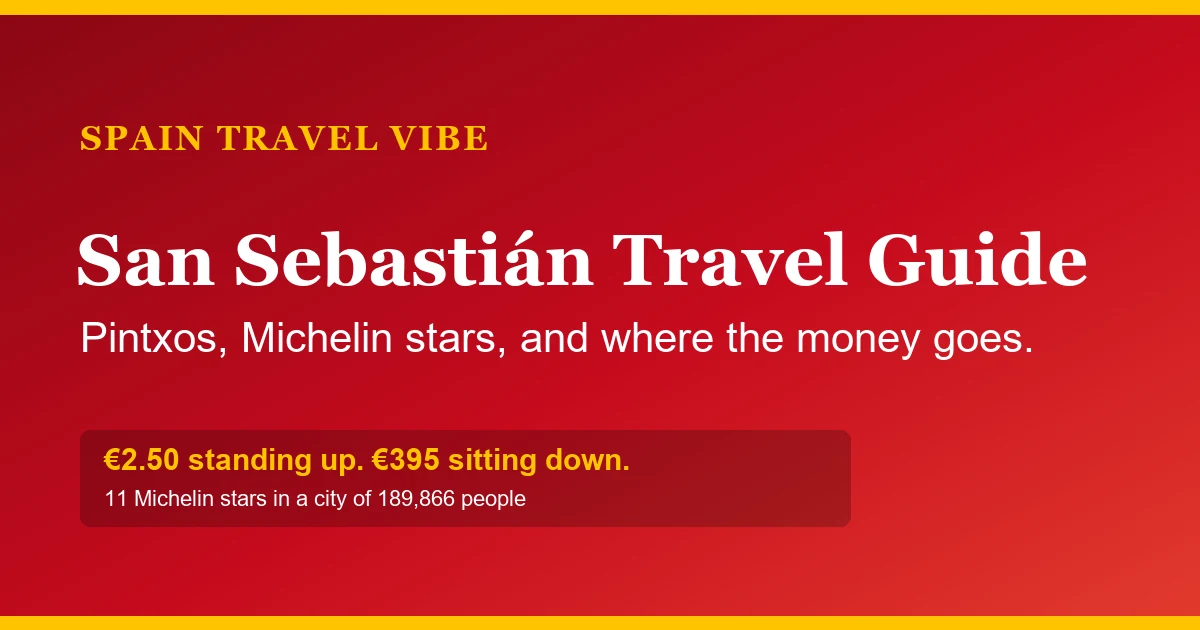
In San Sebastián the same cooking tradition costs €2.50 standing up and €395 sitting down.
That is a 158-fold spread inside a city of 189,866 people (INE, 2025), and both ends of it are genuinely excellent. Only one will surprise your bank.
Disclosure: Some links in this guide may earn us a commission, at no extra cost to you. It never changes what we recommend.
The expensive part of this city, though, is not the food.
One thing to say plainly before I start: nobody here has eaten their way through these bars on your behalf. Every price below is read from an official page or a restaurant’s own site, dated, and re-checked monthly. Where I could not confirm something, I say so instead of guessing.
Every guide calls San Sebastián, or Donostia in Basque, an expensive destination without saying which part. This San Sebastian travel guide answers that with numbers, explains how a pintxo bar actually works, and corrects two things the internet has confidently wrong.
Key Takeaways
- The same tradition runs from a €2.50 pintxo to a €395 tasting menu, a 158-fold spread in one small city.
- The bed is what costs. Donostia hotels averaged €224.51 a night in June 2026, above Barcelona (€214.34) and Madrid (€186.17).
- You pay at a pintxo bar when you leave, not per item. The bar keeps a tally and nobody takes a reservation.
- The city holds 6 starred restaurants and 11 Michelin stars. The “most stars per capita in the world” line you have read is wrong: Kyoto is ahead.
- A Basque tourist tax is now law but nobody pays it until 1 January 2027.
- From Bilbao airport the coach takes about an hour and a quarter, and the €17 fare most guides still quote was replaced in 2024.
Before picking a region, it helps to see the shape of the country: my guide to where to go in Spain, region by region, places the Basque Country against the other sixteen. The rest of this San Sebastián travel guide works through the mechanics, the money and the region, in that order.
Table of Contents
How Do You Order and Pay at a Pintxo Bar?
You take cold pintxos straight off the counter, order the hot ones from the bartender, and settle up once when you leave. There is no booking step and no per-item payment. The official city description of a pintxo crawl contains no reservation stage at all (San Sebastián Turismo).
That single fact explains most of the etiquette.
Cold pintxos sit out on the bar in rows. You take a plate, help yourself, and the staff keep count. Hot ones are different: they are listed on a chalkboard behind the bar, cooked to order, and you ask for them. Missing the chalkboard is the most common way visitors eat only the mediocre half of a bar’s menu.
The tally works on trust.
Plates and toothpicks pile up in front of you, the bartender keeps track, and you settle in one go on the way out. Nobody expects you to flag down a bill after each bite, and trying to will mark you out faster than anything else you could do at the bar. If you are worried about losing count, the honest answer is that the staff rarely do, and the bill at the end is almost always lower than a first-time visitor expects it to be.
The convention is one drink and one pintxo per bar, then move on. That bar-hop has a name, txikiteo, and it is why this city has no equivalent of a long sit-down tapas evening. Four bars in two hours is normal. Settling into one for the night marks you out immediately. It is also a low-stress way to eat alone, which is part of why this city reads as one of Spain’s gentler ones for solo travellers, as my safety guide notes.
A few words help. A zurito is a small beer, a txikito a small glass of wine, and a pote a drink generally. Groups here tend to rotate rounds or run a kitty rather than each person paying for their own.
One thing to be clear about: pintxos are not tapas. Nothing arrives free with the drink, everything is priced individually, and the mechanics above are specific to the Basque Country. My guide to how a Spanish tapas crawl actually works covers the southern version, which runs by different rules entirely.
How Many Michelin Stars Does San Sebastián Really Have?
The city holds 6 starred restaurants and 11 stars among its 189,866 residents. The wider province of Gipuzkoa, including those six, holds 11 restaurants and 19 stars (San Sebastián Turismo, 2026; itemised in Guía Michelin 2026 via Bon Viveur, 2026).
Inside the city: Arzak and Akelarre hold three stars each, Amelia by Paulo Airaudo holds two, and iBAi, Kokotxa and Itzuli hold one apiece. Itzuli is the newest, up on Monte Igeldo, which the funicular reaches for €5.50 return (Monte Igueldo, 2026).
Beyond the city limits but within easy reach: Martín Berasategui holds three stars in Lasarte-Oria, Mugaritz two in Errenteria, and Elkano, Alameda and Ama one each in Getaria, Hondarribia and Tolosa. My region-by-region Spanish food guide covers what to eat where across the country.
Now the correction. You will read almost everywhere that San Sebastián has the most Michelin stars per capita in the world. It does not, and the arithmetic is not close.
The cousin of that claim, that it leads on stars per square metre, is not wrong so much as unfalsifiable. Nobody publishing it names a methodology, a dataset or a source, so there is nothing to check.
Kyoto’s 2026 guide lists 98 starred restaurants holding 129 stars (Japan Times, 2026). Across a city of roughly 1.5 million people that lands somewhere between 8 and 9 stars per 100,000, against San Sebastián’s 5.79. The exact rate moves with whichever population figure you use, and every one of them puts Kyoto ahead.
Even San Sebastián’s own tourist board stops short of the claim its visitors repeat, conceding that Kyoto has the greater concentration (San Sebastián Turismo).
The defensible version is better anyway, and more useful. Three of Spain’s sixteen three-star restaurants sit in San Sebastián and the towns immediately around it, and the tourist board counts 19 stars inside a 25-kilometre radius of the city hall (San Sebastián Turismo, 2026). For a city this size that is genuinely rare, and it is a fact you can check.
What Does Eating Here Actually Cost?
Between €2.50 and €395, from the same tradition. A pintxo-pote in the Amara Viejo district, meaning a pintxo plus a drink, runs €2.50, rising to €3.50 in Gros (San Sebastián Turismo). Akelarre’s tasting menus are €395 (Akelarre, verified August 2026).
At the top end the numbers sit close together. Arzak’s tasting menu is €315 a head and à la carte runs about €285. A paired option is listed separately at €365 for the menu plus €220 for the wines, served only for a whole table (Arzak, verified August 2026). Mugaritz charges €319 per person for its 2026 season (Mugaritz, verified August 2026). All three exclude drinks unless you add the pairing.
One honest note on those figures. Akelarre’s own menu page says the price rises every year just before summer. I have dated it deliberately rather than presenting it as permanent, and it gets re-checked monthly.
The pintxo-pote prices deserve a caveat too. They are a promotional deal on set nights, not the standard counter price, which varies too much between bars for anyone to state an average honestly.
For how a few days here fits a wider budget, my 2026 Spain trip cost breakdown puts these numbers in national context.
Do You Need to Book the Starred Restaurants?
Yes for the starred rooms, and no for anything else. But the booking model at the two restaurants whose pages I read is not the one most guides describe.
The common advice is that these restaurants open reservations on fixed release dates, months ahead, and you must be at the keyboard when they drop. Arzak’s own site describes something different: a rolling request form, answered by email within a maximum of three days, requiring at least 72 hours’ notice, with the phone for anything inside that window. Cancel inside 48 hours and you are charged €315 per guest. It is also closed from 1 to 25 November 2026 (Arzak, 2026).
Mugaritz works by season rather than by release date, and takes a €145 per-diner deposit at booking. That deposit comes off the final bill, is non-refundable if you do not show, and party-size changes need 48 hours’ notice (Mugaritz, 2026).
| Restaurant | Stars | Where | Menu | How you book |
|---|---|---|---|---|
| Arzak | ★★★ | Donostia | €315 tasting, about €285 à la carte | Rolling request form, answered within three days, 72 hours’ minimum notice |
| Akelarre | ★★★ | Donostia, Monte Igeldo | €395 | Direct; the price rises each year just before summer |
| Mugaritz | ★★ | Errenteria | €319, 2026 season | €145 per-person deposit, deducted from the bill, forfeited on a no-show |
Read from each restaurant’s own booking page in August 2026. Cancelling at Arzak inside 48 hours is charged at €315 per guest.
So book early, but book by asking rather than by racing a countdown.
The inverse holds for everything else. Pintxo bars take no reservations at all, which is not an oversight but the whole design. You stand, you eat one thing, you leave. A city that runs on bar-hopping cannot also run on tables held in your name.
Why Is San Sebastián So Expensive to Sleep In?
Because it is small, its peak is short, and demand is concentrated. Donostia hotels averaged €224.51 a night in June 2026, ahead of Barcelona at €214.34 and Madrid at €186.17, and 64% above the €137.11 national average (INE, published July 2026).
That is the number that should shape your budget, and it is the reason this San Sebastian travel guide leads with money rather than sights. Valencia makes the same argument on the Mediterranean coast, for the opposite reason: there the beds are the bargain. A traveller who plans for expensive food and cheap beds has it exactly backwards.
The province softens it a little. Gipuzkoa as a whole averaged €175.49 and the Basque Country €143.63 (INE, 2026), so staying in Hondarribia or Zarautz and travelling in is a real lever if the room rate is the binding constraint. Hondarribia even has a parador, one of Spain’s state-run hotels, inside its old castle.
One change is coming. A Basque tourist tax became law as Norma Foral 3/2026 in June 2026, and applies from 1 January 2027 (Diputación Foral de Gipuzkoa, 2026). San Sebastián’s own top rate was approved in principle in July 2026 at €6.50 a night, capped at the first six nights, with lower bands for smaller hotels and agroturismo (EFE via Infobae, July 2026). The full council approved the ordinance in an initial, unanimous vote on 24 September 2026, without the 50% surcharge the law allows (Noticias de Gipuzkoa, September 2026). Nobody is paying anything yet. My city-by-city tourist tax guide tracks where every Spanish region stands.
My barrio-by-barrio guide to where to stay in San Sebastián compares seven areas and three coast towns, and shows which of them are mostly pensiones or flats.
Where Should You Go Beyond the City?
A good San Sebastián travel guide has to cover the region, because the city is small enough that the region is the trip. Getaria for grilled turbot, Zarautz for the beach, Hondarribia for a walled old town, Bilbao for the Guggenheim, and Rioja Alavesa for wine with one caveat. San Sebastián is small enough that the region is the trip, not an extension of it.
| Where | Distance | Time | Getting there | What it is for |
|---|---|---|---|---|
| Getaria | 25 km | about 58 min | Lurraldebus UK09/UK10/UK11, roughly every 30 min | Whole turbot grilled over coals, txakoli, Elkano ★ |
| Zarautz | about 22 km | about 30 min | Euskotren or Lurraldebus | The longest beach in Gipuzkoa, surf, and a 4.5 km walk on to Getaria |
| Hondarribia | about 20 km | about 30 min | Lurraldebus | Walled old town, Calle San Pedro pintxos, Alameda ★, and the airport |
| Bilbao | about 100 km | roughly an hour on the AP-8 | Coach, or the slow scenic Euskotren line | The Guggenheim and the Casco Viejo |
| Rioja Alavesa | about 145 km | roughly an hour and three quarters | Car or an organised tour | Wine country, with the caveat below |
Only Getaria’s distance is confirmed by an official tourism body (Getaria Turismoa, 2026). The rest are approximate and rounded deliberately.
My roundup of Galicia, Asturias and Cantabria, the other Atlantic communities, covers the coast west of here, where a hotel room costs roughly half what it does in Donostia. That same coastline is the Camino del Norte’s road out of the city; my comparison of the main Camino de Santiago routes covers who it suits. Getaria, though, is the one to prioritise if you came for the food. It sits 25 kilometres west, reachable by Lurraldebus lines UK09, UK10 and UK11 roughly every half hour in about 58 minutes (Getaria Turismoa, 2026). Whole turbot grilled over coals in the street is the local speciality, and Elkano holds a star for doing it.
Bilbao is the other anchor. The Guggenheim drew 1,305,003 visitors in 2025, up marginally on the previous year, with 69% arriving from outside Spain (Guggenheim Bilbao, 2026).
Rioja Alavesa needs an honest warning that guides skip. It is close enough to reach and the wine region itself is compact, but it is roughly an hour and a half each way by car, and a winery day built around tasting is a poor fit for a self-drive round trip. Take a tour or stay the night.
When Should You Visit San Sebastián?
June and September, with September carrying a caveat. Every San Sebastián travel guide tells you it rains here. Few of them say which weather station they got that from. The city is on the Atlantic, so it does not do the dry Mediterranean summer, and the numbers depend entirely on which weather station you quote.
Two different AEMET stations are both called San Sebastián, and they do not agree.
Igeldo sits at 250 metres on a hilltop inside the city. It gives an August mean daily maximum of 22.5°C on the 1981-2010 series, with 117mm of rain in that month alone (AEMET, station 1024E). The second station is not even in the city: it sits at the airport in Hondarribia, twenty kilometres east, at sea level. It is generally reported warmer, though AEMET’s own table for it returned no figures when I checked, so I’m not quoting one.
General climate references land nearer 23°C. Which number you see depends entirely on whose station someone used, and almost nobody says which.
Two dates to plan around. The San Sebastián International Film Festival runs 18 to 26 September 2026 (San Sebastián Festival, 2026), which fills the city and lifts rates. Aste Nagusia, the August fiesta week, brings hundreds of events and an international fireworks competition (Basque Government, 2026).
And if you want the city at its strangest, come on 20 January for La Tamborrada. A flag goes up at midnight in the Plaza de la Constitución and the whole city drums for twenty-four hours, with more than 150 companies taking part (Turismo Euskadi, 2026).
My region-by-region month guide covers how the Atlantic coast differs from the rest of Spain, and my packing guide explains why this corner needs a waterproof in August.
Getting to San Sebastián from Bilbao Airport
Most people fly into Bilbao and take the bus, which is far cheaper than the internet thinks. The coach runs on Lurraldebus line DO04, roughly hourly according to Aena (Aena, 2026), and takes about an hour and a quarter (Basque Government, 2026).
What it costs is where the guides go wrong. Most still quote €17, a fare that stopped applying in March 2024 when the route joined the regional Mugi card system (Mugi, 2024). Gipuzkoa then restructured its tariffs again for 2026 (Diario Euskadi, 2025). Two changes in two years, and no official route page I could reach names a current figure. So I’m not printing one. Carry a Mugi card if you can, and check lurraldebus.eus before you travel.
San Sebastián does have its own airport, though it is a small one and it is not in San Sebastián. EAS sits at Hondarribia about twenty kilometres east, serving nine destinations on five airlines: Madrid, Barcelona, London City, Glasgow, Málaga, Menorca, Palma, Gran Canaria and Tenerife Norte (Aena, 2026).
Once here you will not need a car for the city, which is compact and walkable. You will want one for the region, or a willingness to work with Lurraldebus and Euskotren. Two weeks is the point at which the Basque Country becomes a realistic second region rather than a rushed detour, as my itinerary-length guide sets out. My comparison of Spain’s rail and road options covers where a rental starts to pay in the Basque Country.
Five Mistakes First-Timers Make in San Sebastián
These five come up more than any others, and heading them off is most of what this San Sebastián travel guide is for.
- Sitting down. Pintxo bars are standing rooms, and taking a table often means table service at a different price.
- Paying per item. You settle once, on the way out.
- Treating pintxos as tapas. Nothing arrives free with the drink, everything is priced individually, and a bar that would give you a free plate in Granada will simply charge you here. The two traditions share a country and almost nothing else.
- Budgeting for the food and not the bed. The plate is a bargain. The room outprices Barcelona.
- Repeating the per-capita Michelin line. Kyoto beats it.
Frequently Asked Questions
How do you pay at a pintxo bar in San Sebastián?
You pay once, when you leave, not per item. Cold pintxos are taken from the counter and hot ones ordered from the chalkboard, while the bar keeps a running tally on trust. No pintxo bar takes reservations.
How many Michelin stars does San Sebastián have?
Six starred restaurants and 11 stars inside the city, across 189,866 residents. The wider province of Gipuzkoa holds 11 restaurants and 19 stars in total, the city’s six included, among them Martín Berasategui’s three in Lasarte-Oria.
Is San Sebastián expensive?
For beds, yes. Donostia hotels averaged €224.51 a night in June 2026, more than Barcelona or Madrid (INE, 2026). For food, not necessarily: a pintxo and a drink can cost €2.50.
Does the Basque Country charge a tourist tax?
Not yet. The foral law passed in June 2026 and applies from 1 January 2027. San Sebastián’s own rate is provisionally set at €6.50 a night for top-band hotels and tourist flats, capped at six nights, approved by the full council in an initial vote on 24 September 2026. My tourist tax guide covers the rest of Spain.
How do you get from Bilbao airport to San Sebastián?
By coach on Lurraldebus line DO04, in about an hour and a quarter. Ignore the €17 fare older guides quote: it stopped applying in March 2024 when the route joined the Mugi card system, and Gipuzkoa revised its tariffs again for 2026.
San Sebastián Travel Guide: Where the Money Actually Goes
Budget for the bed and stand up to eat. If you take one thing from this San Sebastian travel guide, take that reversal; it will do more for a trip here than any restaurant list.
The food at the cheap end is genuinely world class, the food at the expensive end is worth planning months around, and the gap between them is 158-fold in a city you can walk across. The room is the line item that will surprise you.
Two of the things you have read about this city are wrong, and both are checkable: the per-capita star claim, and the fixed-release booking model. I have shown the working on each.
Prices, the incoming tax and the Michelin list all move, and the Michelin guide is reissued each November, which is why this page carries a verification date and gets re-checked monthly. Want to know when Spanish prices, taxes or rules change before your trip? Join the free Spain rules and updates list.
If you are building a wider route, my guide to where to go in Spain shows where the Basque Country sits among the seventeen regions, and the Barcelona, Madrid, Seville and Granada guides cover the cities most people pair it with.