

Last verified: August 19, 2026. Regional arrival figures come from INE’s annual FRONTUR release and move once a year. Tourist taxes, heat alerts and visitor rules move continuously, and I re-check those monthly against official sources alongside my tourist-tax and best-time guides.
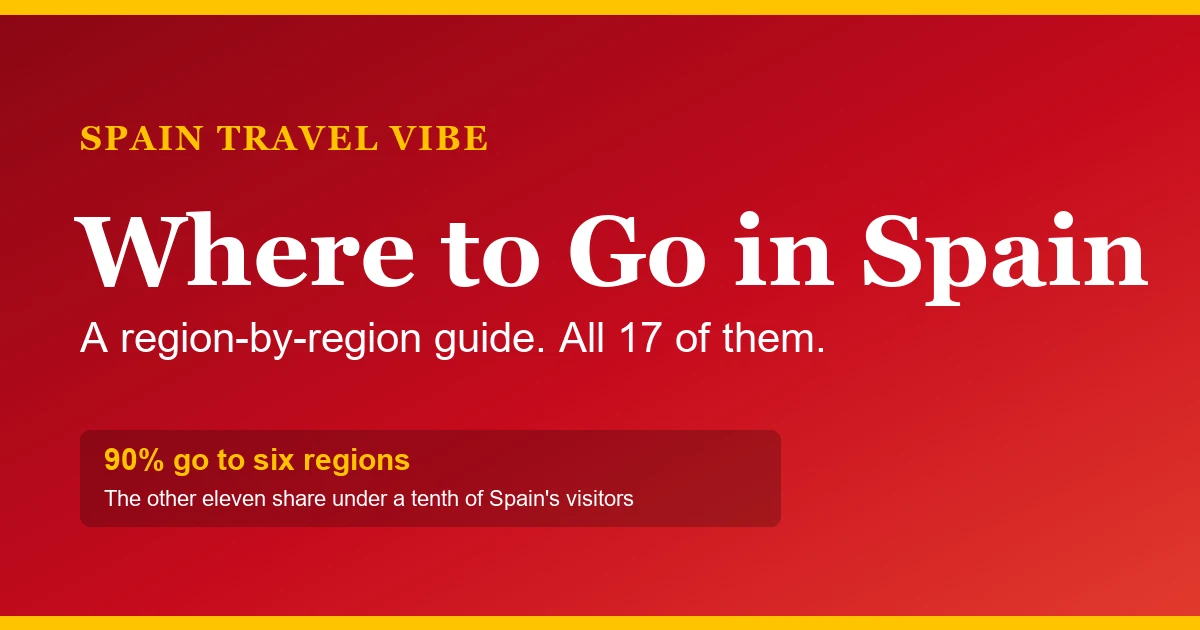
Spain has seventeen autonomous communities. In 2025, roughly nine in ten of its record 96.8 million international visitors went to six of them (INE, 2026).
Catalonia alone took 20.0 million. Extremadura, Aragón, Cantabria and eight other regions split what was left.
Disclosure: Some links in this guide may earn us a commission, at no extra cost to you. It never changes what we recommend.
That imbalance is the most useful thing to know before you pick where to go in Spain. It explains almost everything else: which places have queues and ticket lotteries, which ones have added a tourist tax, which ones had protests this summer, and which ones are still quietly excellent.
So the honest answer to where to go in Spain depends on which of those seventeen you pick. This guide covers all of them, grouped the way the country actually works rather than as a ranked list of cities.
Key Takeaways
- Six regions absorb about 90% of Spain’s international visitors; the other eleven share under 10% (INE, 2026).
- Per resident, the Balearic Islands host 12.6 international tourists a year against a national average of 2.0, while Castilla-La Mancha hosts 0.11, a spread of more than a hundredfold across one country (my calculation from INE arrival and census data).
- Pick two regions for ten days, and stay put.
- The month decides the region. Interior Spain and the Mediterranean coast sat under AEMET alerts for 42-44°C this summer, while the Canaries run winter as their peak season.
- Barcelona charges up to €12 per person per night in tourist tax. Madrid, Valencia and all of Andalusia charge nothing.
- Quiet comes at a price: less English, fewer trains, thinner public transport.
Before you narrow down regions, it’s worth having the basics settled first: my complete Spain travel guide covers entry rules, budgets and timing for a first trip.
Table of Contents
How Is Spain Organized?
Spain is not one country’s worth of travel. It’s seventeen autonomous communities, plus two autonomous cities on the North African coast, Ceuta and Melilla. Each has its own regional government, and several have their own official language. What that means for how people eat, pray, speak and celebrate is the subject of my guide to understanding Spanish culture. Between them they hold 50 UNESCO World Heritage sites, the fifth-highest count of any country (UNESCO, 2025).
This matters more practically than it sounds. Tourist taxes are set at the regional and municipal level, not nationally, which is why Barcelona charges €12 a night and Seville charges nothing. Low-emission driving zones, school-holiday calendars and even shop opening rules vary the same way.
It also shapes good routes. Neighbouring regions combine cheaply and quickly; distant ones don’t. A trip built as “Seville, Córdoba, Granada” is one region and short drives. A trip built as “Barcelona, Seville, San Sebastián” is three corners of a large country, and you’ll spend a day of it moving.
Those heritage sites are spread across nearly every one of the seventeen regions, which is the real argument against treating any single city as the trip. Work out where to go in Spain at the regional level first, and the cities sort themselves out.
Six regions have a co-official language alongside Castilian Spanish: Catalonia, the Valencian Community, the Balearic Islands, Galicia, the Basque Country and the Basque-speaking north of Navarre. You’ll see it on street signs and menus before you hear it. My guide to the languages spoken in Spain explains each one, and my guide to how far English gets you in Spain covers the practical version.
Where Does Everyone Actually Go?
Six regions absorb about 90% of Spain’s international visitors. Catalonia took 20.0 million in 2025, the Balearics and the Canaries 15.7 million each, Andalusia 14.4 million, the Valencian Community 12.4 million and Madrid 9.1 million (INE, 2026). Those six come to 87.4 million of Spain’s 96.8 million total, leaving 9.3 million for the other eleven communities and roughly 87,000 for the autonomous cities of Ceuta and Melilla.
No competing guide to where to go in Spain puts that distribution in front of you, so here it is in one chart:
The pattern isn’t softening. Spain logged 36.8 million arrivals from January to May 2026, up 5.0% year on year, and June set a monthly record at 9.7 million (INE via The Corner, 2026). Foreign visitors spent €134.7 billion across the country in 2025, up 6.8% (Ministerio de Industria y Turismo, 2026).
Does that mean the popular six are overrated? No, and this guide isn’t going to pretend otherwise. They’re popular because the Alhambra, the Sagrada Família and the Prado are genuinely worth the trip. But the concentration is why those places now need booking months ahead, and why the cost of a bed climbs fastest exactly where the numbers are highest. My 2026 Spain budget breakdown has the regional price gaps in full.
Where to Go in Spain by Trip Length and Season
Two things narrow the field faster than anything else: how many days you have, and which month you’re travelling. Trip length is the harder constraint, because Spain is bigger than it looks on a map. Madrid to Seville is two and a half hours on the fast train, and that’s the easy direction; Barcelona to Santiago de Compostela is most of a day however you do it.
When you’re deciding where to go in Spain, pick regions first and cities second.
Most bad Spain itineraries come from choosing four famous cities off a list and only afterwards discovering how far apart they sit. The order in which you make those two decisions matters more than which cities you land on.
| Days | High season (Jun-Sep) | Shoulder and winter |
|---|---|---|
| 5-7 | One region. Andalusia, or Madrid with its day trips | One region. Andalusia or Catalonia |
| 8-10 | Two neighbouring regions, e.g. Madrid + Andalusia | Two regions, e.g. Catalonia + Madrid |
| 14+ | Two regions plus the north, or add an island | Three regions comfortably |
| Repeat visit | Basque Country, Green Spain, the quiet eleven | Canaries, Extremadura, inland Andalusia |
Two more variables sit underneath that table. What you’re actually there for pushes you toward specific regions regardless of dates: Andalusia and Castilla y León for history and monuments, the Basque Country and Galicia for food, Catalonia and the Canaries for coastline, Aragón and Asturias for mountains. And your tolerance for crowds decides whether you take the famous version of each of those or the quiet one, which is what the rest of this guide is really about.
Three nights per base is the working floor. Below that you spend the trip checking in and out, a point my itinerary-length guide works through city by city.
Spain makes this easier than most of Europe, at least between the big cities. It runs the largest high-speed rail network in Europe, nearly 4,000 km of dedicated track (Adif, 2026). Only China’s is larger, and three operators compete on the main routes. The catch is that the network is built around Madrid. Regions connect brilliantly to the capital and often poorly to each other, which my comparison of Spain’s rail operators covers route by route.
The variable most guides ignore entirely is the month, and in Spain it doesn’t just shift the weather, it changes the answer. Interior Spain and the Mediterranean coast were under AEMET alerts for 42-44°C repeatedly through July and August 2026. The Costa Blanca drew red warnings for 44°C (AEMET warnings, reported via the Olive Press, August 2026, and Euronews, July 2026). In the same weeks, the Atlantic north stayed in the low twenties.
Look at what the normals do rather than the headlines. In August these six regions spread across thirteen degrees, from Seville’s 36.2°C average daily maximum down to A Coruña’s 23.1°C. In January the spread narrows to eleven degrees and the ends of the table trade places: Gran Canaria leads at 21.1°C, while Madrid, comfortably warm in August, drops to 10.0°C and finishes last (AEMET, 1991-2020 normals).
So the honest answer to “where should I go in Spain” changes completely depending on when you’re asking. In August, the north and the islands. In January, the Canaries or a mainland city break. In May and October, essentially anywhere, which is why those two months come out on top in my region-by-region month guide.
Catalonia: Is Barcelona Worth the Crowds?
Catalonia is Spain’s most-visited region by a wide margin, with 20.0 million international visitors in 2025 (INE, 2026). It’s also the most expensive place in the country to sleep. Barcelona has charged up to €12 per person per night in tourist tax at five-star hotels since April 2026, the highest confirmed rate in Spain (idealista, 2026).
If you only have one week and want a single answer to where to go in Spain, this is it. Catalonia suits anyone who wants Gaudí, a Gothic quarter and a city beach in one place, and for anyone flying long-haul, since Barcelona is Spain’s best-connected international gateway. For a short first trip, it remains the easiest single answer in the country.
The direction of travel on cost is worth knowing before you book. The municipal surcharge is scheduled to rise €1 a year through 2029, and Catalonia has approved a levy of up to €30 on cruise passengers stopping for under twelve hours (The Local, 2026). None of that is aimed at ordinary visitors, but it tells you which way the region is leaning.
What most people miss is that Catalonia is much larger than its capital. Girona is an hour away by train, the Costa Brava’s coves are the best on Spain’s Mediterranean side, Priorat and Penedès make serious wine, and the Catalan Pyrenees get almost no foreign visitors at all. If you’re set on the region but not on the crowds, the region has an answer.
My Barcelona travel guide covers the city itself, from Sagrada Família timing to which neighbourhoods are worth sleeping in, and my city-by-city tourist tax table shows exactly what you’ll pay by accommodation type.
Madrid: Is It Spain’s Best Base?
No Spanish region is a better base, and few are less photogenic from the outside. Madrid drew 9.1 million international visitors in 2025, the smallest share of the big six (INE, 2026). It also sits at the dead centre of the high-speed rail network, which puts Toledo, Segovia and Salamanca inside a day trip.
The art is the reason to come. The Prado, Reina Sofía and Thyssen sit within a fifteen-minute walk of each other, and no other Spanish city comes close on that front. Madrid also charges no municipal tourist tax, which quietly saves a family a meaningful amount over a week compared with Barcelona.
Madrid broke its own record with more than €10 billion in international visitor spending in the first half of 2026 (Euronews, August 2026), so “smallest of the big six” doesn’t mean undiscovered. It means the crowds are diluted across a large working city rather than concentrated in a small old town.
Who should skip it? Anyone whose ideal trip involves coastline. Madrid is the one major Spanish region with no sea at all, and travellers who came for beaches consistently rate it lowest.
The surrounding regions, Castilla-La Mancha and Castilla y León, are where central Spain gets interesting and empty at once. My Madrid guide, including its day-trip radius, covers the city and its barrios, and my full ranking of those day trips is live now.
Andalusia: Should Every First Trip Include It?
Andalusia took 14.4 million international visitors in 2025 (INE, 2026). It packs the highest density of things people picture when they picture Spain: the Alhambra and the Mezquita of Moorish Spain, Seville’s cathedral and Semana Santa, flamenco’s home ground, the white villages. All of it fits inside a region you can drive across in a day.
The classic loop runs Seville, Córdoba, Granada, then Ronda and the pueblos blancos. Seven days is the realistic floor for it and ten is comfortable. It is also cheap to move through and cheap to enter. Every road on that circuit is toll-free, and apart from the Alhambra at €21, no major monument costs more than the Mezquita’s €15, as my Córdoba, Ronda and white-villages loop verifies ticket by ticket.
Heat is the region’s one hard constraint, and it is not a minor one. Seville averages 36.2°C as an August daily maximum, the highest of any major Spanish city (AEMET, 1991-2020 normals), and interior Andalusia was under orange and red heat warnings repeatedly this summer. Almost everything worth doing here happens outdoors, which is why the answer is April to June, or September to October.
That heat is the reason the region rewards a slower route than most people plan, and it’s the single most common way a well-researched Andalusia itinerary still goes wrong. Andalusian towns empty out between two and six in the afternoon for good reason, and a schedule that ignores it turns the best hours of the day into the worst. You end up queueing for the Alcázar at three in the afternoon in August, which is precisely when nobody who lives there would be outside. Build the sightseeing into the mornings, treat the early afternoon as genuinely unusable, eat at nine like everyone else, and the region stops feeling like an endurance test.
This is also why the white villages are a different summer proposition from the valley cities altogether. Grazalema and Zahara sit several hundred metres up in the sierra, and the evenings there are cool enough to need a layer in a month when Seville is still at thirty degrees after dark.
Andalusia charges no tourist tax anywhere, which makes it one of the better-value regions in the country despite its popularity. Granada was the only Spanish city where hotel rates fell in the first half of 2026. They dropped 1.9%, while the national average rose 4.9% to €163.40 a night (STR / Cushman & Wakefield Hotel Barometer, via Gaceta del Turismo, July 2026).
Three of my guides cover this region in detail: Seville for the starting city, Granada and the Alhambra for the booking rules that catch people out, and the Córdoba, Ronda and white-villages loop for everything past them.
Valencia: Spain’s Most Underrated Region?
Spain’s third-largest city sits in one of its most-visited regions and somehow escapes the crush. The Valencian Community received 12.4 million international visitors in 2025 (INE, 2026). The great majority went to the Costa Blanca resorts rather than to Valencia itself. That’s why the city still feels comparatively unpressured, and why the whole region, Benidorm included, still charges no tourist tax.
Valencia city makes a strong case on its own. It’s the birthplace of paella, it has a beach inside the city, the Ciudad de las Artes y las Ciencias is the most striking modern architecture in Spain, and Las Fallas in March is one of the country’s great festivals.
The coast splits sharply. The Costa Blanca around Benidorm is package-resort Spain, which some travellers want and others should avoid on purpose. North of Valencia, and in the inland sierras, it thins out fast.
One seasonal warning: this stretch drew some of Spain’s most severe heat alerts this August, with AEMET issuing red warnings for 44°C on the Costa Blanca (AEMET warnings, reported via the Olive Press, August 2026). The region is easy to reach, sitting on the fast line between Barcelona and Andalusia, and it makes a natural third stop on a two-week route. My full Valencia travel guide covers the city, its prices and the honest post-flood picture.
The Basque Country: Where Do You Go for the Food?
The Basque Country sits outside the big six entirely, among the eleven regions sharing under 10% of Spain’s arrivals (INE, 2026). It is also the strongest argument in the country for going where the numbers aren’t. Bilbao averages 26.3°C in August against Seville’s 36.2°C (AEMET, 1991-2020 normals), a ten-degree difference that decides a lot of summer trips.
It is also, by most accounts, where Spain eats best. San Sebastián carries a concentration of Michelin-starred restaurants that few cities of 190,000 people anywhere can match, and the everyday version of that food culture costs a few euros a plate.
Pintxos are not tapas, and the mechanics differ. You stand, you order one or two things at a bar, you pay, and you move on. Nothing is free with a drink, portions are small and priced individually, and the point is covering four or five bars in an evening rather than settling into one.
Bilbao is the other anchor, rebuilt around the Guggenheim into one of the more convincing urban turnarounds in Europe. La Rioja starts an hour south, which makes a food-and-wine week here almost too easy to plan.
Two honest caveats. It rains, including in summer, which is the price of that green coastline and those mild Augusts. And its peak season is exactly when the rest of Spain is unbearable, so San Sebastián books out early and prices accordingly. Reserve months ahead rather than improvise. A Basque tourist tax is now law and applies from 1 January 2027, with San Sebastián’s own rate initially set at €6.50 a night capped at six nights, tracked in my city-by-city tourist tax guide. My guide to San Sebastián and the Basque coast covers the food, the prices and the region in full.
Green Spain: Galicia, Asturias and Cantabria
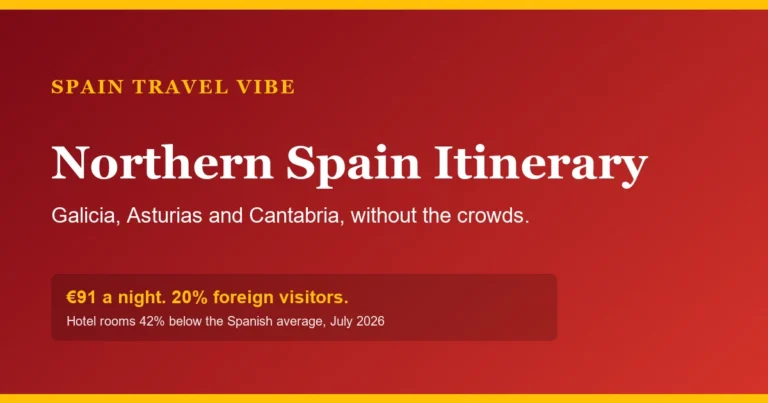
The three communities along the Atlantic north are the clearest answer to “where in Spain isn’t crowded.” All three sit outside the big six, and yet Santiago de Compostela issued a record 530,987 Compostelas to Camino pilgrims in 2025, up 6% and the third consecutive record year (Oficina del Peregrino data, reported via Follow the Camino, 2026).
That number is the tell, with one caveat: a large share of those pilgrims are Spanish rather than foreign, so it isn’t directly comparable to the international arrival figures above. What it shows is that interest in this part of Spain is real and rising. It just hasn’t turned into Mediterranean-scale visitor volume.
The draw: Santiago de Compostela and the end of the Camino, the Rías Baixas and some of the best seafood in Spain, the Picos de Europa for serious mountain walking, Asturian cider culture, and a coastline of small beaches backed by green hills rather than concrete.
The trade-offs are real and worth stating plainly. This is the wet part of Spain, which is exactly why it’s green. English is thinner on the ground than in Barcelona or the costas. And a car goes from useful to close to essential, because the high-speed network that makes the golden triangle so easy mostly doesn’t come here.
Rent one, or pick somewhere else.
Galicia is also the newest region to start charging visitors. A Coruña and Santiago de Compostela both introduced a municipal tourist tax of €1-2.50 a night in 2025, detailed in my tourist tax guide. Asturias and Cantabria charge nothing yet, though Asturias approved a bill in June 2026 that would let its councils levy €0.50 to €3 a night. My roundup of Galicia, Asturias and Cantabria covers all three.
The Islands: Balearics or Canaries?
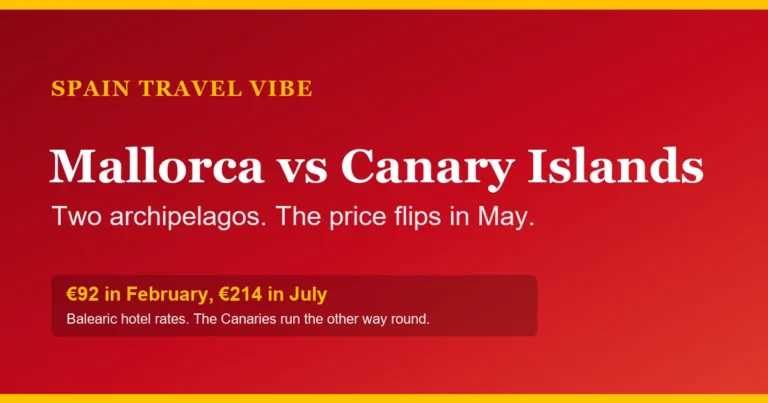
The two island groups took 15.7 million international visitors each in 2025 (INE, 2026), an identical figure that hides two completely different destinations. The Balearics are a May-to-October proposition. The Canaries run winter as their peak season. Both Gran Canaria and Santa Cruz de Tenerife average a January daily maximum of 21.1°C (AEMET, 1991-2020 normals), about the warmest in Europe in midwinter.
Pick the island group by the month and the rest follows. In February the Balearics are half-shut and the Canaries are at their best, with hotels, ferries and restaurants running full schedules while Mallorca’s resort towns are still boarded up. In July the logic reverses, though both groups will be busy whichever way you go.
Cost differs too. The Balearic sustainable tourism tax runs €1-4 per person per night in high season, from 1 May to 31 October, with a 50% discount after the eighth night and under-16s exempt (idealista, 2026). The Canaries have no general regional tourist tax. The one exception is Mogán on Gran Canaria, whose small municipal charge was annulled by a court and is still collected pending appeal, as my tourist tax guide explains.
Mallorca is also where Spain’s overtourism argument is loudest. Around 25,000 people marched through Palma on 26 July 2026 by police count, with organisers claiming 70,000, in what was described as the largest such demonstration yet (The Local, 2026).
None of that should put you off, and it’s worth being clear about why. These are protests about housing costs and infrastructure, aimed at policy rather than at individual visitors, and they have not made the islands unwelcoming or unsafe to visit. The grievance is specific and it is largely economic: island rents have risen faster than island wages, seasonal workers struggle to find anywhere to live on the islands they work on, and residents see water and road capacity absorbed by a population that multiplies every summer. Reading that as hostility toward tourists misses what the placards actually say.
It is a reliable signal about where the pressure has concentrated. Treat it as a nudge toward the quieter islands in each group: Menorca rather than Mallorca, La Palma or El Hierro rather than Tenerife. My full comparison of the Balearics and the Canaries works through the price crossover, the permits and which island fits which month.
Which Regions Does Almost Nobody Visit?
Eleven of Spain’s seventeen autonomous communities share 9.3 million international visitors between them, under 10% of the national total (INE, 2026). Most of them charge no tourist tax, and none of them have a monument you need to book three months ahead.
Raw visitor counts undersell how lopsided this is, because they say nothing about the size of the place absorbing them. So I divided INE’s 2025 arrivals for each region by its resident population from the same institute’s annual census, and the gap turns out to be far wider than the headline numbers suggest:
Two caveats on that arithmetic, because they cut in a specific direction. INE counts each traveller once, against a single main destination, so a visitor based in Catalonia who spends two days in Aragón never shows up in Aragón’s column. Madrid is the biggest distortion, since it’s Spain’s main air gateway and many arrivals logged there disperse elsewhere. The effect is that these quiet regions are, if anything, slightly busier than the chart says.
Not busier enough to change the picture.
The strongest of them, briefly. Extremadura has Roman Mérida, one of the best-preserved theatre complexes outside Italy, plus the medieval old towns of Cáceres and Trujillo. Castilla y León holds Salamanca, Segovia’s aqueduct, Burgos and León, and has more UNESCO-listed cities than most European countries. Aragón runs from the Mudéjar towers of Teruel to the Ordesa valley in the Pyrenees. Navarra and La Rioja are wine country with San Fermín attached. Murcia has a warm, quiet coast that the Costa Blanca crowds mostly skip.
The cost difference shows up on the hotel bill before you have bought a single ticket:
| Where you sleep | Tourist tax per person, per night |
|---|---|
| Barcelona, 5-star | €12.00 |
| Barcelona, apartments and rentals | €9.50 |
| Catalonia outside Barcelona, 5-star | €6.00 |
| Balearic Islands, high season | €1.00-4.00 |
| A Coruña and Santiago de Compostela | €1.00-2.50 |
| Madrid, Valencia region, all of Andalusia, Castilla y León, Extremadura, Aragón and most of inland Spain | €0.00 |
Rates as of August 2026, cross-checked against my monthly-verified city-by-city tourist tax guide and idealista’s 2026 rate summary. Barcelona’s €12 is a regional rate plus a municipal surcharge, which is why it exceeds the €6 charged elsewhere in Catalonia. The Basque Country’s tax is law but only applies from 1 January 2027, and the Canary Islands run a voluntary contribution scheme, so nobody is paying either one today.
Here’s the part these regions’ boosters usually leave out. Lower crowds are not free. English is meaningfully less common, intercity trains are slower and less frequent or absent entirely, opening hours are less forgiving, and you will need a car. That’s the real exchange rate: you’re trading convenience for space. It’s a good trade on a second trip and a poor one on a rushed first.
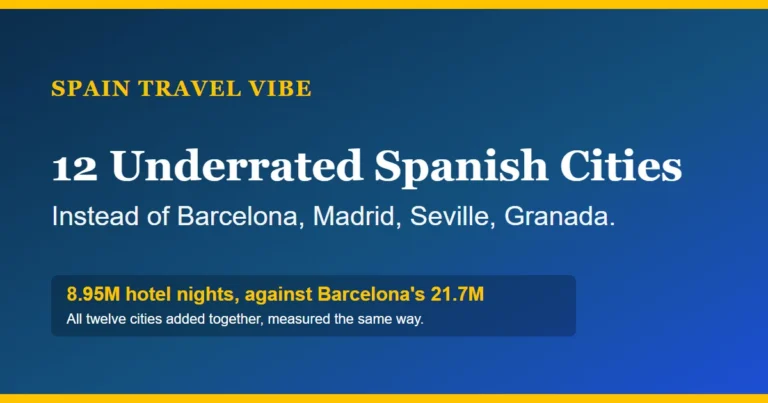
These are the regions to pick when you already know where to go in Spain the obvious way and want the other version. The people who should genuinely go: repeat visitors, slow travellers, anyone travelling in August who wants to dodge both the heat and the queues, and anyone who has already done the golden triangle and found it crowded. My roundup of twelve underrated Spanish cities worth choosing instead of the big four puts numbers under that idea: all twelve together take 41% of what Barcelona absorbs on its own.
Frequently Asked Questions
Where should I go in Spain for the first time?
Madrid and Andalusia, or Barcelona and Andalusia, for anything up to ten days. Each pairs one major city with the region holding the highest density of first-trip sights, and both work entirely by rail without needing a car.
How many regions does Spain have?
Seventeen autonomous communities, plus the two autonomous cities of Ceuta and Melilla on the North African coast. Each sets its own tourist tax independently, and four have a co-official language alongside Castilian Spanish.
Which part of Spain is least touristy?
Castilla-La Mancha, on the numbers. It hosts 0.11 international tourists per resident against a national average of 2.0 and 12.6 in the Balearics, on my calculation from INE arrival and census data. Extremadura is nearly as quiet at 0.19. For a traveller who wants major sights without queues rather than emptiness for its own sake, though, the better picks are Extremadura for Roman Mérida and Cáceres, and Castilla y León for Salamanca, Segovia and Burgos.
Is Barcelona or Madrid better to visit?
Barcelona for architecture, a city beach and a shorter first trip. Madrid for art, food and day trips, plus no municipal tourist tax and far better rail connections onward. Barcelona charges up to €12 per person per night; Madrid charges nothing.
What part of Spain should I visit in August?
The Atlantic north or the Canary Islands. Interior Andalusia, Madrid and the Mediterranean coast were all under AEMET heat alerts of 42-44°C during summer 2026, while the Basque Country and Galicia stayed comfortable.
Where should I go in Spain if I’ve already seen Barcelona and Madrid?
The Basque Country for food, Green Spain for coast and mountains, or Extremadura and Castilla y León for Roman and medieval cities without queues. All four sit outside the six regions that take 90% of Spain’s visitors.
How many regions can I realistically visit in ten days?
Two. Three regions in ten days means a large share of the trip happens on trains.
Deciding Where to Go in Spain
The useful question isn’t which places in Spain are best. It’s which regions match the trip you’re actually taking: the days you have, the month you’re going, and whether you’d rather see the famous thing with a crowd or the quieter thing without one.
Where to go in Spain is really a question about trade-offs, not rankings. The six popular regions earn their reputations, and they carry the costs that come with them, in taxes, queues and booking windows. The eleven quiet ones trade convenience for space. And the month you travel can flip the right answer completely, which is why a guide that names one best region without asking when you’re going isn’t answering the question.
Arrival numbers keep concentrating, tourist taxes keep spreading, and the regions that are quiet today are the likeliest to change first. That’s why this page is re-checked monthly against INE, AEMET and the regional authorities that set the rules, with the date stamped at the top. Want to know when a Spanish region adds a tourist tax or a visitor cap before you book? Join the free Spain rules & updates list.
Start wherever your dates point you. My Barcelona and Madrid guides cover the two big-city gateways, while Seville and Granada open up Andalusia, with the road trip beyond them for everything the trains miss. If you still aren’t sure where to go in Spain, work backwards from the calendar: my month-by-month guide to the best time to visit is the fastest way to find the regions your dates actually suit. And once the region is settled, my roundup of the best things to do in Spain sorts the experiences by how far ahead each one needs booking.