

Last verified: September 6, 2026. The Spanish eating schedule figures here come from European time-use surveys as analysed by the Universidad de Sevilla, from Eurostat’s 2025 working-hours release, and from the 1940 order in the Boletín Oficial del Estado itself. Not from other travel sites. I re-check the Eurostat series and the sunset times each season, and I’ll rebuild the meal-time section when the INE publishes its 2024-2025 Time Use Survey, due late 2026.
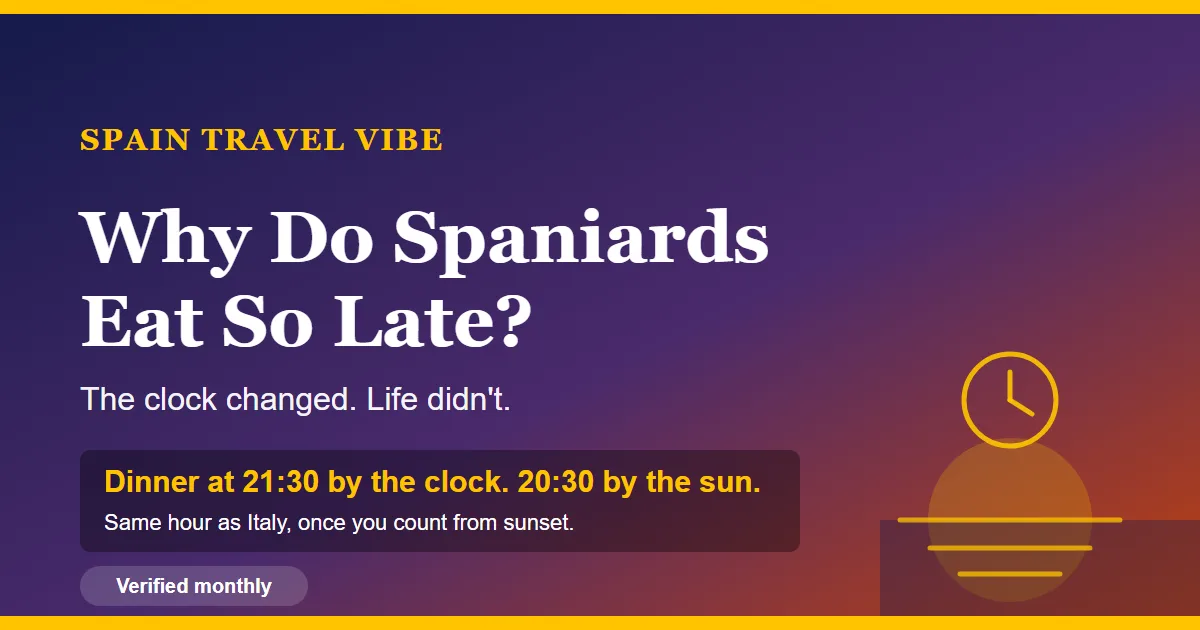
Why do Spaniards eat so late? The honest answer is that the Spanish eating schedule is late by the clock and ordinary by the sun, and almost every explanation you’ve heard skips that distinction. Lunch peaks around 14:30 and dinner around 21:30. Convert both to the time London’s clocks would show and you get 13:30 and 20:30, which is roughly when Italy and France eat.
You’ve probably heard the other version. Franco moved Spain’s clocks forward in 1940 to match Nazi Germany, Spain has lived in “the wrong time zone” ever since, and that’s why dinner is at ten. I believed it for years. Then I read the 1940 order, and a physicist in Seville who has spent a decade taking the story apart.
Disclosure: Some links in this guide may earn us a commission, at no extra cost to you. It never changes what we recommend.
This post gives you the real reasons behind the Spanish eating schedule, with the data. Then the practical part: what time the kitchens actually open, and how to eat well on Spanish time without going hungry at 19:00.
Key Takeaways
- The Spanish eating schedule puts lunch around 14:30 and dinner around 21:30 by the clock. In standard time that is 13:30 and 20:30, in line with Italy and France (Universidad de Sevilla, 2017).
- The “Franco copied Hitler” story fails on timing. Spain advanced its clocks in March 1940, Germany in April.
- Across Europe, dinner lands about three hours after the winter sunset. Spain’s sun sets late: 21:50 in Madrid on 21 June.
- The working day ends around 18:20, yet weekly hours (36.3) sit next to the EU average of 35.9. Later, not longer.
- Dinner service runs 20:00 to 23:30. Eat a merienda at 18:00 and book for 21:00.
Table of Contents
Why Do Spaniards Eat So Late? The Short Answer
In 2017, physicist José María Martín-Olalla of the Universidad de Sevilla measured the Spanish eating schedule against the sun using European time-use surveys. Spain’s lunch peak is 14:30 by the clock but 13:30 in London-standard time. Its dinner peak is 21:30 by the clock and 20:30 by the sun (Martín-Olalla, Consello da Cultura Galega, Cuadro I, 2017).
So the Spanish eating schedule has three drivers. They stack. Spain’s clock runs about an hour ahead of the sun. Its working day ends late, with a long lunch break in the middle. And the sun itself sets late by that clock, so the whole evening, dinner included, sits later on the dial.
One consequence follows from the long lunch break: lunch is the main meal, so dinner is lighter and later still. The result is a day with five eating moments rather than three. Here’s how they fall, and what a restaurant will actually do about each one.
| Meal | Typical clock time | What it is | Restaurant reality |
|---|---|---|---|
| Desayuno | 07:00 to 09:00 | Coffee and something small: toast, a pastry | Bars serve it, hotels serve it; nobody lingers |
| Almuerzo | 10:30 to 12:00 | Second breakfast, often a bocadillo or tortilla | The busiest hour in a neighbourhood bar |
| Comida | 14:00 to 16:00 | The main meal, three courses on a menú del día | Kitchens open around 13:00 to 13:30, fill after 14:00 |
| Merienda | 17:30 to 19:00 | A snack, coffee, churros, a pastry | Most kitchens are off; bars pour drinks, cook nothing |
| Cena | 21:00 to 23:00 | Lighter than lunch, often shared plates | Official service 20:00 to 23:30; rooms fill after 21:00 |
The service windows in that table are the ones Spain’s tourism board publishes, broadly 13:00 to 16:00 and 20:00 to 23:30 (spain.info). That “kitchens off” row matters more than the late dinner. The four-hour gap between lunch service and dinner service is what actually strands visitors, and my guide to how a tapas crawl actually works covers it hour by hour.
Did Franco Really Change Spain’s Clocks for Hitler?
Spain did move its clocks forward in 1940, but the order says nothing about Germany. The Orden de 7 de marzo de 1940 gives its reason as “la conveniencia de que el horario nacional marche de acuerdo con los de otros países europeos” (BOE núm. 68, pp. 1675-1676, 1940). It also speaks of the benefits that “el adelanto temporal de la hora” would bring. Clocks went forward sixty minutes at 23:00 on Saturday 16 March.
Then comes the detail that breaks the popular story. Germany advanced its own clocks in April 1940, a month after Spain. Pere Planesas, a former astronomer at Spain’s National Astronomical Observatory, told Euronews in March 2026 that the Nazi-gesture reading “is a hoax”. Britain, France, Belgium, the Netherlands and Portugal all made the same wartime advance (Euronews, 2026).
What happened afterwards is the interesting part. Some countries went back. Britain tried the advance again from 1969 to 1971 and abandoned it. Portugal tried it twice, from 1967 to 1976 and from 1992 to 1996, and abandoned it both times (Martín-Olalla, Scientific Reports 8:5350, 2018). Spain and France kept it. So Spain is genuinely an hour ahead of its meridian, and has been for 86 years. That part of the story is true.
What’s mythical is the motive and the consequence. In its own words, the order was a wartime alignment with the rest of Europe. And, as the next section shows, it didn’t make the Spanish eating schedule late. It made Spaniards change what the clock said while they ate.
Does the Time Zone Actually Explain Late Dinner?
Only partly, and less than you’d think. In 2018, Martín-Olalla’s peer-reviewed study of 19 countries found that European dinner times cluster about three hours after the winter sunset, inside a band one hour wide. That band is 40% narrower than the spread of dinner times read off the clock (Scientific Reports 8:5350, 2018).
Put Spain on that scale and it stops looking strange. Spanish dinner falls 3h30m after the winter sunset, level with Latvia and ten minutes behind Italy and Poland at 3h40m. France is close behind at 3h00m. Britain eats 2h40m after dark and Germany 2h20m, and Norway, at 1h20m, is the real outlier (Martín-Olalla, Cuadro I, 2017).
How did the clock move an hour without the habits moving with it? Martín-Olalla’s answer is that Spaniards did the rational thing. When the legal time jumped forward in 1940, they delayed their nominal timetables by about the same amount. Lunch and dinner stayed at the same solar hour they’d had in 1930. His one-line summary is worth learning in Spanish: el reloj cambió, la vida no. The clock changed, life didn’t.
There’s a control case you can check yourself. Out in the Canary Islands the clocks run on Western European Time, one hour behind the mainland and in step with London. Canarians eat on Canarian clocks, and nobody writes articles about their exotic dinner hour. The Spanish eating schedule is not a national quirk. It’s what happens when a Mediterranean day is read off a Central European clock.
How Late Does the Sun Set in Spain?
Later than almost anywhere in Europe at the same latitude, by the clock. On 21 June 2026 the sun sets at 21:50 in Madrid and 21:23 in London, and in A Coruña, on Spain’s north-west corner, it sets at 22:19. Madrid’s solar noon, the moment the sun is highest, arrives at 14:16 on the clock (sunrise-sunset.org, pulled 5 September 2026).
Read that last number again. When a Madrid office breaks for lunch at 14:00, the sun has not yet reached its peak. Lunch at 14:30 in Madrid is lunch at 13:30 by London’s clock, and earlier still by the sun. The Spanish eating schedule looks late because you’re reading Madrid’s habits off a clock that is set for Prague.
Winter tells the other half of the story. On 21 December the sun sets at 17:53 in Madrid, and at 15:55 in London. Madrid gets nine hours and twenty minutes of daylight that day, London under eight. So the sense that Spaniards eat dinner in broad daylight is a summer effect, and in July it’s real. Anyone who has tried to put children to bed in Seville at 21:30 in broad daylight knows exactly what I mean. My guide to the best time to visit Spain has more on what those long summer evenings mean for planning a day.
Why Does the Spanish Working Day End So Late?
Because the Spanish working day is later, not longer. In 2025, Eurostat measured actual weekly working hours at 36.3 for Spain against 35.9 for the EU as a whole, 33.9 for Germany and 37.4 for Portugal (Eurostat, Labour Force Survey, lfsa_ewhan2, dataset updated 30 June 2026). Spaniards work an ordinary week. They just finish it at 18:20 instead of 17:00.
That 18:20 comes from the same time-use analysis. Spain’s work rhythm ends at 18:20 by the clock, which is only 30 minutes after the winter sunset. Britain’s ends at 17:00, a full hour after its own sunset (Martín-Olalla, Cuadro IV, 2017). Spaniards start at 08:10 and Britons at 08:20, so the morning is nearly identical. The difference is the middle of the day.
The mechanism is the jornada partida, the split day. A long break in the middle, historically two hours or more, pushes the afternoon block to 16:00 or 17:00, and in plenty of the offices I’ve dealt with the finish drifts to 19:00 or 20:00. Add a culture of presentismo, being seen at your desk late, and dinner cannot start before 21:00 for a large share of working adults.
Spain has argued about this for years without moving the clock or the day. In September 2013, Congress approved a subcommittee report, built on some 60 expert hearings, asking the government to study a return to Greenwich time (Libertad Digital, 2013). In December 2016, the Employment Minister, Fátima Báñez, proposed a national pact to end the working day at 18:00 (Público, 2016). And on 10 September 2025, Congress rejected a bill for a 37.5-hour week by 178 votes (Deia, 2025). The Spanish eating schedule has outlasted every proposal to change it.
What Does a Full Spanish Day Look Like?
Work starts at 08:10, lunch peaks at 14:30, work ends at 18:20, dinner peaks at 21:30 and television prime time arrives at 22:40. Those are the standard-population time marks for the Spanish eating schedule in the European time-use data, and each one pushes the next (Martín-Olalla, Scientific Reports 8:5350, 2018). Italy’s prime time is 21:50 and France’s 21:40.
Lay Spain’s day beside Britain’s and the shape is the same, shifted. Britain works 08:20 to 17:00, eats lunch at 13:00 and dinner at 18:40. Every Spanish mark except the first sits later. Spaniards clock in ten minutes earlier than Britons, then fall ninety minutes behind at lunch and nearly three hours behind at dinner.
Two things fall out of that picture. First, the 16:00 to 20:00 dead zone in restaurant kitchens isn’t laziness. It’s the gap between a lunch service that runs to 16:00 and a working population that won’t be free until after 19:00. Second, prime time drifting later is a symptom. In December 2025, Público reported that Spanish channels now start their flagship shows at 22:30 to 23:00, against 21:30 to 21:45 in the early 1990s. The audience’s peak minute has moved to 21:00 to 21:30, before prime time even begins (Público, 2025). Television follows the Spanish eating schedule.
If you want the full menu of what to do with those long evenings, see my roundup of the best things to do in Spain. It’s built around the day’s real rhythm rather than a museum’s opening hours.
Is Late Eating Bad for You?
The strongest evidence is about lunch, not dinner. In 2013, a team led by Marta Garaulet at the University of Murcia followed 420 people through a 20-week weight-loss programme in Spain. Those who ate lunch after 15:00 lost less weight, and lost it more slowly, than those who ate before, with no difference in calories, physical activity, appetite hormones or sleep (Garaulet et al., International Journal of Obesity, 2013).
That’s one study, and it’s about a mid-afternoon main meal rather than a 22:00 supper. I’d read it as a reason to keep Spanish lunch on the earlier side of its window, not as a verdict on the Spanish eating schedule as a whole.
The health argument is now driving policy at the clock end instead. In October 2025, Spain formally asked the European Union to abolish the twice-yearly clock change from 2026, citing sleep disruption, and said it would prefer to keep summer time all year (European Newsroom, 2025). Not everyone agrees on which time to keep. Darío Acuña, professor emeritus of physiology at the University of Granada, told Euronews he’d keep winter time year-round, to limit the amount of evening light after 20:00 (Euronews, 2026). Either way, nobody in that debate is proposing that Spaniards eat at 18:30.
How Should a Traveler Adapt to Spanish Meal Times?
Three moves solve almost everything about the Spanish eating schedule. Eat a proper merienda at 18:00. Book dinner for 21:00, not 19:30. And make the menú del día at 14:00 your main meal. It’s also the cheapest good food in the country: my Spain trip cost guide puts the national average near €14 for three courses with a drink. My Madrid travel guide explains why that lunch is where the capital rewards you.
The mistake I see most often is the 20:00 dinner. Technically the kitchen has just opened, but the room is empty and the menu on the pavement is in four languages. I did this in Madrid’s Chamberí district on my first trip and ate a mediocre plate alone at 20:15. At 21:45 I walked past the same room and found every table full and the good dishes coming out. That room wasn’t bad. I was early.
Children don’t change the maths. Spanish children eat at Spanish hours, and kitchens don’t open earlier for them. Where early kitchens genuinely exist, use them: hotel dining rooms, market halls with counters, and pintxo bars in the north. In San Sebastián a pintxo counter is stocked and open at 19:00, and my San Sebastián travel guide covers how that counter works. In Andalusia, on the other hand, my Seville travel guide is blunt: dinner rarely starts before 21:30, so don’t fight it.
Here’s the scorecard for the five explanations of the Spanish eating schedule you’ll hear, so you can settle the argument at the table. Three carry the weight: the clock, the working day and the sun.
| Explanation | Verdict | What the evidence says |
|---|---|---|
| Franco changed the clocks to match Hitler | False on timing | Spain moved in March 1940, Germany in April; the order cites alignment with Europe |
| Spain is in the wrong time zone | True, but it explains the clock, not the habit | Spain is an hour ahead of its meridian; by solar time its meals match Italy’s |
| The working day ends late | Strong | Work rhythm ends 18:20; total hours 36.3 a week, near the EU average |
| The sun sets late | Strong | Madrid sunset 21:50 on 21 June; dinner 3h30m after winter sunset, like most of Europe |
| Heat, sobremesa, the culture of the evening | Real, but unmeasured | Plausible, unquantified, true of Italy and Greece too |
If you’d like the etiquette side of the table, my guide to what to leave when you pay covers tipping, greetings and what to wear.
Five Mistakes Visitors Make With the Spanish Eating Schedule
- Dinner at 18:30 on a main square. You’ll pay double for the worst kitchen within a kilometre. My Barcelona travel guide calls it the city’s most expensive habit.
- Skipping merienda. The 18:00 snack is part of the day’s structure. Skip it and you’ll cave at 19:30 in the wrong place.
- Assuming the siesta closes everything. Kitchens close in the afternoon, and so do many small shops, but chains, museums and transport don’t. My guide to what actually closes during the siesta in Spain has the full list.
- Ordering a full ración at the first bar. A tapas crawl runs on one plate per stop.
- Repeating the Franco line at the table. The order cited Europe, and Spaniards kept their solar hours anyway.
Frequently Asked Questions
Why do Spaniards eat so late?
Because the Spanish eating schedule runs late by the clock. Work ends around 18:20 and the dinner peak is 21:30. Measured by the sun, that dinner is 20:30, within an hour of Italy and France. It falls about three and a half hours after the winter sunset, which is where most of Europe eats (Martín-Olalla, Universidad de Sevilla, 2017).
What time do Spaniards eat dinner?
Most people sit down between 21:00 and 22:00, with the peak at 21:30 in the European time-use data. Spain’s tourism board lists dinner service from 20:00 to 23:30 (spain.info), and the rooms fill after 21:00. In summer, when the Madrid sun sets at 21:50, a 22:00 start is entirely normal.
Did Franco change Spain’s time zone to match Nazi Germany?
Spain moved its clocks forward one hour at 23:00 on 16 March 1940. The order in the BOE cites alignment with other European countries and calls the advance temporary. Germany moved its own clocks in April 1940, after Spain, and Britain, France and Portugal made the same change. Former National Astronomical Observatory astronomer Pere Planesas calls the Nazi-gesture explanation a hoax (Euronews, 2026).
Can I eat dinner at 7 PM in Spain?
Rarely in a normal restaurant, because most kitchens are closed between about 16:00 and 20:00. Hotel dining rooms, market halls and the pintxo bars of the Basque Country are the exceptions. The fix is a merienda at 18:00 and a dinner booking at 21:00.
Is Spain going to change its time zone?
Not so far. Congress asked for a study of returning to Greenwich time in 2013, and a minister proposed an 18:00 working day in 2016. In October 2025 Spain asked the EU to abolish the clock change from 2026, preferring permanent summer time (European Newsroom, 2025). None of it has moved the clock or the Spanish eating schedule.
Late by the Clock, Ordinary by the Sun
That’s the whole Spanish eating schedule in one line. Lunch at 14:30 and dinner at 21:30 sound extreme until you notice three things. Spain’s clock is set an hour ahead of the sun. Its working day ends at 18:20. And its sun sets so late that the dinner hour sits exactly where Italy’s and France’s do once you count from sunset. Spaniards didn’t start eating late in 1940. The clock changed, life didn’t.
For a visitor, the practical version is short. Take a merienda at 18:00, book for 21:00, and eat your main meal at lunch. Do that and the Spanish eating schedule stops being an obstacle and becomes the best part of the day.
If you want the mechanics of the bar itself, my guide to how a tapas crawl actually works covers ordering, paying and the kitchen hours. Region by region, the dishes worth eating at each of those hours are in my Spanish food guide. For the wider picture of how Spaniards live their day, start with my traveler’s guide to Spanish culture.