

Last verified: September 9, 2026. The prices, counts and labels in this Spanish food guide come from primary sources: the Ministry of Agriculture’s registers and harvest forecasts, ASICI’s ham traceability database, Hostelería de España’s menú del día survey and the Michelin Guide’s 2026 list. Not from other travel sites. I re-check the menú del día average, the Michelin count and the protected-name list each season. I’ll rebuild the jamón section when ASICI closes the 2026/27 montanera in spring 2027.
This Spanish food guide starts with the one thing most of the others leave out: Spain doesn’t have a national cuisine. It has seventeen regional ones that happen to share an olive-oil base. In 2025, 24.8 million international visitors did a food or wine activity in Spain, one in four of everyone who came (Turespaña, Análisis de segmentos: turismo enogastronómico 2025, 2026). Of those, 83% had been before. People come back to Spain to eat. Most of them still order badly on the first trip.
I did. My first paella was at 21:00 on a tourist street in Madrid, yellow with colouring, studded with frozen peas and slices of chorizo. I decided Spanish food was overrated. The dish hadn’t failed. The geography had. Paella is a Valencian lunch, and I was 350 kilometres and seven hours away from where it makes sense.
Disclosure: Some links in this guide may earn us a commission, at no extra cost to you. It never changes what we recommend.
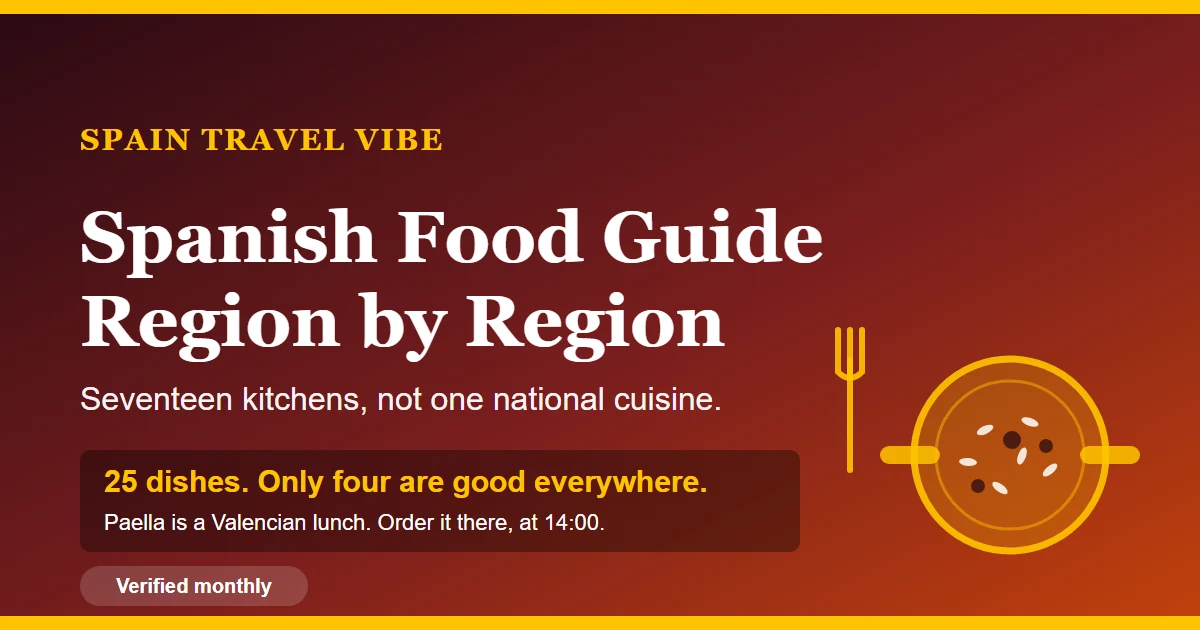
So this Spanish food guide is organised by region, not by course. Twenty-five dishes, each with the place that owns it, the label to look for and the season. Plus an honest note on whether it’s worth ordering anywhere else.
Key Takeaways
- Spain has no single national cuisine. This Spanish food guide is organised by region because most dishes are bad more than a few hundred kilometres from home.
- Paella is a Valencian lunch dish with a heritage decree behind it (Generalitat Valenciana, 2021). Ordering it at dinner in Madrid is the most common food mistake in Spain.
- Jamón ibérico is sold under a four-colour seal set by law. Only the black seal means 100% ibérico and acorn-fed.
- Four dishes genuinely travel everywhere: tortilla de patatas, croquetas, jamón and churros. Everything else has a home.
- A menú del día averaged €14.20 nationally in 2025 (Hostelería de España). The Canaries were cheapest at €13.00, the Balearics dearest at €16.00.
Table of Contents
What Food Is Spain Famous For?
Spain is famous for jamón ibérico, paella, tortilla de patatas, tapas and olive oil, and every one of those belongs to a place. Spanish food is really seventeen regional cuisines on a shared base of olive oil. For the 2025/26 harvest, Spain expected to press 1.37 million tonnes of it (Ministerio de Agricultura, 2025). That is about 40% of a world crop of 3.44 million (International Olive Council, 2026).
The Mediterranean diet has been on UNESCO’s Representative List since 2010, with Spain one of the four states that nominated it (UNESCO). In June 2026 Spain’s hospitality federations published a manifesto backing a Ministry of Agriculture bid to add tapeo, the habit of going for tapas, as an entry of its own (Lanza Digital, 2026). The Michelin Guide Spain and Andorra 2026 lists 307 starred restaurants, 16 of them with three stars (Michelin Guide, 2025). None of that tells you what to order. The number that does is one in four.
My roundup of the best things to do in Spain puts eating next to everything else. Here, eating is the whole point.
Which Spanish Dishes Are Actually National?
Four. Of the 25 dishes in this Spanish food guide, only tortilla de patatas, croquetas, jamón and churros are reliably good in every region. Even jamón has a home. In the 2025/26 montanera, ASICI’s traceability database counted 598,090 acorn-fed ibérico pigs (ASICI via 3tres3, 2026). Of those, 63.8% carried the black seal that means 100% ibérico.
1. Tortilla de patatas. The one dish every region claims. Potato, egg, olive oil, salt, and the onion argument that has divided families for a century. Spanish breakfast is coffee and toast with tomato; tortilla is the mid-morning bite, cut fresh at the bar. A good one is still slightly liquid in the middle. If the slice is dry, uniform and lukewarm, it came from a factory.
2. Jamón ibérico de bellota. The hind leg of a black-hoofed Iberian pig that spent its last autumn eating acorns on the dehesa. That oak pasture covers Extremadura, Salamanca, Huelva and Córdoba. Four protected names cover it: DOP Jabugo, Guijuelo, Dehesa de Extremadura and Los Pedroches. It’s the one national dish where you can check authenticity in ten seconds, because the seal on the hoof is set by law.
3. Croquetas. Bechamel around jamón or salt cod, rolled, breaded and fried the moment you order. A croqueta is the tapa most likely to tell you whether a kitchen cooks. Frozen ones are perfect cylinders. Real ones are slightly irregular and too hot to eat for a minute.
4. Churros con chocolate. Madrid’s breakfast, and its post-nightclub dish, dipped in chocolate thick enough to hold a spoon upright. Everywhere else they’re a weekend or festival food. San Ginés in Madrid is a queue, not a benchmark. Any neighbourhood churrería at 08:00 will do better.
The jamón seal is worth a table of its own in any Spanish food guide, because almost every English-language menu gets it wrong. Real Decreto 4/2014 sets the four sales names by feed and breed in article 3, and assigns each a seal colour in article 9 (BOE, 2014).
| Seal colour | Legal name (Real Decreto 4/2014) | Breed | How the pig was fed | What to expect |
|---|---|---|---|---|
| Black | De bellota 100% ibérico | 100% Iberian | Acorns and pasture on the dehesa during the montanera | The most expensive ham in Spain, and the one worth the money |
| Red | De bellota ibérico | 75% or 50% Iberian, crossed with Duroc | Acorns and pasture | Bellota flavour at a lower price; the label must state the percentage |
| Green | De cebo de campo ibérico | 100%, 75% or 50% Iberian | Feed plus pasture, outdoors | Good everyday ibérico, and honest value |
| White | De cebo ibérico | 100%, 75% or 50% Iberian | Feed, indoors | The entry level, and often what a “jamón ibérico” tapa actually is |
Why Does the Region Matter More Than the Dish?
Spain’s 17 autonomous communities eat as differently as neighbouring European countries do, so the first question isn’t what to order but where you’re standing. The Ministry of Agriculture’s 2023 register counted 377 protected food names in Spain, 212 DOP and 165 IGP (Ministerio de Agricultura, Datos de las DOP, IGP y ETG, 2023). Only Italy and France have more in the EU. Every one of them is tied to a place.
The map is simple once you see it. The Atlantic north eats fish, beans and cider. The high central plateau eats roast lamb, suckling pig, chickpeas and cured pork. The south, shaped by eight centuries of Moorish kitchens, eats cold soups, fried fish and sherry. The east eats rice. A dish that crosses one of those borders is usually a dish cooked from a photo.
That’s what happened to my Madrid paella. Nobody in that kitchen had eaten one in Valencia. The fix wasn’t a better restaurant. It was the right region, at lunch, which is the hour my guide to the Spanish eating schedule explains. How you order it once you’re at the bar is covered in how a tapas crawl actually works, and I won’t repeat either here.
Here’s the whole Spanish food guide on one screen: each dish, its home, its season, its label, and an honest verdict on ordering it anywhere else.
| # | Dish | Home region | Season | Protected label | Order it elsewhere? |
|---|---|---|---|---|---|
| 1 | Tortilla de patatas | Everywhere | All year | None | Anywhere |
| 2 | Jamón ibérico de bellota | Extremadura, Salamanca, Huelva, Córdoba | All year | DOP Jabugo, Guijuelo, Dehesa de Extremadura, Los Pedroches | Anywhere, check the seal |
| 3 | Croquetas | Everywhere | All year | None | Anywhere |
| 4 | Churros con chocolate | Madrid, everywhere | All year, best in winter | None | Anywhere |
| 5 | Gazpacho and salmorejo | Seville, Córdoba | May to September | None | Gazpacho anywhere in summer; salmorejo only at home |
| 6 | Espetos de sardinas | Málaga coast | May to September | None | Only at home |
| 7 | Pescaíto frito | Cádiz, Sanlúcar, Seville | All year | None | Only in Andalucía |
| 8 | Paella valenciana | Valencia, at lunch | All year | DOP Arroz de Valencia; heritage decree 2021 | Only at home |
| 9 | Fideuà | Gandia and the Valencian coast | All year, lunch | None | Only at home |
| 10 | Horchata con fartons | Alboraia, Valencia | April to October | DOP Chufa de Valencia | Only at home |
| 11 | Pa amb tomàquet | Catalonia | All year | None | Anywhere in Catalonia |
| 12 | Calçots amb romesco | Valls, Tarragona | January to March | IGP Calçot de Valls | Only at home |
| 13 | Crema catalana | Catalonia | All year | None | Big cities, ask |
| 14 | The Gilda and pintxos | San Sebastián, Basque Country | All year | None | Only at home |
| 15 | Bacalao al pil-pil | Bizkaia | All year | None | Big cities, ask |
| 16 | Txuleta | Getaria, Tolosa | All year | None | Big cities, at an asador |
| 17 | Basque cheesecake | San Sebastián | All year | None | Anywhere, rarely as good |
| 18 | Pulpo á feira | Galicia, the interior fairs | All year | None | Big cities, ask |
| 19 | Pimientos de Padrón | Padrón, Galicia | May to October | DOP Pemento de Herbón | Anywhere in summer |
| 20 | Tarta de Santiago | Galicia | All year | IGP Tarta de Santiago | Carry one home; don’t order it elsewhere |
| 21 | Fabada asturiana | Asturias, at lunch | October to April | IGP Faba Asturiana; DOP Sidra de Asturias | Only at home |
| 22 | Cachopo | Asturias | All year | None | Only at home |
| 23 | Cocido madrileño | Madrid, at lunch | October to April | None | Only at home |
| 24 | Cochinillo and lechazo | Segovia; Aranda de Duero | All year, lunch | IGP Lechazo de Castilla y León | Only at home |
| 25 | Papas arrugadas con mojo | Canary Islands | All year | DOP Papas Antiguas de Canarias | Only at home |
Screenshot that. The rest of this Spanish food guide is the same table with the reasons attached.
Andalucía: Olive Oil, Frying and Cold Soups
Andalucía is where this Spanish food guide fries. It’s Spain’s olive-oil region and its frying region, and those are the same fact. The Ministry’s 2025/26 forecast gave Andalucía 1,080,900 tonnes of olive oil, about 79% of the national crop (Ministerio de Agricultura, 2025). With that much oil, you fry. Nobody in Europe fries better.
5. Gazpacho and salmorejo. Two cold soups for a region that hits 40°C. Gazpacho is thin, drinkable, tomato, cucumber, pepper and garlic, and it travels well in summer. Salmorejo, from Córdoba, is thicker, bread and tomato beaten with oil into something you eat with a spoon, topped with chopped egg and jamón. It’s best within an hour of Córdoba, which an Andalucía road trip passes through. Neither belongs on a January menu.
6. Espetos de sardinas. Six sardines threaded on a cane and angled over driftwood embers in a sand-filled boat, on the beaches from Málaga to Estepona. May to September, at a chiringuito, with your fingers. Inland, or in February, an espeto is a photograph of one. My guide to Spain’s best beaches covers when that coast is warm.
7. Pescaíto frito. A paper cone of small fish, squid and boquerones, floured and fried for seconds in very hot olive oil. The coating shatters and the fish steams inside it. Cádiz, Sanlúcar and Seville do it best, with a cold fino or manzanilla. Frying is a technique here, not a shortcut. Seville’s other dishes are in my Seville travel guide.
What Should You Eat in Valencia?
Paella valenciana is the only dish in this Spanish food guide with a heritage decree behind it. On 29 October 2021 the Generalitat Valenciana declared it a Bien de Interés Cultural Inmaterial (Decreto 176/2021, BOE, 2022). The title is “el arte de unir y compartir”, the art of bringing people together and sharing. The decree fixes no recipe. It says many versions exist and that rice is the only indispensable ingredient.
8. Paella valenciana. The Valencian version is rice, chicken, rabbit, flat garrofó beans, green ferraúra beans, tomato, saffron and olive oil, sometimes snails. No chorizo, no peas, no seafood. The rice should be DOP Arroz de Valencia from the Albufera lagoon south of the city. It’s a lunch dish, and the good ones are in El Palmar and the lagoon villages my Valencia travel guide covers. Wikipaella, which certifies restaurants cooking it properly, listed 349 worldwide in its 2022 guide, 180 of them in Valencia province (Valencia Secreta, 2022).
9. Fideuà. Gandia’s answer to paella, made with short noodles instead of rice, fish stock, and a spoon of alioli on the side. Order it on the coast south of Valencia city, where it was invented on a fishing boat, and nowhere inland.
10. Horchata con fartons. Cold, sweet tiger-nut milk from Alboraia, just north of the city, where the chufa is grown under DOP Chufa de Valencia. Drink it in the late afternoon with fartons, the long sugar-glazed buns made for dunking. It doesn’t keep, so it doesn’t travel.
What Should You Eat in Catalonia?
Catalonia eats well and charges accordingly. In 2025 its average menú del día was €15.40, the third-highest of any region, against a national €14.20 (Hostelería de España with Edenred, 2025). Its kitchen is also the least like the rest of this Spanish food guide, which is exactly why it’s worth eating in.
11. Pa amb tomàquet. Toasted bread rubbed with the cut side of a ripe tomato, then oil and salt. It’s the start of every Catalan meal and the base of every bocadillo. It’s rarely done right outside Catalonia, because the trick is the tomato, not the bread. If you’re handed the tomato to do it yourself, that’s normal. Where Barcelona does it well is in my Barcelona travel guide.
12. Calçots amb romesco. Sweet spring onions, IGP Calçot de Valls, charred black over vine cuttings, wrapped in newspaper to steam, then peeled with your fingers and dipped in romesco. A calçotada is an outdoor lunch in Tarragona province between January and March, with a bib. The season is measured in weeks, and it sits in my Spain festival calendar with the year’s other dated events. Out of season, don’t order them.
13. Crema catalana. Egg custard under a sheet of burnt sugar, flavoured with lemon peel and cinnamon rather than vanilla. Catalans will tell you it predates crème brûlée. Anywhere in Catalonia, all year. In big cities elsewhere, ask whether it was made in the house.
What Should You Eat in the Basque Country?
The Basque Country holds Spain’s densest cluster of three-star restaurants, and its everyday eating is dearest too. A Basque menú del día averaged €15.80 in 2025, second only to the Balearics (Hostelería de España with Edenred, 2025). Of the 16 three-star restaurants in the Michelin Guide 2026, three are in or just outside San Sebastián (Michelin Guide, 2025). You don’t need any of them for the four Basque dishes in this Spanish food guide.
14. The Gilda and pintxos. An anchovy, a green olive and a pickled guindilla pepper on a stick, named in the 1940s after Rita Hayworth’s film. It’s the original San Sebastián pintxo and the right first thing to eat. Pintxos are priced per piece and nothing arrives free with the drink. The counter mechanics, and what a night costs, are in my San Sebastián travel guide.
15. Bacalao al pil-pil. Salt cod cooked slowly in olive oil and garlic until the fish’s own gelatin emulsifies the oil into a pale sauce. It’s Bizkaia’s dish, and Bilbao does it best. If it arrives with a smooth, glossy sauce and nothing else on the plate, the kitchen knows what it’s doing.
16. Txuleta. A thick rib steak from older cattle, aged, salt-crusted and grilled over coals until charred outside and red within. Getaria and Tolosa are the towns. It’s sold by weight and meant for two or more. An asador in a big city can do it; a tourist-street restaurant cannot.
17. Basque cheesecake. La Viña, in San Sebastián’s old town, baked it burnt on top and barely set inside, and the world copied it. It’s now on menus from London to Seoul, and it’s still best at the source, cut from a tin at the bar.
My first Gilda came with my first pintxo bill, three times what I’d expected. I’d eaten from the counter as if it were free. Read the price board.
Beyond Euskadi, Navarra’s piquillo peppers and La Rioja’s patatas a la riojana belong to the same table and the same wine, so they’re in my guide to Spain’s wine regions.
Green Spain: Fish, Beans and Cider
Spain is the EU’s second-biggest fish eater. In 2023 it ate 40.68 kg of fish and seafood per person, against an EU average of 22.89 kg (EUMOFA, 2025). Only Portugal eats more. Much of it lands on the Atlantic coast of Galicia, Asturias and Cantabria, the green, wet north that first-time visitors skip and this Spanish food guide doesn’t.
18. Pulpo á feira. Octopus boiled in a copper pot, snipped onto a wooden plate with scissors, dusted with pimentón and coarse salt, and drenched in olive oil. The surprise is that it comes from Galicia’s inland market towns, not its coast. Anywhere in Galicia it’s safe, and the pulperías of Melide are a fixed stop on the Camino de Santiago routes. In Madrid or Barcelona, ask where the octopus came from and how long ago.
19. Pimientos de Padrón. Small green peppers from Padrón, DOP Pemento de Herbón, flash-fried in oil and salted. “Uns pican e outros non”, some are hot and others aren’t, and that’s the game. Summer only. Out of season the peppers come from elsewhere and none of them bite.
20. Tarta de Santiago. Ground almonds, eggs and sugar, no flour, with the cross of Saint James stencilled in icing sugar on top. It carries an IGP and it keeps, so buy one in Santiago and eat it for three days rather than ordering it elsewhere.
21. Fabada asturiana. Big white beans, IGP Faba Asturiana, simmered with chorizo, morcilla and cured pork shoulder until the broth turns silky. A winter lunch, not a summer supper, poured alongside DOP Sidra de Asturias cider from arm’s length above the glass. Outside Asturias it’s a tin.
22. Cachopo. Two veal escalopes wrapped around ham and cheese, breaded and fried, and sized for two hungry people. Asturias only. Anywhere else it’s a novelty, and usually a smaller one.
Cantabria adds Santoña’s salt-cured anchovies, the best in Spain, and Santander’s rabas, fried squid strips eaten at midday. The whole coast fits into my northern Spain itinerary.
What Should You Eat in Madrid and Castile?
Madrid is where international visitors ate on purpose most often in 2025. Some 5.1 million did a food or wine activity there, 56.4% of everyone who visited the region (Turespaña, 2026). The city holds 31 Michelin-starred restaurants in the 2026 guide (Madrid tourism board, 2026). Its own entries in this Spanish food guide, though, are plain, heavy and built for a cold plateau winter.
23. Cocido madrileño. A chickpea stew served in three courses, the tres vuelcos: first the broth with fine noodles, then the chickpeas and vegetables, then the meats. It’s a winter lunch that takes the afternoon, and Madrid’s one true dish. Book it, at midday, between October and April. Where else Madrid eats, and why Mercado de San Miguel is for photographing, is in my Madrid travel guide.
24. Cochinillo asado and lechazo. Segovia’s suckling pig, roasted in a wood oven until the skin crackles and carved with the edge of a plate to prove it. Aranda de Duero’s milk-fed lamb, IGP Lechazo de Castilla y León, roasted the same way. Both are lunch dishes, both are a mistake in Madrid’s tourist streets, and Segovia’s is the lunch that justifies the day trip from Madrid.
The meseta also makes two of Spain’s great cheeses. Queso Manchego, DOP, comes from La Mancha’s sheep. Torta del Casar, DOP, from Extremadura, is so soft you cut the top off and spoon it. Add Idiazabal, DOP, smoked in the Basque hills, for a third. La Mancha also grows DOP Azafrán de La Mancha, the saffron that makes a real paella yellow.
What Should You Eat in the Islands?
The islands sit at both ends of Spain’s price scale. In 2025 the Balearics had the dearest menú del día in Spain at €16.00, and the Canaries the cheapest at €13.00 (Hostelería de España with Edenred, 2025). They cook differently too. The Canaries cook like nowhere else in this Spanish food guide.
25. Papas arrugadas con mojo. Small potatoes boiled in heavily salted water until the skins wrinkle and whiten. They come with two sauces: mojo rojo, red pepper and cumin, and mojo verde, coriander and garlic. The potatoes themselves are DOP Papas Antiguas de Canarias, 29 old varieties grown on the islands since the 16th century (Gobierno de Canarias). They’re on every Canarian table and on no mainland one worth eating.
Mallorca does breakfast better than anywhere in Spain. Ensaimada, IGP, is a coil of lard-laminated pastry under icing sugar. Sobrasada, IGP, is soft paprika-cured pork, spread on bread. Which island group suits your trip is a longer question, and my comparison of Mallorca and the Canary Islands answers it.
How Much Does Eating in Spain Cost?
A menú del día averaged €14.20 across Spain in 2025, up 1.5% on 2024’s €14.00 (Hostelería de España with Edenred, 2025). It’s still the best-value meal in Western Europe: three courses, bread, a drink and often coffee, at lunch on weekdays. Eat your main meal that way and the dishes in this Spanish food guide cost less than you’d expect.
Beyond the menú, the units matter more than the prices. A tapa is a few bites, a media ración feeds one, a ración is a shared plate. Paella is priced per person with a two-person minimum, txuleta by the kilo, jamón per 100 grams. In my experience a black-seal ración costs about twice a white one, and a tapas dinner with drinks in a big city lands between €25 and €40 a head.
Where that sits in a whole trip is worked out in my breakdown of how much a trip to Spain costs. What to leave when the bill comes is settled in my guide to tipping in Spain.
Five Mistakes Visitors Make With Spanish Food
Each of these comes back to the rule this Spanish food guide is built on: geography first, then the clock.
1. Ordering paella at dinner, outside Valencia, from a photo menu. Any two of those three is a bad sign. All three is a guarantee. A real pan takes 40 minutes; one that arrives in ten was made this morning.
2. Drinking sangría because it’s Spanish. It’s mostly for visitors. Locals drink a caña of beer, a glass of wine, or a vermut before lunch. In summer they drink tinto de verano, red wine topped with lemon soda, for far less than the jug.
3. Expecting free tapas everywhere. That’s Granada, and a handful of other cities, bar by bar. Most of Spain prices every plate. My Granada travel guide names the streets where the custom still holds, and my tapas crawl guide has the rest of the map.
4. Ordering fish inland on a Monday. The boats don’t go out on Sunday, so Monday’s fish arrived Saturday. On the coast that matters less. Two hundred kilometres from it, order the lamb.
5. Judging Spanish food from the tourist street. The restaurant with the photo menu and the man outside inviting you in is not a sample of Spanish cooking. The good one is two streets away, has a handwritten menú del día in the window, and fills at 14:30. Eat there, at lunch.
Frequently Asked Questions
What food is Spain famous for?
Jamón ibérico, paella, tortilla de patatas, tapas and olive oil, each from a different region. Spain is the world’s largest olive-oil producer, with about 40% of the 2025/26 world crop according to the Ministry of Agriculture and the International Olive Council. This Spanish food guide covers 25 dishes and the region each one belongs to.
What is the national dish of Spain?
There isn’t an official one, which is why this Spanish food guide has 25. Tortilla de patatas is the dish every region eats, which makes it the closest thing. Paella is Valencian, and the Generalitat Valenciana declared it Valencian intangible cultural heritage by decree on 29 October 2021. Calling it Spain’s national dish annoys Valencians for a reason.
Is Spanish food spicy?
No. Almost nothing in this Spanish food guide is hot. The heat that exists comes from pimentón de la Vera, a mostly sweet smoked paprika from Extremadura, and from the occasional guindilla or Padrón pepper. Anything genuinely picante is flagged on the menu, and it’s rare.
What is the difference between tapas and pintxos?
Pintxos are Basque: small bites usually built on bread, held with a stick, laid out on the bar and priced per piece. Tapas are the rest of Spain’s small plates, ordered from a list or the counter. A free tapa with a drink is a local custom in Granada and a few other cities, not a national rule.
How much does a meal cost in Spain?
A menú del día, the weekday set lunch, averaged €14.20 across Spain in 2025 according to Hostelería de España’s survey with Edenred. It ranged from €13.00 in the Canaries to €16.00 in the Balearics. In my experience a tapas dinner with drinks in Madrid or Barcelona runs €25 to €40 a head. Eating your main meal at lunch is the single biggest saving.
Eat the Region You’re Standing In
That’s the whole Spanish food guide in one sentence. Spain has 377 protected food names and seventeen kitchens, and the dishes that travel between them can be counted on one hand. Tortilla, croquetas, jamón and churros will be good anywhere. Everything else is best where it was born, at the hour it’s meant to be eaten, which in Spain is usually lunch.
If you’re building a first trip around this Spanish food guide, three meals will do it. Paella in a lagoon village outside Valencia at 14:00. A counter of pintxos in San Sebastián’s old town. A plate of pulpo in a Galician market town. Fill the days between with the four national dishes and a menú del día wherever you are.
For the mechanics of the bar itself, my guide to how a tapas crawl actually works covers ordering and paying. My post on the Spanish eating schedule explains why every kitchen in this guide opens at 13:30 and not before. For the wider picture of how Spaniards live around these meals, read my Spanish culture guide, which tests ten beliefs about Spain against the numbers.