

Last verified: September 17, 2026. Semana Santa in Spain changes date every year, and so do the seat prices, the public holidays and the hotel rates around it. I check the brotherhood counts against Seville’s Consejo and Málaga’s Agrupación, the holidays against the BOE, and the hotel figures against INE. I re-check every autumn, when the next year’s calendars and price sheets publish, and re-date this box when a figure moves.
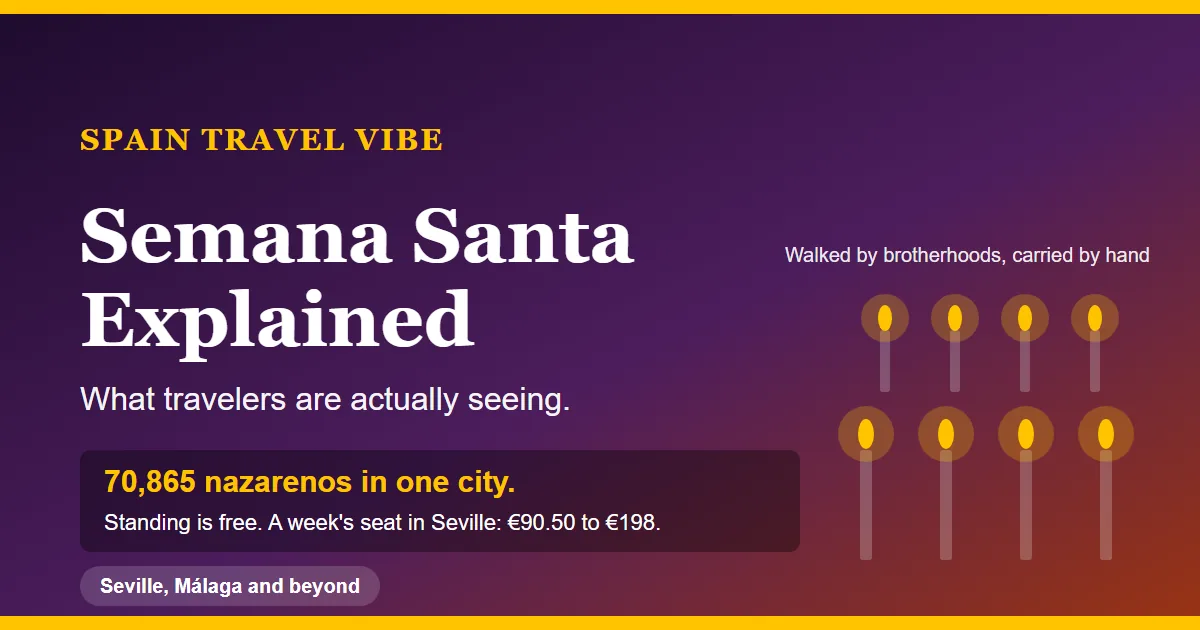
Semana Santa in Spain looks, from the kerb, like a costume parade, and almost nothing about it is a costume. The hooded figure with the candle is a member of a neighbourhood brotherhood doing penance. The float is carried by hand, often by people you can’t see. And in 2026 Seville’s brotherhoods put 70,865 of those hooded and barefoot walkers on the street in a single week.
That’s a lot of penance for a country where, by the state pollster’s September count, fewer than one adult in six practises. So what are you actually watching?
Disclosure: Some links in this guide may earn us a commission, at no extra cost to you. It never changes what we recommend.
This guide answers that the way I’d want it answered before standing in a crowd at midnight. It explains each figure in a procession, the hood, and how Seville and Málaga do the same week in opposite ways. Then it gets practical. Where do you stand for free? What does a seat, a wet night or a hotel room cost you? Every figure is dated and sourced, most to a brotherhood federation, a city council, the CIS, INE or the BOE, and the rest to named Spanish press reports.
Key Takeaways
- Semana Santa in Spain is Holy Week, from Palm Sunday to Easter Sunday, and the processions are run by lay brotherhoods. In 2027 it falls on 21 to 28 March.
- Seville’s brotherhoods put 70,865 nazarenos and penitents on the street in 2026, while just 15.9% of Spanish adults practise (CIS, September 2026). It’s civic ritual as much as religion.
- The pointed hood comes from Spanish penitential dress centuries older than the Ku Klux Klan.
- Seville’s floats are carried by at most about 60 hidden bearers. Málaga’s tronos take up to 250, in full view.
- Spain holds 32 international tourist-interest titles for Holy Week. Castilla y León has 8 and Andalusia 4.
- Standing on the route is free. A week’s chair on Seville’s official route cost €90.50 to €197.96 in 2026, and 686 spare chairs drew 28,246 applications.
Table of Contents
What Is Semana Santa in Spain, and Why Does It Still Stop the Country?
Semana Santa in Spain is Holy Week, the eight days from Palm Sunday to Easter Sunday. The processions are organised by lay brotherhoods, not by the clergy. In 2026 Seville’s brotherhoods alone put 70,865 nazarenos and penitents on the street, up 1.7% on comparable days in 2025, by the count of the Consejo General de Hermandades y Cofradías de Sevilla (reported by Viva Sevilla, June 2026).
Locally, brotherhoods are called hermandades or cofradías, and the words are used almost interchangeably. Each one makes an estación de penitencia, a set route that must pass through a church. In Seville that church is the Cathedral. A brotherhood is part parish, part neighbourhood club, and membership often passes down through families.
Here’s the puzzle that makes it interesting. In September 2026 the Centro de Investigaciones Sociológicas (CIS) found 15.9% of Spanish adults practising Catholicism. Atheists were 17.1% (CIS, Study 3577, September 2026). Yet the Macarena brotherhood alone put 3,958 nazarenos on the street that spring. I take on that gap at more length in why a country where few practise still stops for Holy Week. The short answer is that Semana Santa in Spain is a neighbourhood’s identity carried through its own streets. Doctrine is only part of it.
Why does the date move? Easter is the first Sunday after the first full moon, as the Church reckons it, on or after 21 March. So it can land anywhere from 22 March to 25 April. In 2027 Easter is 28 March, which puts Semana Santa in Spain on 21 to 28 March. La Madrugá, the all-night walk, falls on the night of 25 into 26 March. That early date squeezes Valencia’s Fallas and Seville’s Feria into the same five weeks, which the 2027 festival calendar lays out date by date.
What Are You Actually Looking At in a Procession?
A procession usually runs in this order: a leading cross, rows of hooded nazarenos with candles, the float, then a band. Every role has a name and a job, and Seville’s tourist board keeps a glossary of the brotherhood terms.
| What you see | Its name | What it is | Where it differs |
|---|---|---|---|
| Hooded figure with a long candle | Nazareno with a cirio | A brotherhood member doing penance | Each brotherhood has its own tunic colours |
| Barefoot figure carrying a wooden cross | Penitente | A nazareno who carries a cross instead of a candle, often without the cone | Not every city draws the distinction |
| The tall pointed cone | Capirote under the antifaz | A cardboard or mesh cone beneath the face cloth | Cuenca’s Turbas wrap theirs like turbans |
| The float with carved figures | Paso (de misterio for a Passion scene, de palio for the Virgin under a canopy) | A platform carrying centuries-old images | In Málaga it’s a trono |
| Feet shuffling under the float’s skirt | Costaleros | Bearers hidden beneath, taking the weight on the back of the neck | Málaga’s bearers carry in full view on long poles |
| A man walking backwards in front of the float | Capataz | Directs the bearers by voice and a knock | In Málaga the mayordomo directs with a bell |
| The crush at a corner | Bulla | The crowd that packs around a passing paso | Worst in Seville’s narrow central streets |
| Someone singing from a balcony | Saeta | An unaccompanied sung prayer to the image | Heard most in Andalusia |
Candle-bearers are the part people photograph. Bearers are the part that impresses locals. When a Seville paso lifts in one movement at the capataz’s call, the street applauds people it can barely see.
Then there’s the saeta. Someone on a balcony starts to sing, unaccompanied, to the image below. The procession pauses, and the street goes quiet until the singing ends. How it fits into flamenco as a whole is a story for my Flamenco 101 guide.
Is the Pointed Hood Connected to the Ku Klux Klan?
No. The capirote descends from the coroza, the pointed cap the Inquisition made the condemned wear. Seville brotherhoods took it up voluntarily as a sign of penance from the late 16th century (BBC Mundo, reprinted by La Nación, April 2025). That’s centuries before the Klan existed.
The BBC piece quotes historians Manuel Jesús Roldán and José Martínez Millán on that line of descent. A shaming garment turned into a chosen one. The face cloth has a purpose too. It hides who is doing penance, so the act stays between the penitent and God rather than becoming a public display of piety.
What about the Klan? Its robes date from the late 19th century at the earliest. Euronews reports that a 1927 magazine clipping suggested the Klan borrowed the look, but nobody has established that it did (Euronews, April 2025). So the only safe statement is the one about dates: the Spanish garment is centuries older. The resemblance still startles a lot of first-time visitors.
How Is Semana Santa in Seville Different from Málaga?
Seville carries wooden pasos out of sight, with at most about 60 costaleros under each. Málaga carries larger, mostly metal tronos in full view, with up to 250 bearers who don’t swap out (El Debate, April 2026). Same week, same faith, opposite spectacle.
Seville runs about 70 brotherhoods and 120 pasos across the week, by the press count for 2026 (elDiario.es, March 2026). Its bearers work in relays under a heavy skirt, and the signature moment is the levantá, the synchronised lift at the capataz’s call. The mood leans solemn. The peak is La Madrugá, the night from Holy Thursday into Good Friday. Six brotherhoods walk through the small hours, and in 2026 they fielded 13,819 nazarenos and penitents. The rest of the city is in my Seville travel guide.
Málaga is louder, brighter and built for being seen. Its Agrupación de Cofradías published its first official count in 2026. It found 44 processions and 11,429 rows of participants, with Holy Thursday’s Mena procession the largest at 464 rows (Agrupación de Cofradías, official count, May 2026). That Holy Thursday morning, soldiers of the Spanish Legion land at the port and escort the Mena Christ (COPE, April 2026). Where Seville lifts in unison, Málaga’s bearers raise the trono overhead. The mayordomo walking in front rings a bell to call it.
Which is better for Semana Santa in Spain? Neither, and that isn’t a dodge. If you want silence broken by a single voice, go to Seville. If you want brass bands and a float the size of a small house moving down wide avenues, go to Málaga. Plenty of travelers split the week between them, and my guide to Andalusia beyond Seville covers Málaga as a base.
Where Else in Spain Is Semana Santa Worth Planning Around?
Almost everywhere, and much of it looks nothing like Andalusia. Spain has given its highest festival title, Fiesta de Interés Turístico Internacional, to 32 Holy Week celebrations. Castilla y León holds 8 of them, Andalusia 4. The newest, the Ruta de la Pasión Calatrava in Ciudad Real, was published in the BOE on 10 August 2026 (BOE-A-2026-17493, August 2026).
I built that count from a 2025 list of 30 (Tourinews, April 2025), checked entries against their BOE resolutions, and added Baena, published in February 2026 (BOE-A-2026-4642), and the Calatrava route. Routes that span several towns count once.
A title is only a proxy, but it points at something real. Semana Santa in Spain has at least four distinct styles. In my own shorthand, there’s Andalusian spectacle, Castilian sculpture, Murcian theatre, and the drums of Aragón and Hellín. The table below gives one place for each, plus a few that fit none of them.
| Town | What you see | When to be there | Status |
|---|---|---|---|
| Zamora | The Merlú, pairs of brothers with a cornet and a deliberately off-key drum, calls members out before dawn | Good Friday, Congregación leaves at 05:00 | International title |
| Valladolid | Museum-grade Baroque sculpture by Gregorio Fernández, lent back to the brotherhoods by the national sculpture museum each year | Good Friday general procession | International title |
| Cuenca | The Turbas, drums and clarions mocking Christ on the road to Calvary | Good Friday, from 05:30 | International title |
| Murcia | Francisco Salzillo’s 18th-century sculptures, and more than 4,000 nazarenos in purple handing out sweets | Good Friday, at 06:00 solar time | International title |
| Lorca | Biblical parades with chariots and more than 300 horses, the Blue brotherhood against the White | Evenings through the week, peak on Good Friday | International title |
| Cartagena | Penitents marching and stopping to the drum in perfect unison | Ten days, from the Friday before Palm Sunday | International title |
| Calanda and the Ruta del Tambor y Bombo | The Rompida de la Hora, thousands of drums starting at once | Good Friday, 12:00 exactly | International title; UNESCO listing |
| Hellín | More than 20,000 drums across six tamboradas | Friday before Palm Sunday to Easter Sunday | International title; UNESCO listing |
| Verges (Girona) | A Dance of Death: five dancing skeletons | Holy Thursday night | Catalan festive heritage |
| Balmaseda (Bizkaia) | A living Way of the Cross acted by more than 700 residents | Holy Week | No international title |
Sources for the table: Junta Pro Semana Santa de Zamora, El Debate on Valladolid’s museum loans, Junta de Cofradías de Cuenca, Cofradía de Jesús, Murcia, Ayuntamiento de Lorca, ORM on Cartagena, Ayuntamiento de Calanda, Asociación de Peñas de Tamborileros de Hellín, Generalitat de Catalunya and Basque Tourism.
How do you choose between them? Decide what you want to watch, then check the clock. Zamora and Cuenca stage their signature processions before dawn on Good Friday, at 05:00 and 05:30, so they suit anyone willing to set an alarm. Murcia’s Salzillo procession leaves at six by the sun, which means seven or eight on your phone. Calanda’s drums start at noon, and Lorca’s parades fill the evenings, with the Blue and White brotherhoods competing for applause.
Valladolid is the pick if sculpture matters more than spectacle, because carvings normally shown in its national sculpture museum go out onto the streets. None of these towns is a smaller Seville. Each is a different answer to the same week, and a good reason to build a trip around it, the way I sort experiences in the best things to do in Spain.
Drums deserve a word of their own. UNESCO added the tamboradas, Holy Week drum rituals in towns such as Hellín, Calanda and Alcañiz, to its heritage list in 2018 (UNESCO, 2018). Calanda, where that noon drumming starts, is Luis Buñuel’s birthplace.
One planning warning goes with the small towns. Cuenca, León, Cartagena, Cáceres and Mérida all hold the international title, and all have a small stock of beds. As I found for 12 underrated Spanish cities, one big weekend can fill a small city. Toledo, which also holds the title, is close enough to Madrid to see its daytime and early-evening processions as one of the day trips from Madrid, though its night processions mean staying over.
How Do You Watch a Procession Without Paying for a Seat?
Stand on the route anywhere outside the official section. It’s free, and near the church where a brotherhood leaves or returns it’s often better than a chair. Seats on Seville’s Carrera Oficial are sold by the week, from €90.50 to €197.96 for a chair in 2026 (the Consejo’s 2026 price sheet).
The Carrera Oficial is the route every Seville brotherhood must take, from Plaza de la Campana down Sierpes to the Cathedral. Its chairs are almost all renewed by last year’s holders. For 2026 the Consejo opened new applications in January and raffled what was left before a notary. There were 686 chairs for 28,246 requests (La Voz del Sur, 2026). I couldn’t find a single-day seat sold by the Consejo itself. Málaga works the same way, with a renewal window that ran from October 2025 to January 2026 (Agrupación de Cofradías).
So the street it is, and the street has rules. Each brotherhood publishes its route and times before the week, collected by the Consejo in Seville and the Agrupación in Málaga. Pick a spot near where a procession leaves its church, because you’ll see the paso squeeze through the door. Don’t cut through a procession. Cross only where a gap opens and an officer waves you through. When a float turns a corner, the bulla closes in fast, so know your way out before it does.
Seville’s own end-of-week report reads like a list of things not to do (Ayuntamiento de Sevilla, April 2026). Police seized 300 sillitas, the folding stools people leave out to claim pavement. Medical teams logged 656 interventions, 217 of them helping costaleros. Leave the stool at home, carry water, and eat before you go, because you may stand for hours. As a float passes, go quiet. Don’t use flash, and don’t step in front of the paso to film.
What Happens When It Rains on Semana Santa?
Semana Santa in Spain runs on a forecast: each brotherhood decides for itself whether to go out, often at the last minute. A procession may not leave, may shelter in a church or may turn back, because its images are centuries old and rain damages them. On Holy Monday 2025 in Seville four brotherhoods didn’t go out and a fifth turned back (El Español, April 2025).
That Holy Monday gives a sense of how messy a wet night gets. Santa Marta, Vera Cruz, Las Penas and El Museo stayed in. Las Aguas turned back, and others sheltered along the way. A year earlier was worse. In 2024, 38 Seville brotherhoods didn’t process at all, the city’s worst Holy Week for rain since 2011 (El Español, March 2024).
So don’t build a trip around one evening. Two or three nights gives you a real chance of seeing the brotherhood you came for. In 2027 Semana Santa in Spain lands in late March, when Andalusia can still be showery. The month-by-month guide to the best time to visit Spain shows spring weather region by region.
Is Holy Thursday a Public Holiday Everywhere in Spain?
No. Good Friday is a national holiday in every region. In 2026 Holy Thursday was a holiday everywhere except Catalonia and the Valencian Community. Easter Monday was a holiday in seven regions (BOE-A-2025-21667, October 2025). What’s open on your Thursday depends on where you’re standing.
| Where | Holy Thursday (2 Apr 2026) | Good Friday (3 Apr 2026) | Easter Monday (6 Apr 2026) |
|---|---|---|---|
| Andalusia, Aragón, Asturias, Canary Islands, Cantabria, Castilla y León, Extremadura, Galicia, Madrid, Murcia, Ceuta, Melilla | Holiday | Holiday | Working day |
| Balearic Islands, Castilla-La Mancha, Navarre, Basque Country, La Rioja | Holiday | Holiday | Holiday |
| Catalonia, Valencian Community | Working day | Holiday | Holiday |
On a holiday, banks and most small shops close and public offices shut. Big-city museums and monuments usually keep holiday hours. Bars on a procession route stay busy. Sunday and holiday opening gets the full treatment in what actually closes in Spain and when. The 2027 calendar is normally published in the BOE in the autumn, and I’ll update this table when it is.
What Does Semana Santa Do to Hotel Prices?
It moves the dearest month of spring. In 2024, with Easter on 31 March, Málaga’s April hotel rooms cost 4.2% more than March, by my calculation from the average daily rate published by the Instituto Nacional de Estadística (INE). In 2025 and 2026, with Easter in April, the gap was 16.3% and 15.4% (INE, hotel occupancy survey and profitability indicators, 2024 to 2026).
Seville’s numbers are bigger but harder to read, because the Feria de Abril sometimes lands in April too. 2025 is the clean year. The Feria moved to 6 to 11 May (Turismo de Sevilla), so April held Holy Week alone. The average room rose from €128.63 in March to €181.36 in April, a 41.0% jump by my calculation. April 2026 held most of Holy Week and the Feria. Seville’s €204.57 that month was the highest average rate of any tourist destination in Spain (INE, May 2026).
One honest caveat. A monthly average spreads one expensive week across thirty nights, so these percentages understate what Holy Week itself costs. They’re a floor, not a measure. Seville’s hotel association has the closest week-level figure. It reported 88% occupancy across Holy Week 2026, and 93% on Good Friday night (Asociación de Hoteles de Sevilla, reported by La Voz de Sevilla, April 2026).
What does that mean for 2027? With Holy Week wholly in March, expect March to carry the spike. The Feria, on 13 to 18 April, keeps Seville’s April expensive too. Book the room first and the trains straight after, because Holy Week fills both, as getting around Spain explains. What a trip to Spain costs helps set the rest of the budget.
What Do People Eat During Semana Santa?
Sweets, salt cod and chickpeas, shaped by centuries of Lenten fasting. The signature is the torrija, a slice of bread soaked in milk or wine, dipped in egg, fried and sweetened (Real Academia Española). In Holy Week you’ll find it in most pastry shops and plenty of bars.
For something savoury there’s potaje de vigilia, a stew of chickpeas, spinach and salt cod. It grew out of the old rule against meat on Lenten Fridays (El Debate, March 2025). In Catalonia and the Valencian Community, godparents traditionally give their godchildren a mona de Pascua, a decorated cake, on Easter Monday. Salamanca saves its hornazo, a bread pie stuffed with pork loin, chorizo and egg, for the Lunes de Aguas. That’s the Monday after Easter Monday, not Easter Monday itself (Turismo Castilla y León).
Timing matters as much as the menu. Evening processions run late and dinner runs later, so plan to eat after the float you came for has passed. The clock behind that is explained in why dinner in Spain runs so late, and the rest of the year’s dishes are in the Spanish food guide, region by region.
Frequently Asked Questions
Is Semana Santa the same as Easter?
Semana Santa is the whole of Holy Week, from Palm Sunday to Easter Sunday, and Easter Sunday is its final day. In 2027 Semana Santa in Spain runs from 21 to 28 March. In 2026 Holy Thursday was a holiday in every region except Catalonia and the Valencian Community, and seven regions kept Easter Monday.
Which city in Spain is best for Semana Santa?
It depends what you want to see. Seville has the scale, with 70,865 nazarenos and penitents in 2026, and Málaga has the spectacle of tronos carried in full view. Zamora offers the Merlú before dawn, Valladolid museum sculpture on the street, Lorca its horses and chariots, and Calanda and Hellín their drums. Spain has 32 Holy Week celebrations with international tourist-interest status, so choose by style rather than fame.
Can tourists buy seats for the processions in Seville?
Rarely. Chairs on Seville’s Carrera Oficial are sold by the week, for €90.50 to €197.96 in 2026. Almost all are renewed by the previous holders. The Consejo raffled the 686 spare chairs among 28,246 applications for 2026. Standing on the rest of the route is free, and often closer to the action.
Are shops and museums open on Good Friday in Spain?
Banks and most small shops close, because Good Friday is a national holiday in all 17 regions. In 2026 Holy Thursday was also a holiday everywhere except Catalonia and the Valencian Community. Major museums and monuments usually open with holiday hours, and bars on procession routes stay busy, but check each sight before you go.
Is Semana Santa in Spain a good time to visit?
Yes, if you want to see it and book early. It’s a poor choice for a quiet, cheap break in Seville or Málaga. In 2025 Seville’s average April hotel rate ran 41% above March, by my calculation from INE data. Rain can also cancel a night’s processions, so plan two or three evenings rather than one.
Stand in the Street, Not Just in Seville
Semana Santa in Spain rewards the traveler who knows what they’re looking at. The hood is penance, not menace. The float is carried by neighbours, hidden in Seville and on show in Málaga. The best spot is usually the free one, near a church door, with water in your bag and your exit chosen.
And look beyond Andalusia. Spain has given twice as many international Holy Week titles to Castilla y León as to Andalusia. Semana Santa in Spain is also the drums of Calanda and Zamora’s off-key Merlú before dawn.
If your dates already overlap Holy Week, start with the Spain festival calendar, because in 2027 the Fallas and the Feria sit either side of it. And for why a country where few practise still turns out in its tens of thousands, the long answer is in my guide to Spanish culture.