

Last verified: September 27, 2026. Where to stay in Madrid depends on rules that are still settling. Plan RESIDE’s limits on tourist flats face a pending court case, and the city can redraw its noise-protection zones. I re-check the district hotel counts against the Ayuntamiento de Madrid’s statistics tables, the flat rules against madrid.es, and the fares against CRTM and EMT. I update the date above each time one of them changes.
Where to stay in Madrid, for most first trips, means the Centro district. Pick Las Letras if you want the Prado on foot and a decent night’s sleep. Pick Los Austrias if you want the Plaza Mayor and the Royal Palace outside your door.
The choice matters more than it looks, because most visitors barely unpack. In 2025, Madrid welcomed 11.2 million visitors, and they stayed an average of just 2.12 nights (Ayuntamiento de Madrid, tourism results 2025, February 2026). On a two-night trip, your barrio decides what you hear at 2am, how far the museums are, and whether your flat is even legal.
Disclosure: Some links in this guide may earn us a commission, at no extra cost to you. It never changes what we recommend.
So how do you decide where to stay in Madrid? I parsed the city’s own district tables, checked every barrio against Madrid’s official noise zones, and compared nine bases side by side. The sights themselves are in my Madrid travel guide; this page is about the bed.
Key Takeaways
- For most first-timers, where to stay in Madrid means Centro: Sol, Las Letras or Los Austrias.
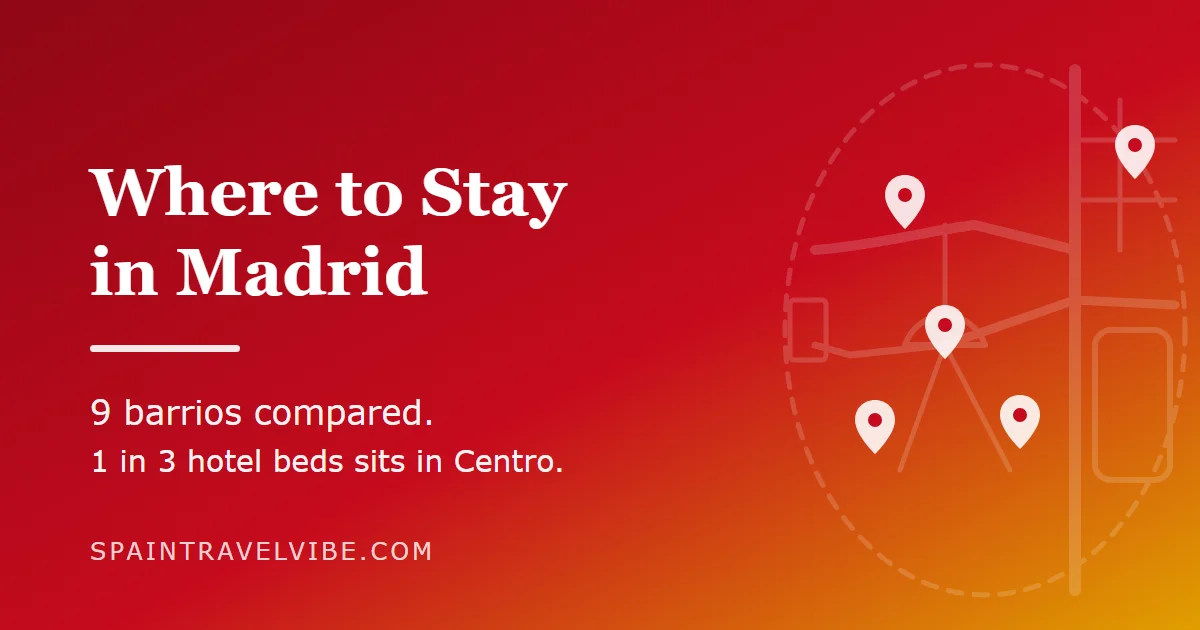
- Centro holds 133 of the city’s 329 hotels and 31% of its hotel beds (Ayuntamiento de Madrid, June 2025).
- Only about 1,200 of 16,100 tourist flats were legal in 2025. Book a hotel or a whole-building apartment.
- Madrid charges no tourist tax.
- A taxi from the airport to anywhere inside the M-30 costs a flat €33.
Table of Contents
Where to Stay in Madrid: The Quick Comparison
For a first trip, stay in Las Letras or Los Austrias; for nights out, Malasaña or Chueca; for tapas, La Latina; for value, Lavapiés; for quiet, Salamanca or Chamberí. As of June 2025, Madrid had 329 hotels, and 133 of them were in the Centro district alone (Ayuntamiento de Madrid, hotel supply by district, August 2025). That’s why the answer to where to stay in Madrid starts there.
| Barrio (district) | Best for | To the Prado / Royal Palace | Nearest Metro | Noise to know about |
|---|---|---|---|---|
| Sol and Gran Vía (Centro) | First trip, short stays, shopping | 1.1 km / 0.8 km | Sol (L1, L2, L3), Gran Vía (L1, L5) | Street-facing rooms on Gran Vía; New Year’s Eve at Sol |
| Los Austrias (Centro) | Old Madrid, the Royal Palace | 1.3 km / 0.6 km | Ópera (L2, L5, R), Sol | Plaza Mayor terraces |
| Las Letras and Huertas (Centro) | Museums, a first trip with better sleep | 0.7 km / 1.1 km | Antón Martín (L1), Sevilla (L2) | Plaza de Santa Ana |
| Malasaña (Centro) | Nightlife, vintage shops | 1.8 km / 1.4 km | Tribunal (L1, L10), Noviciado (L2) | Plaza del Dos de Mayo and the streets around it |
| Chueca (Centro) | Nightlife, the LGBTQ+ scene, food | 1.1 km / 1.5 km | Chueca (L5) | East of Calle Hortaleza; Pride week |
| La Latina (Centro) | Tapas, the Sunday Rastro | 1.7 km / 0.5 km | La Latina (L5) | Cava Baja and Cava Alta; mid-August fiestas |
| Lavapiés (Centro) | Value, character, repeat visits | 0.9 km / 1.4 km | Lavapiés (L3), Tirso de Molina (L1) | Mid-August fiestas |
| Salamanca | Quiet, four-star comfort, shopping | 1.6 km / 2.5 km | Serrano, Velázquez (L4), Goya (L2, L4) | Little: no noise-protection zone |
| Chamberí | Local life, longer stays | 2.2 km / 2.1 km | Iglesia (L1), Quevedo (L2), Bilbao (L1, L4) | Calle Ponzano and the Gaztambide bar streets |
Distances are straight-line and were measured on September 27, 2026. The start points are Puerta del Sol, Plaza Mayor, Plaza de Santa Ana, Plaza del Dos de Mayo, Plaza de Chueca, Plaza de la Paja, Plaza de Lavapiés, Calle de Serrano at number 50, and Plaza de Olavide. Expect the walk to be a little longer than the straight line. Seven of the nine barrios sit inside the Centro district. Booking sites often use their official names: Las Letras appears as Cortes, Los Austrias as Palacio, Malasaña as Universidad, Chueca as Justicia and Lavapiés as Embajadores. The Latina district, out to the southwest, is a different place from the La Latina barrio, and it has no hotels at all.
If you only read one row, read yours. First trip: Las Letras. Couple: Los Austrias. Family: Salamanca, near the Retiro park. Nightlife: Malasaña or Chueca. Budget: Lavapiés, or a hostal anywhere in Centro. Second visit: Chamberí. Early flight: one night by the airport, and no more.
Sol, Los Austrias or Las Letras: Which Is Best for a First Trip?
Las Letras is the best answer to where to stay in Madrid for most people. It’s 0.7 km from the Prado and 0.3 km from Sol, and it sleeps better than Sol itself if you avoid Plaza de Santa Ana. In June 2025, the Centro district these three barrios share held 25,503 of Madrid’s 81,136 hotel beds, 31.4% of the total (Ayuntamiento de Madrid, 2025).
Sol is the literal centre, and it feels like it. Kilometre zero is set in the pavement, three Metro lines meet underneath, and so do most of Madrid’s crowds.
Sol or Gran Vía? Sol if you want the Metro hub and the old town on foot. Gran Vía, just north, if you want the theatres, the shops and more of the big hotels. On both, a street-facing room hears traffic and crowds late, so ask for one at the back.
Los Austrias is the postcard version: the Plaza Mayor, the lanes of the old Habsburg town, and the Royal Palace 0.6 km away. Corral de la Morería, Madrid’s flagship tablao, is on its southern edge. The terraces on the Plaza Mayor are pricey and loud until late, but the lanes behind them go quiet surprisingly early.
Las Letras, also called Huertas, is the literary quarter, with quotations set into its streets and the Paseo del Prado at the bottom of the hill. Its one weak spot is Plaza de Santa Ana, which Madrid classed as a high-noise area in 2012. Two of the venues in my guide to which Madrid tablaos are worth it are right here: Tablao Flamenco 1911 on the square itself, and Cardamomo a street away.
Pickpockets work the Sol and Gran Vía axis and Metro Line 1. In October 2025, plainclothes Policía Nacional officers caught one of the centre’s most active pickpockets on Gran Vía. She already had a record of thefts on Line 1 (El Diario de Madrid, October 2025).
That’s a reason to zip your bag, not to skip the barrio.
Is Malasaña or Chueca Too Loud to Sleep In?
On a weekend, on the wrong street, yes. In 2012, Madrid declared the whole Centro district a Special Acoustic Protection Zone (ZPAE). It classed Malasaña, and Chueca east of Calle Hortaleza, as areas of high acoustic pollution (Ayuntamiento de Madrid, September 2012). Night levels there ran more than 10 decibels over the city’s targets.
Madrid has put its noisiest streets into law. A ZPAE is a formal designation with its own rules on terraces, opening hours and new bars. The Centro zone was revised in 2019 (Ayuntamiento de Madrid, Centro ZPAE). So when you choose where to stay in Madrid, the city has already told you where the late nights are.
Malasaña is Madrid’s young, scruffy, likeable quarter, full of vintage shops, cafés and bars that fill up after midnight. Its heart is the Plaza del Dos de Mayo, which also hosts the barrio’s own festival around the first weekend of May. Stay in Malasaña for the nightlife. Sleep there only in a room facing an inner courtyard.
Chueca is smarter and just as lively. It’s the centre of Madrid’s LGBTQ+ scene, with good restaurants and the Mercado de San Antón, and it’s the heart of MADO, Madrid Pride. In 2026 the neighborhood celebrations ran from June 25 to 30. The main festival followed from July 1 to 5, with a stage on Plaza Pedro Zerolo (Madrid Orgullo, 2026). That week, Chueca doesn’t sleep, and nobody expects it to.
Earplugs help, but geography helps more. Chueca west of Calle Hortaleza falls outside the 2012 high-noise area. A room one street off the Plaza del Dos de Mayo is a different night. Dinner starts late here, so the terraces peak when you’d like to be asleep; the Spanish eating schedule explains why.
Should You Stay in La Latina or Lavapiés?
La Latina for tapas and the Sunday market, Lavapiés for price and character. Both go loud in mid-August. In 2026 the fiestas of San Cayetano, San Lorenzo and La Paloma ran back to back from August 4 to 16. They filled the Rastro streets, Lavapiés and La Latina’s Plaza de la Paja (El Diario de Madrid, July 2026). The rest of the year’s dates are in my guide to Spain’s festivals.
La Latina is where Madrid goes out for tapas. The bars line Cava Baja, Cava Alta and Calle Humilladeros, which is the route my tapas crawl guide follows. The Cavas were a high-noise area on the 2012 map, so book a room off them. On Sundays and holidays the Rastro flea market takes over the streets below, from 9am to 3pm, with about 1,200 stalls (Ayuntamiento de Madrid, El Rastro).
Watch one trap when you book. Madrid’s statistics are by district, and one of the 21 districts is called Latina. It sits out to the southwest, and in June 2025 it had zero hotels and just seven small guesthouses. The La Latina barrio everyone recommends is part of the Centro district. If a booking site offers you “Latina” while you’re deciding where to stay in Madrid, check the map before you pay.
Lavapiés is one of the most mixed barrios in Centro. It has steep streets, cheap restaurants from half the world and the Reina Sofía at the bottom, and most of its residents aren’t tourists. It’s also changing fast. In the census section around Tirso de Molina and Lavapiés, 13.98% of homes were listed as tourist flats in November 2025 (Telemadrid, INE data, March 2026).
Is Lavapiés safe? It gets a rougher reputation online than I can find any data for. Official crime figures stop at city level, and the only district numbers are municipal-police detentions, so any “barrio crime rate” you read is someone’s guess. The pickpocket habits that apply at Sol apply here.
Is Salamanca Worth the Price?
For quiet, grid streets and four-star comfort, yes. For luxury on its own terms, not necessarily. In June 2025, Salamanca had 32 hotels and 8,332 hotel beds, and 5,697 of those beds were four-star (Ayuntamiento de Madrid, 2025). More of the city’s five-star beds are in Centro than anywhere else: 5,461 of 12,733, or 43%.
That runs against the usual advice on where to stay in Madrid. Salamanca is still the city’s smartest address, with the Serrano boutiques and the Retiro park next door. But Madrid’s five-star hotels cluster in Centro: of the 42 in the city in June 2025, 20 were there and 9 in Salamanca. Nobu opened on Calle de Alcalá, between Sol and Cibeles, in September 2026 (Telemadrid, September 2026).
What Salamanca sells, then, is calm. Its streets are wide and straight, there’s no noise-protection zone anywhere in the district, and the Metro puts you a few stops from Sol. It’s my pick for families, with the Retiro on the doorstep. The trade-off is atmosphere: evenings here are quiet and expensive, and you’ll go elsewhere to eat late.
For the park and the museums together, look at the Jerónimos quarter. It sits between the Retiro and the Paseo del Prado, the closest base to the Prado of all. It belongs to the Retiro district, which had only 10 hotels and 2,728 beds in 2025, so book it early. Mercer’s new Madrid hotel opened there in March 2026 (Hosteltur, March 2026), after the city’s count was taken.
Is Chamberí the Best Area to Stay Like a Local?
Yes, if you pick the street. Chamberí is residential, well connected and far less touristed than Centro. It had 20 hotels in June 2025, and 832 listed tourist flats, 1.06% of its homes, that November (Telemadrid, INE data). But it also holds two of Madrid’s four ZPAEs, Gaztambide and Trafalgar-Ríos Rosas (Ayuntamiento de Madrid, transparency portal, May 2026).
Chamberí is where many Madrileños would live if they could afford it: wide streets, old markets, neighborhood bars and a genuine morning rush. It suits a second visit or a longer stay. You’ll use the Metro more, since it’s 2.2 km from the Prado in a straight line.
The noise zones are the part the “live like a local” advice skips. The Trafalgar-Ríos Rosas zone was drawn around Calle Ponzano, Chamberí’s busiest bar street (Madridiario). The Gaztambide zone, on the district’s western side towards Argüelles, covers bar streets such as Fernando el Católico and Hilarión Eslava. There, high-noise terraces must close at 11pm on weekdays and 1am at weekends in season (Ayuntamiento de Madrid, Gaztambide ZPAE, 2016).
My Madrid travel guide calls Chamberí the Madrid locals actually live in, and that holds, street by street. If Chamberí is your answer to where to stay in Madrid, book a street away from Ponzano and ask for a room at the back.
Hotel or Apartment in Madrid? Plan RESIDE and the 7% Problem
A hotel, for most trips. When Plan RESIDE was approved in August 2025, only about 1,200 of Madrid’s 16,100 tourist flats were legal, around 7% (Ayuntamiento de Madrid, August 2025). If you want a kitchen, book a whole-building tourist apartment or an aparthotel, not a flat in a residential block.
Under Plan RESIDE, in the historic centre, tourist flats are now banned anywhere inside a residential building, even on the ground floor. A whole building can switch to tourist use after a full refurbishment, with a licence that lasts 15 years. The rules took effect after publication in the regional bulletin on September 22, 2025 (Garrigues, September 2025).
The plan is still in court. In March 2026, the Madrid High Court refused a rental company’s request to suspend it while the case is heard (eldiario.es, March 2026). The main ruling is still pending. Enforcement is real, too. In 2025 the city returned 323 illegal flats to housing and issued 110 fines of €30,000 (Telemadrid, May 2026).
For a guest, the risk isn’t a fine. It’s a cancellation a few weeks before you fly. And the listings concentrate exactly where visitors want to stay. In November 2025, 20.33% of homes in the census section around Calle San Bernardo and Gran Vía were listed as tourist flats. Around Puerta del Sol and Canalejas the figure was 19.9%, and in the Barrio de las Letras 14.27% (Telemadrid, INE data, March 2026).
Whatever your budget, the answer to where to stay in Madrid keeps coming back to one district.
The safe self-catering option is a registered tourist-apartment building: the city had 177 of them in June 2025, with 14,020 beds, and 59 were in Centro.
Before you book any flat, check its licence number; my guide to the Airbnb ban in Spain shows how, and why Madrid is the country’s biggest trap. Madrid’s problem is different from Barcelona’s. There, as my guide to where to stay in Barcelona explains, every licence ends in 2028. Here, the problem is legality now. My guide to family hotels in Spain compares 12 resort areas, with aparthotels and apartments included.
Which Areas Should You Avoid in Madrid?
Don’t avoid whole barrios. Avoid street-facing rooms on the loudest squares, and choose your weeks. In 2025, conventional crime in Madrid city fell 2.4% (El Diario de Madrid, Government Delegation figures, August 2026). Thefts across the Madrid region fell 5.4% (El Español, Government Delegation figures, February 2026). What visitors usually lose is a phone or a wallet, as my answer to whether Spain is safe explains.
Noise matters more than crime when you choose where to stay in Madrid, and here it’s mapped. These are the places I’d avoid a street-facing room:
- Plaza de Santa Ana, in Las Letras.
- Plaza del Dos de Mayo and the streets around it, in Malasaña.
- Chueca east of Calle Hortaleza, especially in Pride week.
- Cava Baja and Cava Alta, in La Latina.
- Gran Vía and Puerta del Sol, for traffic and crowds rather than bars.
- Calle Ponzano and the Gaztambide bar streets, in Chamberí.
The first four were high-noise areas on the 2012 Centro map, and the Chamberí streets sit inside their own noise zones. Then there’s the airport belt. San Blas-Canillejas and Barajas hold 12,690 hotel beds between them, 15.6% of the city’s total, around the airport, the IFEMA trade-fair grounds and the Metropolitano stadium. They’re fine for an early flight or a trade fair, but a long way from the Prado. If a hotel looks cheap, check the map before you book.
After the summer fiestas, the loud stretch moves to Sol at Christmas. Last season the lights ran from November 22 to January 6 (esMadrid). On December 30 and 31, the city capped the crowd on Puerta del Sol and closed its Metro exits from 6pm (Telemadrid, December 2025).
How Much Does It Cost to Stay in Madrid?
Madrid hotels averaged €178.40 a night in 2025, at 76.8% occupancy (Cushman & Wakefield and STR, hotel barometer 2025, February 2026). There’s no tourist tax on top: in July 2026, the city council voted down a proposal to introduce one (Idealista, July 2026). So where to stay in Madrid changes your room rate, never your tax bill.
That matters most if Madrid and Barcelona share your trip. Here’s what the same stays cost in tourist tax in each city, using Barcelona’s rates since April 2026:
| Stay | Tax in Madrid | Tax in Barcelona |
|---|---|---|
| Couple, 4 nights, 4-star hotel | €0 | €67.20 |
| Couple, 4 nights, licensed flat | €0 | €76.00 |
| Couple, 7 nights, 5-star hotel | €0 | €168.00 |
| Solo traveller, 3 nights, hostel | €0 | €18.00 |
Barcelona’s figures combine the Catalan tax and the €5 city surcharge, capped at seven nights (Agència Tributària de Catalunya, March 2026). For how Madrid compares with the rest of the country, see my breakdown of Spain’s tourist taxes by city.
Which month has the most rooms to spare? August. Madrid’s hotels ran at 64.5% room occupancy in August 2026, well below the 2025 average. That was despite hotel travellers rising 10.9% on August 2025 (El Diario de Madrid, September 2026). Emptier hotels usually mean softer prices, but check the rate before you book. The catch is the heat, the fiestas in La Latina and Lavapiés, and the neighborhood restaurants that shut for the month. My guide to the best time to visit Spain weighs August’s fiestas and heat against its prices.
On a budget, the answer to where to stay in Madrid barely changes, because the cheap beds are central too. Of the city’s 753 hostales and pensiones, 539 were in Centro in June 2025, or 72%. That makes a small guesthouse near Sol or in Huertas a real alternative to a far-out hotel. My guide to the best hostels in Spain puts The Hat Madrid first in the country by guest vote and shows that 72% of Madrid’s hostel nights go to foreign visitors. For the rest of the daily budget, my guide to what a trip to Spain costs has the numbers.
Getting From the Airport and Stations to Each Barrio
A taxi from the airport to anywhere inside the M-30 ring road costs a flat €33, with no supplements (Ayuntamiento de Madrid, taxi fares 2026). Every barrio in this guide is inside it. For two people with bags, that’s often the simplest answer. Public transport is cheaper, and which route is best depends on your answer to where to stay in Madrid.
| Route | Best for | Fare | Worth knowing |
|---|---|---|---|
| Taxi | Every barrio in this guide, late arrivals | €33 flat | Applies to any address inside the M-30 |
| Exprés Aeropuerto bus | Las Letras, Lavapiés, Jerónimos, Salamanca | €5 | Stops at Atocha and Cibeles. Runs 24 hours, from Cibeles only at night |
| Metro Line 8 | Chamberí, Chueca, Malasaña | €1.50 to €2.00, plus a €3 airport supplement | Change at Nuevos Ministerios |
| Cercanías C-1 | Chamartín and the north | Cercanías fare; free for AVE ticket holders | Now a shuttle from Terminal 4 to Chamartín only |
The Exprés bus takes about 30 minutes from Atocha to Terminal 1, and 40 to Terminal 4 (EMT Madrid). The €3 Metro supplement applies to single and 10-trip tickets at the airport stations (CRTM). The Tourist Travel Pass covers it in zone A, from €10.30 for one day to €43.20 for seven. It doesn’t cover the Exprés bus (CRTM, Tourist Travel Pass). A 10-trip Metro ticket costs €7.30 in 2026 (CRTM).
Arriving by train changes the maths. Atocha serves Toledo and the south, and it’s a short walk from Las Letras and Lavapiés. Chamartín serves Segovia and the north, and my guide to day trips from Madrid shows which station each day trip leaves from. For the next leg, my guide to getting around Spain compares the high-speed operators.
Frequently Asked Questions
What is the best area to stay in Madrid for first-timers?
The Centro district, ideally Las Letras or Los Austrias. In June 2025 Centro held 133 of Madrid’s 329 hotels and 31% of its hotel beds (Ayuntamiento de Madrid). From either barrio, the Prado, the Plaza Mayor and the Royal Palace are all on foot, and you’ll sleep better than on Sol itself.
What is the safest area to stay in Madrid?
No official data ranks Madrid’s barrios by crime, so pick for calm. Salamanca and the Retiro side are the quietest residential bases, and so is Chamberí away from Calle Ponzano. Central Madrid isn’t dangerous either. Conventional crime in Madrid city fell 2.4% in 2025 (Government Delegation figures). The main risk is pickpocketing around Sol, Gran Vía and Metro Line 1, so keep your phone zipped away there.
Which areas should I avoid staying in Madrid?
No whole barrio. Avoid street-facing rooms on Plaza de Santa Ana, Plaza del Dos de Mayo and Gran Vía, and check the festival weeks. Be wary of the airport belt too: San Blas-Canillejas and Barajas hold 15.6% of the city’s hotel beds, far from the sights (Ayuntamiento de Madrid, 2025).
Can I still rent an apartment in central Madrid?
Yes, but check it first. Only about 1,200 of Madrid’s 16,100 tourist flats were legal in August 2025 (Ayuntamiento de Madrid). Plan RESIDE now bans tourist flats inside residential buildings in the historic centre. A whole-building tourist apartment or an aparthotel is the safe way to get a kitchen.
Does Madrid have a tourist tax?
No. The city council voted down a tourist-tax proposal in July 2026, and neither the city nor the region charges one. A couple spending four nights in a four-star hotel pays nothing, against €67.20 for the same stay in Barcelona (Agència Tributària de Catalunya rates).
So, Where Should You Stay in Madrid?
My answer to where to stay in Madrid on a first trip is Las Letras, or Los Austrias if you want the old town and the palace. Both put the Prado and the Plaza Mayor on foot. Go to Malasaña or Chueca for the nights, La Latina for the tapas, Lavapiés for value, and Salamanca or Chamberí when you want to sleep.
Whichever you choose, book a hotel or a registered apartment building, and look at the festival calendar before you commit. Then plan your days with my Madrid travel guide and pick a day trip from Madrid or two. Is Madrid one stop on a longer route? My guide to where to stay in Barcelona covers the next city, and my guide to where to stay in Seville covers the one after that. My guide to where to stay in Spain covers the rest of the country, from paradores to campsites.