

Last verified: September 30, 2026. Where to stay in Spain depends on prices and rules that move every month. I rebuild the figures on this page from the Instituto Nacional de Estadística’s occupancy surveys for hotels, tourist apartments, campsites, rural stays and hostels. Hotel data runs to August 2026 and the rest to July 2026. Prices are INE averages for a double room, before VAT.
Where to stay in Spain, for most trips, means a three- or four-star hotel in the centre of each city, plus a night or two somewhere that only exists here: a parador or a casa rural. The longer answer comes down to three choices: the kind of bed, the base and the month.
Spain sold 513.6 million nights in tourist accommodation in 2025, more than any other EU country (Eurostat, another record year for EU tourism, March 2026). Yet the words on the door still trip up first-timers, because a hostal isn’t a hostel, a parador isn’t a private hotel, and an “apartamento turístico” isn’t the same thing as an Airbnb flat.
Disclosure: Some links in this guide may earn us a commission, at no extra cost to you. It never changes what we recommend.
So I went to the source: INE’s five occupancy surveys, its hotel prices by star and month, and each region’s cheapest and dearest month. Still choosing the route? Start with my first-trip planning guide.
Key Takeaways
- Where to stay in Spain comes down to the bed, the base and the month. Hotels sold 71% of Spain’s 512.9 million regulated nights in 2025 (INE, my sum of its five surveys).
- Half of all hotel beds are four-star, and INE’s prices leave out the 10% VAT that any price shown to you must include. At the desk, expect a tourist tax in some places and a request for your passport details.
- A hostal is a small guesthouse with private rooms, not a hostel. It’s the cheapest category INE prices: about €60 a night in January and €90 in August, before VAT.
- A four-star averaged €119.61 in January 2026 and a three-star €144.97 in August. The month matters more than the star.
- The coasts peak in August. Madrid, Seville and Córdoba are cheapest then, which changes where to stay in Spain in summer.
Table of Contents
Where to Stay in Spain: Which of the 8 Options Fits Your Trip?
Book a three- or four-star hotel for city nights, and a hostal when money is tight. Add a parador or a casa rural for a night or two, and a licensed apartment for stays of five nights or more. Hotels took 71.4% of Spain’s 512.9 million regulated nights in 2025 (INE, overnight stays by type of accommodation, my sum of 12 months across five surveys; Eurostat’s own compilation gives 513.6 million). So for where to stay in Spain, a hotel is the default.
Everything else is a choice you make on purpose.
| Option | What it is | Price signal | Best for | Read more |
|---|---|---|---|---|
| Hotel (1 to 5 stars) | Graded by each region; half of all beds are four-star | €116 in January, €167 in August (INE, 2026, before VAT) | City stays, first trips | Barcelona, Madrid and Seville compared |
| Hostal or pensión | Small guesthouse with private rooms, about 26 beds | About €60 in January, €90 in August (INE, 2026, before VAT) | A cheap private room in an old town | Hostal or hostel |
| Parador | One of 99 state-run hotels, most in small towns | €120 to €220 (my planning range) | One or two special nights | What is a parador |
| Casa rural | Country house with about 10 beds, whole or by the room | €32 per person a night (rural-tourism survey, 2026) | Groups, road trips, midweek | Casas rurales |
| Tourist apartment | Unit in a licensed apartment building, graded in keys | No official average; INE’s price index rose 6.2% in a year | Families, five nights or more | Apartments |
| Tourist flat | Private home with a regional licence code | No official average | Longer stays where licences exist | Airbnb ban in Spain |
| Hostel (albergue) | Dorm beds in tourist, youth and pilgrim hostels | €10 in Galicia’s public Camino hostels | Solo travellers, pilgrims | Camino de Santiago routes |
| Campsite | Pitches and bungalows, mostly on the coasts | No official average; INE’s price index rose 6.3% in a year | Families with a car in summer | Best beaches in Spain |
The hotel and hostal prices are INE’s national averages for January and August 2026. The parador range is my own planning figure, and the casa rural figure is what rural travellers said they spent, not a rate card. For flats, apartments and campsites there’s no official average at all, only a price index.
Some options are easy to rule out, though. Skip a hostal if you need a lift and a 24-hour desk, and skip a casa rural without a car. Above all, skip any tourist flat in a big-city old town until you’ve checked its licence.
What Kind of Beds Does Spain Actually Have?
Mostly hotel beds, though the mix changes completely by region, and that mix shapes where to stay in Spain more than any hotel list does. Spain had 1,954,137 hotel bed-places open in August 2026 (INE, hotel establishments and bed-places by category). A month earlier it also had 751,250 campsite places, 608,755 tourist-apartment places, 183,394 rural places and 77,388 hostel places (INE, establishments and bed-places by type of accommodation).
Private flats sit outside those surveys, however. INE’s separate, experimental count found 341,001 tourist flats listed on platforms in May 2026, with 1,714,702 bed-places (INE, tourist dwellings in Spain). The counts use different methods and different months, so I don’t add them up. Together, though, they show why where to stay in Spain has no single answer.
The national picture hides the regional one. Hotels took 86.4% of 2025 nights in the Balearics and 83.1% in Madrid. Tourist apartments took 28.1% in the Canaries. Campsites took 23.5% in Catalonia and 31.0% in Cantabria. Rural stays are 2.5% of nights nationally, but 17.2% in Castilla-La Mancha, 16.5% in Extremadura and 14.0% in Asturias. Hostels reach 10.5% in Navarra and 8.0% in Galicia, the two ends of the Camino de Santiago.
The guests differ too. Foreign residents booked 66.7% of hotel nights and 70.7% of tourist-apartment nights in 2025, but only 45.9% of campsite nights and 30.8% of rural nights. Stays run from 5.0 nights in an apartment and 4.7 on a campsite to 3.1 in a hotel and 1.8 in a hostel (my division of INE’s nights by travellers).
So the right bed depends on the region. My region-by-region guide to where to go in Spain helps you pick the regions. This page picks the bed. In Asturias and Cantabria, the subject of my northern Spain itinerary, rural houses and campsites took three to four nights in ten.
Hotel Stars in Spain: Regional Grades, and the Month Beats the Star
Each of Spain’s 17 regions awards its own stars, and the month changes the price more than a star does. INE’s average rate in August 2026 was €357.83 for a five-star, €176.70 for a four-star and €144.97 for a three-star (INE, average daily rate by hotel category). In January 2026, the same categories averaged €265.86, €119.61 and €90.40.
Look at the middle of that chart, where a four-star in January cost less than a three-star in August. Further down, two-star and one-star hotels averaged €107.02 and €99.07 in August 2026, and about €72 in January. So if your dates are flexible, move the month before you drop a star.
That’s the first rule of where to stay in Spain on a budget.
One caveat applies to every price on this page. INE’s rate is for a double room with bath, room only, and it excludes taxes (INE, methodology of the hotel profitability indicators). Hotel stays in Spain carry 10% VAT, and any price shown to a consumer must include it (BOE, consumer protection law, article 20). So the national average of €166.90 in August 2026 becomes about €183.60 on a booking page, by my arithmetic, before any tourist tax. The Canary Islands, Ceuta and Melilla use their own indirect taxes instead.
In practice, the star you’ll most often find is four. Spain’s 3,173 four-star hotels held 973,348 bed-places in August 2026, 49.8% of the total (INE). Three-star hotels held 24.1% and five-star hotels 7.1%. Four-star hotels average about 307 beds each, which is the resort and big-city model. They also fill fastest: 85.8% of their rooms were occupied that month, against 72.5% in two-star hotels.
Each region awards the stars under its own hotel decree (Hosteltur, what hotel stars mean and how they’re awarded, June 2025). Spain isn’t among the 22 members of the Hotelstars Union, the shared European system (Hotelstars Union, April 2026). So a Spanish four-star isn’t checked against a German or Dutch one, and two regions, Catalonia and Andalusia, add a “Gran Lujo” tier above five stars.
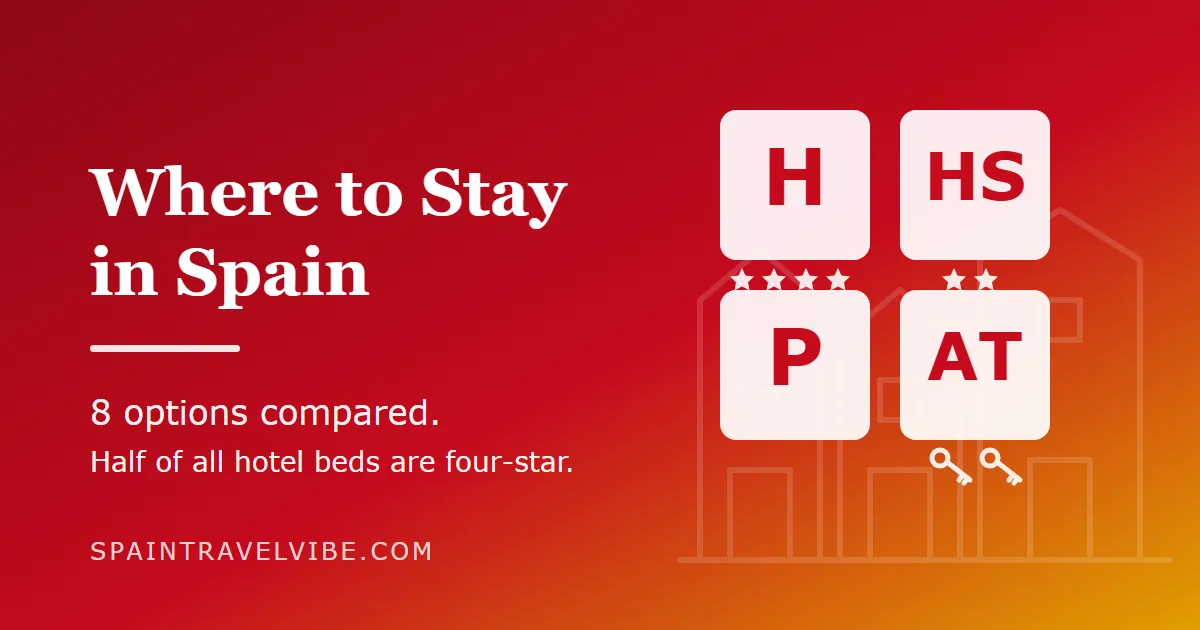
Look for the plaque by the door. Regulated places display their type and category at the entrance. In Catalonia, H means hotel, HS hostal, P pensión, AT tourist apartments and TR rural tourism (Generalitat de Catalunya, plaques for tourist establishments).
The letters vary a little by region, but the idea is the same everywhere.
One more thing the stars don’t tell you is whether the hotel is open at all. Spain had 16,951 hotel establishments open in August 2026 and 11,839 in January 2026, a drop of 30% (INE). For the full budget, see what a trip to Spain costs.
Hostal, Pensión or Hostel: Three Different Beds
A hostal is a small guesthouse with private rooms, while a hostel, called an albergue in Spanish, sells beds in shared dorms. They’re different legal categories. INE counted 6,944 hostales and pensiones open in Spain in August 2026, 41% of all hotel establishments. Yet they held 179,343 bed-places, just 9.2% of the total (INE). That’s about 26 beds each. When where to stay in Spain cheaply is the question, a hostal is the answer far more often than a hostel.
They’re also the cheapest category INE prices. A hostal averaged about €90 a night in August 2026: €90.60 in the two- and three-star band and €89.72 in the one-star band. The January 2026 figures were €59.29 and €62.82, before VAT (INE). INE files them under “silver stars” to keep them apart from hotels.
What do you give up for that price? It depends on the region. In Andalusia, a hotel needs its own building, or an independent part of one. A hostal can share a building with homes or offices, but every room has a bathroom. A pensión may put the bathroom outside the room (Junta de Andalucía, classification of hotel establishments). Andalusia grades hostales at one or two stars. Madrid gives hostales and pensiones one to three (Comunidad de Madrid, tourist accommodation, September 2026). Catalonia doesn’t grade them at all.
That’s why a hostal is often a floor or two of an ordinary building rather than a building of its own, so check the listing for a lift and for reception hours before you book. Most of them sit in old-town centres. Centro holds 72% of the hostales and pensiones in Madrid, and the old town holds 120 of the 152 budget places in Seville.
Hostels are a much smaller world. Spain had 1,249 open in July 2026, with 77,388 places: 917 tourist hostels, 235 youth hostels and 97 pilgrim hostels on the Camino de Santiago (INE, hostels by type of establishment). They sold 7.4 million nights in 2025. Walking the Camino? Galicia’s public pilgrim hostels charge €10 a night (Xunta de Galicia, the network of public hostels), and my guide to the Camino de Santiago routes explains how they work. My guide to the best hostels in Spain names the nine 2026 award winners and compares seven cities on beds, guests and timing.
Are Paradores Worth Building a Trip Around?
For one or two nights, yes. Paradores are 99 state-run hotels, and fewer than half are castles, convents or palaces. Seven in ten sit in towns of under 35,000 people. The chain reported 90.8% average occupancy in August 2026 (Hosteltur, the hotel summer gains profitability, September 2026), against 80.2% of rooms for Spanish hotels overall (INE).
So book summer parador nights early.
I budget €120 to €220 a night as a planning range, not a quote, because Paradores doesn’t publish an average rate and prices swing by hotel and season. Book direct if you want the loyalty points, and expect the tourist tax wherever a town charges one. My guide to what a parador is covers the history, the discounts and the restaurants, which anyone can eat in.
They fit a route best between the cities. Small historic towns, the kind on my Andalusia road trip and among my day trips from Madrid, are typical parador country. For where to stay in Spain on a road trip, a parador night is the easiest upgrade there is. My guide to the best paradores in Spain names the 15 I’d actually splurge on, and the six closed for works.
What Is a Casa Rural, and When Should You Book One?
A casa rural is a licensed country house, rented whole or by the room, and it’s also Spain’s most common lodging business. Some 17,791 rural establishments were open in July 2026, with 183,394 bed-places, about 10 beds each. The same month, Spain had 17,063 open hotels, hostales and pensiones (INE, establishments by type of accommodation).
Yet foreign visitors barely use them. Spanish residents booked 69.2% of rural nights in 2025 (INE, my sum). For a visitor, that means less competition for the beds, especially midweek. It’s the least contested answer to where to stay in Spain, and hardly anyone from abroad gives it.
The chart shows when to go. Rural beds were 13.9% full across November 2025 and 29.6% full at its weekends (INE, rural tourism occupancy). Even in August, the busiest month, occupancy was 42.3%. In other words, a casa rural is a weekend habit for Spanish families.
Arrive on a Tuesday outside August and you’ll have your pick.
Castilla y León had the most open in July 2026, with 3,236, followed by Andalusia with 2,524, Castilla-La Mancha with 1,951, Catalonia with 1,890 and Asturias with 1,436. The Balearics are the exception to everything above. Their 572 rural places, mostly agroturismos and rural hotels, ran at 69.0% occupancy in July 2026, and 87.3% of their 2025 nights were foreign. Book those the way you’d book a hotel on the coast, months ahead for summer.
Rules differ by region. Castilla y León caps a casa rural at 16 guests, grades it from one to five green stars and keeps it to small municipalities (Junta de Castilla y León, Decreto 75/2013). Always check whether the listing is for the whole house or a single room. Both exist, and the price difference is large.
There’s no official average price. Rural travellers reported spending €32 per person per night on accommodation in 2025, the same as in 2024 (Observatorio del Turismo Rural, 2026 report, May 2026). That’s a survey of more than 8,000 travellers, not a rate card.
You’ll almost always need a car, so read my guide to getting around Spain first. Rural houses suit hiking in Spain and slow days in Spain’s wine regions. My guide to casas rurales in Spain covers how to book one, region by region.
Apartment or Airbnb: What Can You Still Book?
Both, but they aren’t the same thing. A tourist apartment is a unit in a licensed apartment building, often with a reception. That category sold 76.7 million nights in 2025 (INE). A tourist flat is a private home with a regional licence code. INE counted 341,001 of them listed on platforms in May 2026, down 10.7% in a year (INE, tourist dwellings in Spain).
The law treats them differently, too. Madrid grades tourist apartments from one to four keys and defines a tourist flat as a whole home let to visitors (Comunidad de Madrid, September 2026). An aparthotel is a third thing: a hotel category, graded in stars. Why should you care? An apartment building is a business with an inspection regime. A flat is someone’s property, under rules that are tightening.
Same kitchen, different risk of a cancelled booking.
Tourist apartments are a coastal and island product. The Canary Islands alone took 28.7 million of those 76.7 million nights in 2025, or 37.5%. The Valencia region took 12.7 million and Andalusia 11.6 million. For the islands, my comparison of Mallorca and the Canary Islands goes deeper. My guide to family hotels in Spain compares 12 resort areas, with aparthotels and apartments included.
Private flats matter most where hotels are thin. Spain had 0.92 flat bed-places for every hotel bed-place in May 2026. But Cantabria had 2.01, the Valencia region 1.73, Murcia 1.50, Asturias and Galicia 1.44 each, Andalusia 1.40 and La Rioja 1.14. Madrid had 0.40 and the Balearics 0.37 (my division of two INE counts). In those seven regions, where to stay in Spain often means a flat whether you planned it or not.
Supply is shrinking while demand grows. Some 12.1 million international tourists stayed in rented housing in 2025 (INE, FRONTUR, December 2025). From January to July 2026, that group grew 11.0% (INE, FRONTUR, July 2026). Nights booked through Airbnb, Booking, Expedia Group and Tripadvisor reached 189.5 million in 2025, up 11.1% (INE, platform occupancy, experimental).
So wherever you settle on where to stay in Spain, check the licence before you pay. The number to look for is the regional licence code. The Supreme Court annulled the national registry number on 19 May 2026. My guide to the Airbnb ban in Spain shows how I check a rental’s licence. City rules differ too. Barcelona’s flat licences end in November 2028, Madrid’s problem is unlicensed flats, and Seville has closed its old town to new ones.
Spain’s Campsites: A Summer Habit on the Mediterranean
Campsites are for families with a car in July and August, and for them where to stay in Spain in summer is often a bungalow on a pitch. They sold 49.8 million nights in 2025, 9.7% of Spain’s total. Catalonia hosted 21.1 million of them, or 42% (INE, my sum).
They’re a summer business as well. Some 1,259 campsites were open in July 2026 with 751,250 places, against only 527 in January (INE). Guests stay 4.7 nights on average, and Spanish residents book 54% of the nights. In Cantabria, campsites take 31.0% of all nights, more than in any other region.
Can you camp outside one? Generally not, because the rules are regional and mostly restrictive. Andalusia, for example, bans camping and overnight stays for leisure outside campsites as a general rule (Junta de Andalucía, campsites in Andalusia). For a coast trip, my guide to the best beaches in Spain says when the water is actually warm.
Where Should You Base Yourself, Region by Region?
Pick one base per region and let the bed follow the region. Hotels took 86.4% of 2025 nights in the Balearics and 83.1% in Madrid; campsites took 31.0% in Cantabria and rural houses 17.2% in Castilla-La Mancha (INE, my sums). The table gives my answer to where to stay in Spain for ten regions, with each one’s dearest and cheapest month for hotel rates.
| Region | Where I’d base | What the beds are | Dearest / cheapest month | My guide |
|---|---|---|---|---|
| Barcelona and Catalonia | The Eixample on a first trip | Hotels 67.5%, campsites 23.5% | May €174 / Dec €120 | Where to stay in Barcelona |
| Madrid | Las Letras or Los Austrias | Hotels 83.1% | Oct €173 / Aug €117 | Where to stay in Madrid |
| Seville, Granada and Córdoba | El Arenal in Seville; the Albaicín or the centre in Granada | Hotels 73.3%, apartments 14.9% (Andalusia) | Seville Apr €178 / Aug €82 | Where to stay in Seville, Granada guide |
| Costa del Sol and the Cádiz coast | A beach town, booked early for August | As above | Málaga Aug €218 / Feb €94 | Andalusia road trip |
| Balearic Islands | A hotel on the coast, or a rural hotel inland | Hotels 86.4%, apartments 10.9% | Aug €231 / Mar €92 | Mallorca vs the Canary Islands |
| Canary Islands | A hotel or a tourist apartment; both are normal here | Hotels 71.4%, apartments 28.1% | Dec €162 / Jun €125 | Mallorca vs the Canary Islands |
| Valencia region | Ciutat Vella in Valencia | Hotels 57.5%, apartments 23.2%, campsites 17.8% | Aug €131 / Jan €79 | Valencia guide |
| Basque Country | San Sebastián, or Hondarribia or Zarautz to save in summer | Hotels 73.6% | Gipuzkoa Jul €231 / Jan €84 | San Sebastián guide |
| Green Spain (Galicia, Asturias, Cantabria) | A coastal town plus a casa rural | Asturias: rural 14.0%, campsites 16.9%. Cantabria: campsites 31.0% | Asturias Aug €135 / Feb €61 | Northern Spain itinerary |
| Inland Spain (the Castillas, Extremadura, Aragón, La Rioja) | A small historic city, or a casa rural | Rural 13% to 17% in the Castillas and Extremadura | Castilla y León Aug €86 / Jan €64 | Underrated cities in Spain, Spain wine regions |
This is where to stay in Spain region by region. Rates are INE province or region averages over the 12 months to August 2026, for a double room before VAT, rounded to the euro. Bed shares are 2025 nights. The bases match the picks in each linked guide. Two rows hide a second city: Córdoba peaked in May (€121) and bottomed in July (€62), and Cádiz ran from €71 in January to €200 in August.
Spain’s cheapest hotel prices are inland. Castilla y León, Castilla-La Mancha and Extremadura never averaged above €86 a night in any month to August 2026. That’s also casa rural country, and where many paradores are. San Sebastián is the opposite case. Gipuzkoa averaged €230.82 in July 2026, level with the Balearics in August. My San Sebastián travel guide explains why, and my guide to where to stay in San Sebastián compares its seven areas and the Basque coast towns.
One oddity in the table: Granada province was dearest in January, at €110.90, which coincides with the Sierra Nevada ski season. Another: the Canaries were dearest in December and cheapest in June. If where to stay in Spain is a winter question, the islands answer it with some of the flattest prices on the map, since December’s peak was only 30% above June’s trough.
When Is It Cheapest to Stay in Spain?
January, nationally. INE’s average hotel rate ran from €116.04 in January 2026 to €166.90 in August 2026, which was 7.3% above August 2025 (INE, hotel tourism trends, August 2026, September 2026). The coasts follow that curve. The inland capitals run the other way.
Spain has two price calendars, not one. On the coasts and in the north, August is the dearest month: €230.70 in the Balearics, €218.34 in Málaga province, €199.82 in Cádiz. Inland, August is the cheapest. Seville province averaged €82.04 in August 2026 against €177.98 in April. Madrid bottomed out at €116.89 in August 2026 and peaked at €173.05 in October 2025. Barcelona province peaked in May, at €174.11.
Why is inland August so cheap? Mostly heat, and my guide to the best time to visit Spain weighs that trade region by region. But the two calendars open a trick. Pair an inland capital in August with a coast in May or October, and you pay the low rate twice.
Some places swing far more than others. Castellón’s dearest month cost 2.9 times its cheapest, and the Balearics’ 2.5 times. In Castilla-La Mancha and Extremadura, the ratio was about 1.2.
Inland, the month barely matters.
Occupancy tells the same story. Spain’s hotel rooms were 80.2% full in August 2026, against 57.3% in January (INE). Festival weeks are a separate problem for where to stay in Spain. My Spain festival calendar lists the weeks that need booking months ahead. Fewer bases also mean fewer check-ins, which is one argument in my guide to how long to spend in Spain.
Prices are still climbing. Over the year to July 2026, INE’s price index rose 6.2% for tourist apartments, 6.3% for campsites and 1.5% for rural stays (INE, non-hotel tourist accommodation, July 2026, August 2026). Whatever your answer to where to stay in Spain, book it earlier than last year’s prices suggest.
What Happens at Check-In: Tourist Tax, VAT and Your Passport
Whatever you decide about where to stay in Spain, three things happen at the desk. Two get added, and one is already in the price. A tourist tax is charged in some places. Your identity details are registered, because every accommodation in Spain has had to send them to the Interior Ministry since 2 December 2024 (BOE, Real Decreto 933/2021). And the 10% VAT is already inside any price you were shown.
| What | Where | How much | What to do |
|---|---|---|---|
| Tourist tax | Catalonia, the Balearics and some cities. Not Madrid, Andalusia or the Valencia region | Up to €12 per person a night in Barcelona’s five-star hotels | Pay at the desk; it’s usually a separate line on the bill |
| VAT | Mainland Spain and the Balearics | 10% on hotel and campsite stays | Nothing; it’s in the price you saw |
| ID registration | Every hotel, hostal, campsite and rental | Free | Show your passport and give your address, phone and email |
| Licence code | Tourist flats only | Free | Check the regional code on the region’s register before paying |
Spain has no national tourist tax. Instead, since 1 April 2026, Barcelona has charged up to €12 per person per night at five-star hotels, the highest rate in the country. Madrid, Seville, Málaga and the whole Valencia region charge nothing. Your accommodation collects it at check-in or check-out, itemised per night and per guest. My guide lists every city and region that charges a tourist tax.
The passport request surprises people, but it’s the law. Hotels collect your name, sex, nationality, date of birth, document type and number, home address, phone and email, and if you travel with a child they record how you’re related. Everyone aged 14 or over signs the entry form. An adult supplies the details of younger children, and the record is kept for three years (BOE).
Will that last? On 4 June 2026, the European Commission opened an infringement procedure against Spain over the register. It argues the rule collects too much data and keeps it too long (Hosteltur, Brussels challenges Spain’s traveller register, June 2026). The decree hasn’t been amended, though, and it stays in force while the procedure runs. Rental hosts ask for the same details.
So expect the form at every check-in. You’ll have the passport to hand anyway: my guide to Spain’s entry requirements covers the border.
Finally, a few rights are worth knowing. You can ask for an invoice and for an official complaint form, the hoja de reclamaciones. In the Madrid region, the hotel day ends at 12:00 noon unless you’ve agreed otherwise (Comunidad de Madrid). Spain’s official tourism site suggests arriving after 2pm (spain.info, accommodation tips). Neither time is national law, so check your booking.
Frequently Asked Questions
Where is the best place to stay in Spain for the first time?
A three- or four-star hotel in the centre of each city on your route. Four-star hotels held 49.8% of Spain’s hotel beds in August 2026 (INE). For where to stay in Spain city by city, start with my comparisons of the Eixample in Barcelona, Las Letras in Madrid and El Arenal in Seville.
What is the difference between a hostal and a hostel in Spain?
A hostal is a small guesthouse with private rooms, which INE groups under silver stars. A hostel, or albergue, sells dorm beds. INE counted 6,944 hostales and pensiones in August 2026 and 1,249 hostels in July. Expect a hostal to average about €90 a night in August and €60 in January, before VAT.
How much does a hotel cost per night in Spain?
INE’s national average for a double room was €116.04 in January 2026 and €166.90 in August 2026, before 10% VAT. A three-star averaged €90.40 and €144.97 in those months, and a four-star €119.61 and €176.70. Inland cities such as Madrid and Seville are cheapest in August.
Is Airbnb legal in Spain?
Yes, for flats with a regional tourist licence. INE counted 341,001 tourist flats listed on platforms in May 2026, 10.7% fewer than a year earlier. Since the Supreme Court annulled the national registry in May 2026, the regional licence code is the number to check before you pay.
Do hotels in Spain ask for your passport?
Yes. Since 2 December 2024, every hotel, hostal, campsite and rental must register each guest’s identity details with the Interior Ministry under Real Decreto 933/2021, including children’s. The European Commission challenged the rule in June 2026, but it remains in force, so expect the form at every check-in.
What is a casa rural?
A licensed country house, rented whole or by the room, with about 10 beds on average. Spain had 17,791 rural establishments open in July 2026, more than its 17,063 hotels, hostales and pensiones. Spanish residents book 69% of the nights, and outside August occupancy at weekends runs at about twice the monthly rate (INE), so with a car it’s my favourite answer to where to stay in Spain.
So, Where Should You Stay in Spain?
My answer to where to stay in Spain is a three- or four-star hotel in each city centre, with one night in a parador or a casa rural. Half of Spain’s hotel beds are four-star, so that’s the easy booking. Then choose the month, because it moves the price more than the star does. And remember that Madrid, Seville and Córdoba are cheapest in August, when the coasts are dearest.
So pick the base first. My comparisons of where to stay in Barcelona, where to stay in Madrid and where to stay in Seville cover the three cities most first trips include. Not sure of the route yet? My guide to where to go in Spain sorts the regions, and my list of the best things to do in Spain tells you what each base is for.