

Last verified: September 12, 2026. The opening hours and rules for the siesta in Spain in this guide are linked to their sources inline, and each chart and table names its own. Most come from the museums, banks and transport operators themselves, the Boletín Oficial del Estado, regional governments and AEMET, and a few from the Spanish press where no official page exists. Hours shift with the seasons, so I re-check the tables at each seasonal change and whenever a region publishes its Sunday trading calendar.
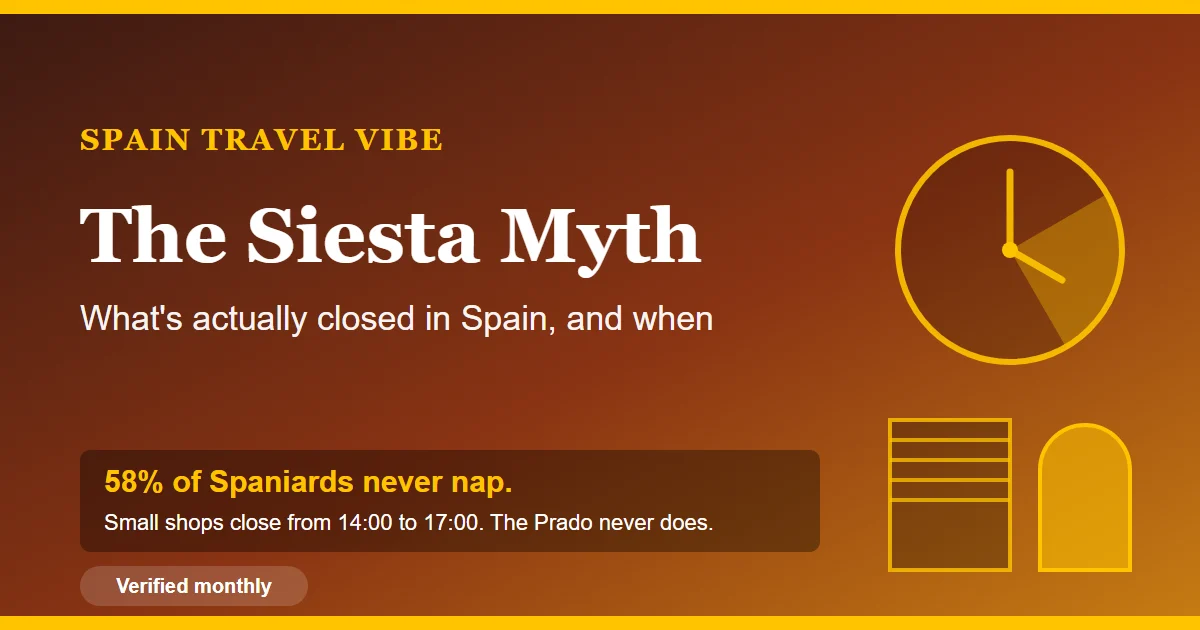
The siesta in Spain is real, but it isn’t the thing you’ve been warned about. Most Spaniards don’t nap at all: in a 2016 Simple Lógica poll, 57.9% said they never do. What survives is a long lunch break, and it closes a much shorter list of doors than the guidebooks suggest.
You’ve probably read that Spain shuts from 14:00 to 17:00. Stand in a Seville side street at 15:30 in July and it can look that way. Walk ten minutes to the Real Alcázar, though, and it’s open as usual. Both are the siesta in Spain, and only one of them affects your afternoon.
Disclosure: Some links in this guide may earn us a commission, at no extra cost to you. It never changes what we recommend.
Key Takeaways
- The siesta in Spain today is a long lunch break, not a nap. 57.9% of Spaniards say they never nap (Simple Lógica, 2016).
- Small shops and neighbourhood markets close from about 14:00 to 17:00, and restaurant kitchens from about 16:00 to 20:00. Banks and public offices close for the day by 14:00 to 15:00.
- Big-name museums, chain supermarkets, department stores and transport don’t close for it. The Prado runs 10:00 to 20:00.
- The real traps are weekly museum closing days and cathedrals’ Sunday worship hours.
- Sundays depend on the city: Madrid shops may open any day, while larger Andalusian shops get 16 a year.
Table of Contents
What Is the Siesta in Spain, Really?
The word comes from the Latin sexta, the sixth hour of the Roman day, around noon. The Real Academia Española defines the siesta as sleep or rest taken after eating (RAE, Diccionario de la lengua española). In working Spain today it’s mostly the long midday break of the split shift, not a nap. Its origin is simple: a heavy midday meal in a hot climate invites a rest.
That split day has a recognisable shape: about five hours of work, a two-hour break, then three more hours. The pattern comes from a 2014 analysis of Spain’s working-conditions surveys (González Chapela, MPRA Paper 57301, 2014). The break exists for lunch, still the main meal of the day. It’s also what pushes the end of work, and dinner, so late. My post on the Spanish eating schedule explains why Spain runs on that later clock in the first place.
Do Spaniards Still Take a Siesta?
Mostly, they don’t. In December 2016, a Simple Lógica poll found that 57.9% of Spaniards never nap, while 17.6% nap four to seven days a week and 15.8% one to three days (Simple Lógica, La siesta entre los españoles, December 2016). Those who do nap sleep for 35 minutes on average. The siesta in Spain has become an occasional pleasure more than a daily routine.
Age matters. Among over-65s, 48.0% nap at least sometimes, against 38.1% of under-34s, so the siesta in Spain is more a habit of retirement than of working life.
Working days explain the rest. A 2016 study of the 2002 to 2003 time-use diaries of 1,416 couples found that about 45% of employed parents had a long lunch break, yet “hardly any” Spanish employee takes a restful siesta on a working day (Gracia and Kalmijn, Journal of Marriage and Family, 2016).
What Time Is the Siesta in Spain?
For shops, roughly 14:00 to 17:00. Andalusia’s official tourism board gives typical shop hours of 10:00 to 14:00 and 17:00 to 20:00 or 21:00. Large stores open 10:00 to 21:00 or 22:00 without a break, and museums keep continuous hours (Andalucía, official tourism site, Horarios, checked September 2026). Banks and public offices don’t reopen at all. They close for the day between about 14:00 and 15:00.
The window slides. It sits later and lasts longer in the south and in summer, and on the main shopping streets of Madrid and Barcelona it has all but disappeared. The long lunch break usually falls between 14:00 and 16:00, so the shop gap simply tracks the meal. The siesta in Spain isn’t a law, either: no national rule tells a business to close after lunch.
One more clock matters to visitors, and it’s the kitchen. Most restaurant kitchens close between about 16:00 and 20:00 while the bar stays open and pours drinks. My guide to how a tapas crawl actually works covers that gap hour by hour.
What Actually Closes During the Siesta in Spain?
Small independent shops, neighbourhood markets and restaurant kitchens close in the afternoon, and banks and public offices close for the day by 14:00 to 15:00. Museums, chain supermarkets, department stores and public transport stay open, and the Madrid metro runs 06:00 to 01:30 every day (CRTM). The supermarket chain Mercadona, for example, runs 09:00 to 21:30, Monday to Saturday (Libertad Digital, August 2026).
The pattern follows the size of the shop. Spain’s shop-hours law lets any shop under 300 m² that isn’t part of a large group set its own hours (Ley 1/2004 de Horarios Comerciales, BOE, as amended in 2012). So the family shop that pulls its shutter at 14:00 is choosing to. The chain next door usually stays open all afternoon.
Category by category, here’s what to expect in the afternoon, on Sundays and in August.
| What | 14:00 to 17:00 | Sundays | August |
|---|---|---|---|
| Small independent shops | Usually closed, reopen about 17:00 to 20:30 | Many closed, though legally free to open | Some close for holidays |
| Department stores | Open straight through | Authorised Sundays only; any Sunday in Madrid | Open |
| Supermarket chains | Open (Mercadona 09:00 to 21:30) | Mercadona closed; others vary | Open, longer hours on the coast |
| Pharmacies | Many close at midday; a duty pharmacy is always open | Duty pharmacy rota | Duty pharmacy rota |
| Banks | Closed from about 14:30 | Closed | Close about 14:00 |
| Post offices (Correos) | Many open 08:30 to 20:30; small offices vary | Closed | Summer hours vary by office |
| Public offices | Most close by 14:00 to 15:00 | Closed | Summer hours, mornings only |
| Neighbourhood markets | Mostly closed | Closed | Varies |
| Tourist markets | Open (San Miguel to midnight, Boqueria to 20:30) | San Miguel open; Boqueria closed | Open |
| Museums and monuments | Major ones open; some convents close | Open, sometimes shorter hours | Open |
| Cathedrals | Major ones open for visits | Worship cuts visiting hours | Open |
| Restaurant kitchens | Lunch to about 16:00, then closed to 20:00 | Mostly open; some close Sunday night | Some family places close |
| Bars | Open | Open | Mostly open |
| Metro and buses | Running | Running | Running |
Pharmacies
Many pharmacies close at midday, but every area runs a farmacia de guardia rota, so one is always open, nights and Sundays included. Cities publish the list online, as Madrid’s city council does.
Closed Signs in Catalan and Basque
The sign on the door won’t always be in Spanish. In Barcelona a closed shop says tancat, and in the Basque Country itxita. My guide to the languages of Spain explains which regions put which language first.
Markets
Neighbourhood markets are a morning job. Madrid’s city council requires its municipal markets to open on weekday and Saturday mornings, and on weekday afternoons, though many stalls close after lunch anyway (Ayuntamiento de Madrid, Mercados municipales). The big tourist markets are different: the Mercado de San Miguel stays open until midnight (esMadrid). Barcelona’s La Boqueria runs 08:00 to 20:30 but closes on Sundays and holidays (Ajuntament de Barcelona). Go before lunch and you can build a picnic from the stalls; my Spanish food guide lists what’s worth buying region by region.
Are Museums and Monuments Open During the Siesta?
Yes, the big names are. No major museum or monument closes at midday on a weekday. Some convents, monasteries and smaller churches still break for lunch, though, and Sunday hours and weekly closing days are the real traps. The Prado opens 10:00 to 20:00 from Monday to Saturday (Ayuntamiento de Madrid, Museo del Prado), the Alhambra 08:30 to 20:00 until 14 October and 08:30 to 18:00 from 15 October (Patronato de la Alhambra), and the Sagrada Família 09:00 to 20:00 on weekdays from April to September (Sagrada Família).
Opening hours aren’t the hard part at those two. Tickets are, and my guides to Alhambra tickets and Sagrada Família tickets cover how to get them.
In summer, I’d argue the siesta hours are the best museum hours in the country: the rooms are cool, and in my experience the queues thin out while everyone else is at lunch. If you’d rather not pay, time the free windows instead. The Prado is free from 18:00 to 20:00, Monday to Saturday, and from 17:00 to 19:00 on Sundays, and the Thyssen is free on Mondays from 12:00 to 16:00 (Museo Thyssen).
The real trap is the weekly closing day, not the hour. The Reina Sofía closes on Tuesdays, and on Sundays it shuts at 14:30, half an hour into the siesta (Museo Reina Sofía). Barcelona’s Picasso Museum closes every Monday (Museu Picasso). The Guggenheim Bilbao closes on Mondays outside its summer season, which ran from 15 June to 7 September in 2026 (Guggenheim Bilbao). Check the day before you check the clock.
Sundays are when cathedrals change the picture, because worship comes first. Outside July and August, Seville Cathedral opens to visitors on Sundays only from 14:30 to 18:00 (Catedral de Sevilla). Córdoba’s Mezquita-Catedral closes to visitors between 11:30 and 15:00 on Sundays (Mezquita-Catedral de Córdoba). And Toledo Cathedral doesn’t open until 14:00 on Sundays, a trap I flag in my guide to day trips from Madrid.
Is There a Siesta in Madrid, Barcelona and Seville?
Barely in Madrid, patchily in Barcelona, and fully in Seville’s side streets. The difference is legal as much as cultural. Since July 2012, Madrid’s shops have been free to set any hours on any day (Ley 2/2012, BOE). In 2026, Andalusia allows larger shops 16 Sunday and holiday openings a year (Junta de Andalucía, 2025).
| City or area | Afternoon in the centre | Sunday shopping | Tourist zone |
|---|---|---|---|
| Madrid | Most shops open straight through | Any Sunday | Not needed |
| Barcelona | Chains open; small shops close | Authorised Sundays only after 15 September | Old town, Eixample and nearby districts, mid-May to mid-September |
| Seville | Small shops close about 14:00 to 17:00 | 16 days; free in tourist zones in season | Centre, Triana and Nervión, in season |
| Córdoba and Granada | Small shops close | 16 authorised days a year | Historic centres |
| Costa del Sol | Tourist-zone shops set their own hours | Free in season | Whole resort towns, Holy Week and summer |
| Palma and the Balearics | Tourist-zone shops set their own hours | 10 authorised days a year | Palma city centre |
| Small towns anywhere | Most shops close 14:00 to 17:00 | Mostly closed | Rarely |
In central Madrid the siesta in Spain is hard to find: most shops on the main streets open straight through, Sundays included, so a Madrid city break needs almost no siesta planning.
Barcelona sits in between. In 2026 its tourist zone let shops open on Sundays from 12:00 to 20:00 between 15 May and 15 September (Crónica Global, May 2026). After that, only the regional Sunday calendar applies, which matters if your Barcelona itinerary includes a Sunday later in the year.
Seville is where the afternoon still empties, above all in July and August. Its centre, Triana and Nervión are seasonal tourist zones with extra Sunday openings (Junta de Andalucía, zonas de gran afluencia turística). In summer I plan Seville around its shaded streets, the ones my Seville travel guide names. The old hours hold firmest further out, in Córdoba and the white villages of Andalusia.
Are Shops Open on Sundays and Public Holidays in Spain?
Some are. Spain’s shop-hours law sets 16 Sunday and holiday openings a year for larger shops, and each region may cut that to 10 or, like Madrid, lift the limit entirely. Shops under 300 m² and anything in a declared tourist zone set their own hours (Ley 1/2004, BOE). The result is a different Sunday in every region.
In 2026 the numbers vary widely. Andalusia allows 16, the Valencian Community 11, the Balearics 10, and Catalonia 8 plus two chosen by each town. Madrid has no limit at all (Ministerio de Economía, Comercio y Empresa, 2026 Sunday trading calendar).
Supermarket chains choose within those rules. Mercadona, for one, normally closes on Sundays, although about 320 of its coastal and tourist-area stores opened on Sundays until 15:00 in July and August 2026 (Libertad Digital). On a Sunday in a small town, the bakery and a small convenience store may be your only options.
Public holidays work like Sundays. Spain’s remaining national holidays in 2026 are 12 October, 1 November, 6 December, 8 December and 25 December. Because 1 November and 6 December fall on Sundays, most regions, Andalusia and Madrid included, move them to Monday 2 November and Monday 7 December (BOE-A-2025-21667). Towns add two local holidays of their own, and my Spain festival calendar flags the big ones.
Why Does Spain Slow Down in Summer and Close in August?
Heat and the summer working day. Under the 2026 rules, central government staff may work 6.5 continuous hours between 08:00 and 15:00 from 16 June to 15 September (Resolución de 14 de abril de 2026, BOE-A-2026-8287). Santander’s branches close at 14:00 from 15 July to 14 September (Banco Santander, branch hours). For those workers, the working day ends at lunch.
The heat is no longer a cliché. Summer 2026 averaged 24.5°C on mainland Spain, the hottest since records began in 1961, with 61 heatwave days against 36 in 2025 (AEMET, olas de calor 2026, September 2026). Since 2023, employers have had to adapt or restrict outdoor work whenever AEMET issues an orange or red heat warning (Real Decreto-ley 4/2023, BOE). For outdoor workers, the midday retreat now has a legal footing.
August adds a second kind of closure to the siesta in Spain. Family-run bars, restaurants and shops put up a cerrado por vacaciones sign for a week or more. In 2024, Telemadrid reported that about 35% of Madrid’s bars and restaurants close in August, but only about 10% in the busy centre (Telemadrid, 2024). The coast goes the other way, with longer supermarket hours in July and August.
If you’re travelling in July or August, put outdoor sights in the morning and the evening. June and September are kinder almost everywhere, as my best time to visit Spain breakdown shows. The loose, light clothes on my Spain packing list make a midday walk bearable.
Is Spain Getting Rid of the Siesta?
Slowly, by shrinking the lunch break rather than banning anything. Between 2003 and 2011, the share of Spanish workers on a split shift fell from 52.2% to 40.2%, while continuous morning shifts rose from 21.9% to 28.6% (INSHT working-conditions surveys, via González Chapela, MPRA Paper 57301, 2014).
Politicians have pushed at the edges. In April 2016, acting prime minister Mariano Rajoy proposed a pact to end the working day at 18:00 (infoLibre, 2016). No law followed. In September 2025, Congress voted down a bill to cut the legal working week to 37.5 hours (eldiario.es, 2025).
None of this touches the shop on the corner. The siesta in Spain is fading because offices are moving to a continuous day, not because anyone is ordering the shutters up.
How Should You Plan Your Day Around the Spanish Afternoon?
Shop and visit markets in the morning, spend 14:00 to 17:00 at lunch or in a museum, and head back out after 17:00 when shops reopen. With restaurant kitchens serving lunch from about 13:00 to 16:00 and dinner from 20:00 (spain.info, opening times), that rhythm matches the country’s own.
A few habits of my own save most of the frustration. I do any banking before 14:00, look up a cathedral’s Sunday hours before building a day around it, and outside Madrid I buy Sunday’s groceries on Saturday.
In summer I also flip the sightseeing: outdoor sights first thing, museums and a long lunch in the heat, walks after 19:00. Evenings are when Spain comes into its own. Several of the best things to do in Spain don’t start until after dark. Planning a first trip? The complete Spain travel guide puts all of this in order.
Frequently Asked Questions
What time is siesta in Spain?
Small shops usually close from about 14:00 to 17:00 and reopen until 20:00 or 21:00, according to Andalusia’s official tourism board. Banks and public offices close for the day between about 14:00 and 15:00. Museums, chain supermarkets and public transport don’t close for the siesta in Spain at all.
Do people still take a siesta in Spain?
Most don’t. In a December 2016 Simple Lógica poll, 57.9% of Spaniards said they never nap and 17.6% said they nap four to seven days a week. The siesta in Spain survives mainly as a long lunch break on working days.
Do supermarkets and restaurants close for the siesta?
Supermarket chains stay open all day, and Mercadona runs 09:00 to 21:30 from Monday to Saturday. Restaurants serve lunch until about 16:00, then close the kitchen until about 20:00, although bars stay open and keep pouring drinks.
Are shops open on Sundays in Spain?
It depends on the region. Madrid lets shops open any day. Elsewhere, larger shops may open only on a set number of authorised Sundays and holidays, such as 16 a year in Andalusia and 10 in the Balearics, while shops under 300 m² and shops in declared tourist zones set their own hours (Ley 1/2004).
Is the siesta a law in Spain?
No. No national law requires a business to close in the afternoon, and an afternoon closure is the owner’s choice. What Spanish law does limit, under Ley 1/2004, is how many Sundays and public holidays larger shops may open, a number each region sets.
Fewer Naps, Fewer Closed Doors
That’s the siesta in Spain in three sentences. Most Spaniards never nap. A short list of doors still closes after lunch: small shops, local markets, banks, public offices and kitchens. And, I’d argue, the afternoon is the best museum time in the country.
Why does Spain keep this later rhythm at all? My post on the Spanish eating schedule covers the clock and the working day behind it. For the rest of the etiquette, my guide to tipping in Spain is the next read. And for the wider picture of how Spaniards live, my Spanish culture guide tests the siesta and nine other beliefs against official numbers.