

Last verified: September 19, 2026. The dates in Moorish Spain history don’t move, but the numbers around its monuments do. I check the Alhambra, Alcázar and Mezquita visitor counts against the Junta de Andalucía, the Patronato and the Cabildo each year, and the UNESCO listings against the Ministry of Culture’s register. I update the date above each time.
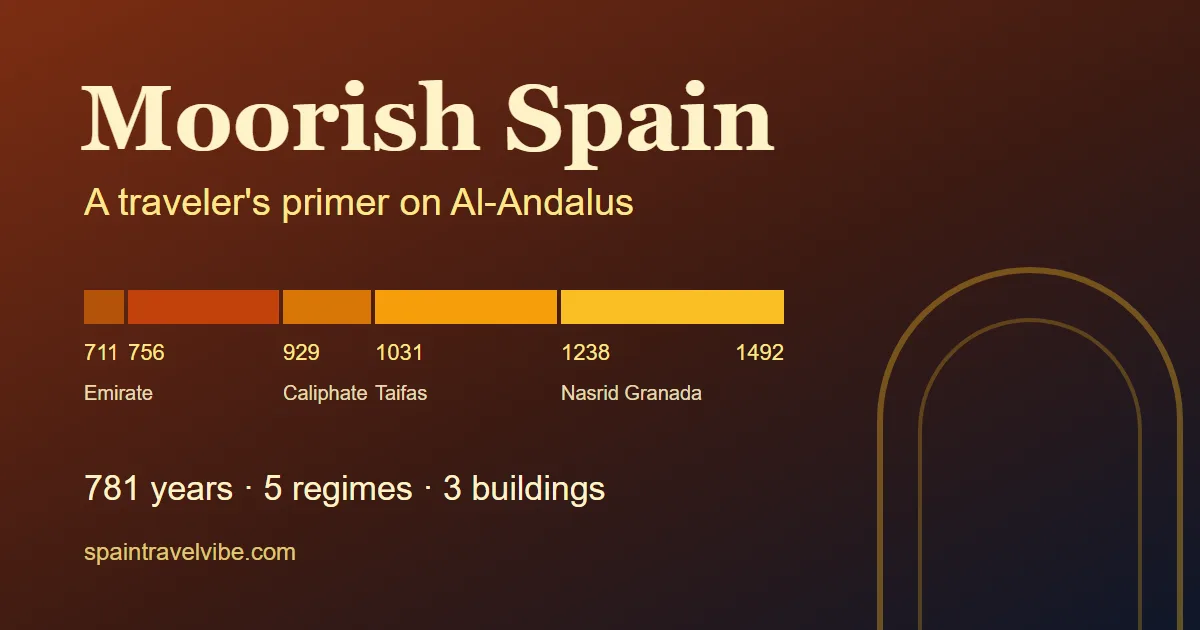
Moorish Spain history is 781 years long, from the landing of 711 to the fall of Granada in 1492. Almost every Moorish building you’ll stand in front of in Andalusia was built under one of five different regimes that ruled inside those years. That’s the sentence I wish someone had handed me before my first trip south.
The mistake it prevents goes like this. On Tuesday you stand under the striped arches in Córdoba. On Thursday you look up at a carved plaster ceiling in Granada. A sign or a blog calls both “Moorish”, so you file them together. They’re 500 years and three dynasties apart.
Disclosure: Some links in this guide may earn us a commission, at no extra cost to you. It never changes what we recommend.
This primer fixes that. It covers who the Moors were and weren’t, the 781 years as five regimes, and how to read the three buildings everyone goes to see. It’s honest about what historians argue over, and about the century after 1492 that most travel pages skip.
Key Takeaways
- Moorish Spain history runs from the landing of 711 to the surrender of Granada on 2 January 1492: 781 years, under five regimes, not one.
- “Moor” was a European label, from the Latin for Mauretania. The people were Berber (Amazigh), Arab, and above all Iberian-born converts. Al-Andalus is the name they used.
- Córdoba’s arches are Umayyad, Seville’s Giralda is Almohad, the Alhambra is Nasrid, and the palace everyone photographs in Seville’s Alcázar was built for a Christian king by Muslim craftsmen after the conquest.
- The three headline monuments each admitted more than 2 million visitors in 2025. The Alhambra ran at 98.7% of its legal ceiling.
- Whether Al-Andalus was a golden age of tolerance is argued by popular books, not settled by historians. Coexistence and persecution both happened, with dates.
- It ended slowly: the Jews expelled in 1492, Muslims forcibly converted from 1502, and roughly 300,000 Moriscos deported between 1609 and 1614.
Table of Contents
What Is Moorish Spain History, in One Answer?
Moorish Spain history is the story of Al-Andalus, the Muslim-ruled part of the Iberian Peninsula, from the landing of 711 to the surrender of Granada on 2 January 1492. At its largest it covered most of the peninsula. By the 1250s it had shrunk to the Nasrid kingdom of Granada, which held out for another 240 years (Maribel Fierro, Encyclopedia of Religion, via Encyclopedia.com).
Start with the word, because it misleads. “Moor” comes from the Latin Maurus, an inhabitant of Mauretania. Europeans applied it to the Muslim, largely Berber-descended population of north-west Africa and Spain. It was never a self-name, and for centuries it was used loosely for anyone with dark skin (Encyclopedia.com, Moors).
Who actually came, then? The army of 711 was mostly Berber, the people who call themselves Amazigh, under Arab command (Encyclopedia.com, Berbers). Arab and Syrian settlers followed. Within two centuries most Muslims in Al-Andalus were Iberian-born converts and their descendants, the muwalladun. Christian and Jewish communities lived alongside them the whole time.
Al-Andalus is the name its people used, so I’ll use it from here and keep “Moorish” for the buildings, since that’s the word on the signs. My guide to Spanish culture argues that Spain’s famous traditions have addresses. This one’s address is the south, and its era is fixed.
The terms you’ll meet are worth ten seconds each, because the travel pages never define them.
| Term | What it means |
|---|---|
| Moor | A European label for the Muslims of north-west Africa and Iberia. Not an ethnic group or a self-name. |
| Arab | Settlers and rulers from the Arabian peninsula and Syria; the Umayyad dynasty was Arab. |
| Berber (Amazigh) | The North African peoples who made up most of the 711 army and the later Almoravid and Almohad empires. |
| Muwallad | An Iberian-born Muslim, usually a convert or a convert’s descendant; the majority by the 10th century. |
| Mozarab | A Christian living under Muslim rule, often Arabic-speaking. |
| Mudéjar | A Muslim living under Christian rule after a city’s conquest. Also the art style that followed. |
| Morisco | A Muslim, or a Muslim’s descendant, forcibly converted to Christianity after 1502. |
| Taifa | One of the small kingdoms Al-Andalus split into after the caliphate fell in 1031. |
| Convivencia | “Living together”: the modern label for coexistence between the three faiths, and an unfinished argument. |
| Reconquista | The later name for the Christian kingdoms’ conquest of Al-Andalus. Nobody in 800 was using it. |
How Long Did the Moors Rule Spain, and Under Whom?
For 781 years, but never as one state. Moorish Spain history splits into five chapters. Al-Andalus was a province of Damascus from 711, an independent emirate from 756 and a caliphate from 929. From 1031 it was a patchwork of taifa kingdoms, twice swallowed by Berber empires, and from 1238 to 1492 it was the Nasrid kingdom of Granada (Fierro, Encyclopedia of Religion). Five regimes. The buildings track them.
It began in the summer of 711. An army under Tariq ibn Ziyad crossed from North Africa and defeated the Visigothic king Roderic near the Guadalete river (Aaron Hughes, Encyclopedia of Islam and the Muslim World, via Encyclopedia.com). Gibraltar still carries his name: Jabal Tariq, Tariq’s mountain.
The second regime arrived as a refugee. When the Abbasids massacred the Umayyad dynasty in Damascus in 750, one prince escaped west. In 756 Abd al-Rahman I made Córdoba the capital of an emirate answerable to nobody (Fierro). On 16 January 929 his descendant Abd al-Rahman III proclaimed himself caliph. In 936 he began the palace-city of Madinat al-Zahra (EBSCO Research Starters, Caliphate of Córdoba). This is the century people mean by “golden age”. How big was Córdoba then? EBSCO’s entry gives about 100,000 people. Some popular sources claim a million. Trust the low end and admire the arches either way.
Then it broke. In 1031 the elders of Córdoba abolished the caliphate. Al-Andalus shattered into taifas that fought each other and paid tribute to the Christian north (EBSCO). Toledo fell to Castile in 1085, the same Toledo you can reach on a day trip from Madrid. The taifas called for help and got more than they bargained for. The Almoravids, a Berber empire from Morocco, won at Zallaqa in 1086 and then annexed their hosts. A second Berber empire, the Almohads, replaced them from 1147 (Hughes).
The turning point has a date. On 16 July 1212 the armies of Castile, Aragon and Navarre broke the Almohads at Las Navas de Tolosa (EBSCO Research Starters, Battle of Las Navas de Tolosa). Córdoba fell in 1236 and Seville in 1248. What survived was the fifth regime: Nasrid Granada. Its founder, Muhammad ibn al-Ahmar, settled in the old Albaicín fortress in 1238 before rebuilding the Alhambra (Patronato de la Alhambra, History). It paid tribute to Castile and lasted about 250 years. On 2 January 1492 its last ruler, Muhammad XII, remembered as Boabdil, handed over the keys.
The northern kingdoms later called the whole process the Reconquista. It’s a useful search term and a poor description. Nobody in 800 was planning 1492. The Christian kings spent much of those centuries fighting each other and hiring Muslim allies. Their founding legend sits at Covadonga in Asturias, which my green Spain itinerary passes through.
What Are You Actually Looking At in Córdoba, Seville and Granada?
Three cities, three regimes, plus one style that came after all of them. This is where Moorish Spain history stops being dates and becomes something you can point at. Córdoba’s Mezquita is Umayyad work from the 8th to the 10th century. Seville’s Giralda is Almohad, from the 12th. The Alhambra is Nasrid, from the 13th to the 15th. And the palace most visitors photograph inside Seville’s Real Alcázar came after the conquest. It was built for a Christian king by Muslim craftsmen, in a style called Mudéjar (Real Alcázar de Sevilla, History). Learn four sets of tells and the whole region reads differently.
| Period | Who built it | What to look for | Where to see it |
|---|---|---|---|
| Umayyad, 8th to 10th century | The emirs and caliphs of Córdoba | Horseshoe arches, red-and-white striped voussoirs, a mihrab lined with Byzantine mosaic | The Mezquita and Madinat al-Zahra, Córdoba (Andalusia road trip) |
| Almohad, 12th to early 13th century | A Berber empire ruling from Marrakesh and Seville | Brick rather than stone, lozenge-pattern sebka panels, a minaret you climb by ramp | The Giralda and the Torre del Oro, Seville (Seville guide) |
| Nasrid, 13th to 15th century | The kings of Granada | Honeycomb muqarnas ceilings, carved stucco calligraphy, courtyards built around water | The Alhambra and Generalife, Granada (Alhambra tickets) |
| Mudéjar, 12th to 16th century | Christian patrons hiring Muslim builders | Islamic technique on Christian buildings: coffered wooden ceilings, glazed tile, brick towers | The Palacio de Pedro I in Seville’s Alcázar; Toledo’s synagogues; Aragon’s church towers |
Córdoba first, because it’s oldest. Abd al-Rahman I began the Great Mosque in 786. Three later rulers enlarged it, the last in the 980s (Mezquita-Catedral de Córdoba, History). Striped arches and the gold mosaic of the mihrab are the Umayyad signature. In the 16th century a cathedral nave was cut through the middle, which is why it’s the Mezquita-Catedral today. UNESCO listed Córdoba’s historic centre in 1984 (Junta de Andalucía, Patrimonio Mundial).
Eight kilometres out is Madinat al-Zahra, the caliph’s palace-city of 936, which the road signs call Medina Azahara. Digging began in 1911. The palace core excavated so far covers about 10.5 of the walled city’s 112 hectares, roughly a tenth (Museos de Andalucía; Junta de Andalucía, Patrimonio Mundial). UNESCO added it to the World Heritage list on 1 July 2018 (Junta de Andalucía). My Andalusia road trip covers how it fits into a Córdoba day.
Seville is the Almohad city. The Berber empire made it their peninsular capital in the 12th century. Its Giralda began as the great mosque’s minaret, with ramps inside so a rider could reach the top. After 1248 the mosque became the cathedral and the minaret a bell tower. Many church towers in the south have the same story.
The Alcázar next door is older still, founded in 913 by Abd al-Rahman III, sixteen years before he proclaimed himself caliph (Real Alcázar, History). Almohad rulers rebuilt it. Then, in the 1360s, more than a century after the Christian conquest, King Pedro I of Castile built the palace you queue for. He used Muslim craftsmen, in their style, with his own titles worked into the plaster. That’s Mudéjar, and it’s why “Moorish” is the wrong word for Seville’s most famous room. UNESCO listed the cathedral, Alcázar and Archivo de Indias together in 1987. My Seville guide covers the booking situation.
Granada is the Nasrid city. The Alhambra is the best-preserved palace complex built by Muslim rulers anywhere in Spain. Its tells are on every postcard: honeycomb ceilings, walls of carved plaster repeating the Nasrid motto, courtyards arranged around water. In 1526 Emperor Charles V began a square Renaissance palace right inside it, the last layer of the story (Patronato de la Alhambra). The Alhambra and Generalife have been World Heritage since 1984, with the Albaicín added in 1994 (Ministerio de Cultura). Getting in is a subject of its own. My guide to how to actually get Alhambra tickets handles it, and my Granada guide covers how many days the city needs.
This Mudéjar thread runs far beyond Seville. UNESCO listed the Mudéjar architecture of Aragon in 1986 for its brick church towers (Ministerio de Cultura). Toledo’s two surviving medieval synagogues were built the same way, for a third faith. Once you can spot Mudéjar, you’ll see Moorish Spain history outliving the Moorish state everywhere you go.
Which Spanish Cities Were Moorish the Longest?
Granada, by a distance, and Toledo the shortest of the big names. Counting from the conquest, Granada spent 781 years under Muslim rule, Almería 778, Málaga 776, Seville 537, Córdoba 525 and Toledo 374 (Fierro, Encyclopedia of Religion). That gap explains more Moorish Spain history than any dynasty list: it’s why Granada’s old town still reads as an Andalusi city and Toledo reads as a layered Christian one with Mudéjar survivals.
Geography explains the order. Closest to the Christian kingdoms, the Ebro and the Tagus went first, in the 11th and early 12th centuries. Zaragoza’s Aljafería, the finest taifa palace left standing, dates from that last Muslim century, and it’s one reason the city makes my list of underrated Spanish cities. After 1212 the Guadalquivir valley went in one generation. Down in the mountainous south-east, Nasrid tribute and Castile’s own civil wars bought another 250 years.
Valencia is the odd one. It fell to James I of Aragon in 1238, but it had changed hands once already: El Cid took it in 1094 and held it until his death. Today’s Valencia keeps a more practical Andalusi inheritance than any palace, which I’ll come to. My Valencia guide has the rest of the city.
Was Al-Andalus a Golden Age of Tolerance?
Both the tolerance and its limits are documented, so the honest answer is a date, not a verdict. This is the most argued question in Moorish Spain history, and the argument is mostly between popular books. Jews and Christians lived under Muslim rule as dhimmi: protected, taxed and legally subordinate (Fierro, Encyclopedia of Religion). Under that arrangement 10th-century Córdoba produced a Jewish court physician and diplomat, Hasdai ibn Shaprut, and later gave the world Averroes and Maimonides. Under the same arrangement, a mob massacred Granada’s Jewish community in 1066, and the Almohads gave Jews and Christians the choice of conversion or exile. Maimonides’ family left because of it.
Was it a paradise, then? Two popular books fight over that word. María Rosa Menocal’s The Ornament of the World (2002) made the case for a lost culture of tolerance. Darío Fernández-Morera’s The Myth of the Andalusian Paradise (2016) argued the opposite, in openly polemical terms. Both are trade books for general readers, not peer-reviewed history. The medievalist S.J. Pearce of New York University has pointed out that nobody in her field seriously describes medieval Spain as “an Andalusian Paradise” in the first place (S.J. Pearce, NYU, 2017). Historians study the coexistence and the persecution together, because both happened, often in the same century.
The argument over Moorish Spain history is still live in Granada. Every 2 January the city marks the Toma, the 1492 handover, and in 2026 the ceremony included a parade of legionaries and a replica of Boabdil’s sword (Andalucía Información, 2 January 2026). A citizens’ platform, Granada Abierta, holds a counter-event under the slogan “For coexistence, no to the Toma”, and left-wing parties stayed away from the official act in 2024 and 2025 (eldiario.es, January 2025). If you’re in Granada that day, you’ll see both.
What Happened After 1492?
The state ended in 1492. The people took another 122 years to be pushed out, which is the chapter of Moorish Spain history that travel pages skip. On 31 March 1492, Ferdinand and Isabella signed the Alhambra Decree ordering Spain’s Jews to convert or leave by the end of July (EBSCO Research Starters, Jews Are Expelled from Spain). Estimates of how many left run from tens of thousands to around 180,000, the figure EBSCO’s entry uses. Pick a number and someone will dispute it.
Granada’s Muslims had been promised freedom of worship in the surrender terms. The promise lasted about a decade. In 1502 the Muslims of Castile were ordered to convert or leave, and those of Aragon followed in the 1520s (Fierro). The converts were called Moriscos, and they were never trusted. When the Crown banned Arabic, Moorish dress and Moorish names, the Alpujarras villages south of Granada rose in revolt in 1568. The rising took two years to crush (Encyclopedia.com, Moriscos).
The end came under Philip III. Between 1609 and 1614 Spain expelled roughly 300,000 Moriscos, about 120,000 of them from Valencia, where they had been roughly a third of the population (Már Jónsson, Journal of Global History, 2007; Christian Berco, via Encyclopedia.com). Some stayed, hidden or protected by local lords, and some came back. But as a community, the last of Al-Andalus left through the ports four generations after Boabdil.
That’s the real answer to “why did the Moors leave Spain”. Mostly, they didn’t. They were conquered over four centuries, converted by decree, and then deported.
What Did Al-Andalus Leave Behind?
About 4,000 words, much of the map of the south, the crops on the Andalusian table, and a water court that still sits every Thursday. The legacy of Moorish Spain history is easier to hear and taste than to visit. Linguists count more than 2,000 Spanish words with Arabic roots, roughly 4,000 with their derivatives, making Arabic the second-largest contributor to the language after Latin (Universidad de Guadalajara, Gaceta UDG, 2022). By one count attributed to the Real Academia Española, that’s about 8% of the dictionary (El-Shboul, Universidad de Costa Rica, 2018).
You’ll hear them every day. Almost any Spanish word beginning with al- is a candidate: almohada (pillow), alcalde (mayor), azúcar (sugar), arroz (rice). Ojalá, “let’s hope”, is a fossil of the Arabic for “if God wills”. My guide to the languages of Spain explains where Arabic itself is still spoken, in Ceuta.
The map is thicker with it still. The Guadalquivir is al-wadi al-kabir, the great river, and the guad- prefix marks rivers across the south. Gibraltar is Tariq’s mountain. The Alhambra is al-Hamra, the red one (The National, 2023). Alcalá, Almería and the Algarve across the border carry standard Arabic etymologies too.
Then there’s what you eat. Rice, sugar cane, citrus and aubergine reached Spain through Al-Andalus, and so did their names: arroz, azúcar, naranja, berenjena. Saffron’s Spanish name, azafrán, is Arabic too. The south’s cold soups, fried fish and almond sweets are the everyday result. My Spanish food guide calls Andalusian cooking the work of eight centuries of Moorish kitchens, and that’s the reason.
The most surprising survival isn’t a building. Every Thursday at noon, eight elected farmers sit outside Valencia Cathedral’s Puerta de los Apóstoles and settle irrigation disputes by spoken judgement. UNESCO inscribed the Tribunal de las Aguas as intangible heritage in 2009 and dates its origins to the Al-Andalus period (UNESCO, Irrigators’ Tribunals). It’s free to watch and takes about ten minutes. When Thursday is a holiday it sits on the Wednesday before (Visit València).
And flamenco? You’ll read that it descends from Andalusi music. It’s plausible, and it’s argued rather than documented, as I explain in my Flamenco 101 primer. What Al-Andalus verifiably left is on this page: the words, the water, the crops and the buildings.
How Busy Are the Moorish Monuments Now?
Each of the big three passed 2 million visitors in 2025, and the Alhambra is at its legal ceiling, which is why its timed ticket exists. The Alhambra admitted 2,726,871 people in 2025, a record (Junta de Andalucía, Consejería de Cultura, 14 January 2026). The Patronato fixes its annual maximum at 2,763,500 (Patronato de la Alhambra). For the year, it was 98.7% full. The Nasrids’ palace is now the most rationed building their civilisation left.
Seville’s Real Alcázar took 2,221,732 visitors in 2025, up from 1,732,845 in 2022 (COPE Sevilla, 14 January 2026). The Mezquita-Catedral closed 2025 at 2,191,731 visitors, its own record and, by the Cabildo’s count, Spain’s third most-visited monument (Cabildo Catedral de Córdoba, press release, 10 March 2026). That was despite a fire in August 2025 that damaged a side chapel, which reopened in September 2026 after a year of restoration work (El Debate, 11 September 2026).
The quiet one is Madinat al-Zahra, at 230,619 visitors in 2025, less than a tenth of the Alhambra’s count for a site from the same civilisation’s peak (Junta de Andalucía, January 2026). In July 2026 the Junta announced a 3.3-million-euro works programme there, including a solar-panelled roof for the museum and a new access route to the Salón Rico, the caliph’s reception hall (Junta de Andalucía, 29 July 2026). If you want the caliphate without the queue, this is where it is.
What the numbers mean for a trip built around Moorish Spain history is simple. The Alhambra can’t grow, so it’s rationed, and my guide to the best things to do in Spain explains how its booking windows work. The Alcázar has a softer conservation ceiling and the Mezquita none, but both sell timed entry. Book the three in that order of urgency, and use the guides linked in the period table earlier in this post for the practical side of each.
Frequently Asked Questions
How long did the Moors rule Spain?
In Moorish Spain history the span is 781 years, from the landing of 711 to Granada’s surrender on 2 January 1492. It was never one state. Al-Andalus was a province, then an emirate, then a caliphate, then a patchwork of taifa kingdoms under two Berber empires, and finally the Nasrid kingdom of Granada, which alone lasted about 250 years.
Who were the Moors, and were they black?
“Moor” is a European label for the Muslims of north-west Africa and Iberia, from the Latin for Mauretania. It isn’t the name of an ethnic group. The army of 711 was mostly Berber (Amazigh) under Arab command, and by the 10th century most Muslims in Al-Andalus were Iberian-born converts. People of many origins lived there, and the word says nothing reliable about skin colour.
What is the difference between Moors, Arabs and Berbers?
All three get used for the same people, but they aren’t the same. Arabs came from the Arabian peninsula and Syria; they led the conquest and supplied Córdoba’s Umayyad dynasty. Berbers, who call themselves Amazigh, are the native peoples of North Africa; they made up most of the 711 army and the bulk of the later Almoravid and Almohad empires. “Moor” is the outsiders’ word for all of them.
Why did the Moors leave Spain?
Mostly, they didn’t leave. Al-Andalus was conquered city by city over four centuries, from Toledo in 1085 to Granada in 1492. The Muslims who stayed were ordered to convert from 1502, and their descendants, the Moriscos, were expelled between 1609 and 1614: roughly 300,000 people, according to the historian Már Jónsson.
What did the Moors bring to Spain?
About 4,000 Spanish words, according to linguists at the University of Guadalajara, plus many of the place names of the south, irrigated farming and crops like rice, sugar and citrus, and the buildings on this page. Moorish Spain history is still in daily use: Valencia’s water court, which UNESCO dates to the Al-Andalus period, still sits every Thursday.
The Short Version: Five Regimes, Three Buildings, One Afterlife
So what is Moorish Spain history, in the end? Not one lost civilisation but five regimes across 781 years, then an afterlife of converts, craftsmen and loanwords that outlasted the state by centuries. The buildings tell you which chapter you’re in. Striped arches mean Córdoba’s caliphs, brick and ramps mean the Almohads, honeycomb ceilings mean Nasrid Granada, and a Christian king’s titles in Arabic plaster mean Mudéjar.
If you’re planning the trip around Moorish Spain history, start with the one that’s rationed: my guide to how to actually get Alhambra tickets explains the booking windows. Then plan Córdoba and Madinat al-Zahra with my Andalusia road trip, and read my guide to Spanish culture for the traditions that grew up in the centuries after.