

Last verified: August 20, 2026. Ticket prices, flood-recovery status and hotel data on this page are checked monthly against official sources (Oceanogràfic, Visit València, Ministerio de Transportes, Generalitat Valenciana, AEMET, INE), and the date above is updated each time.
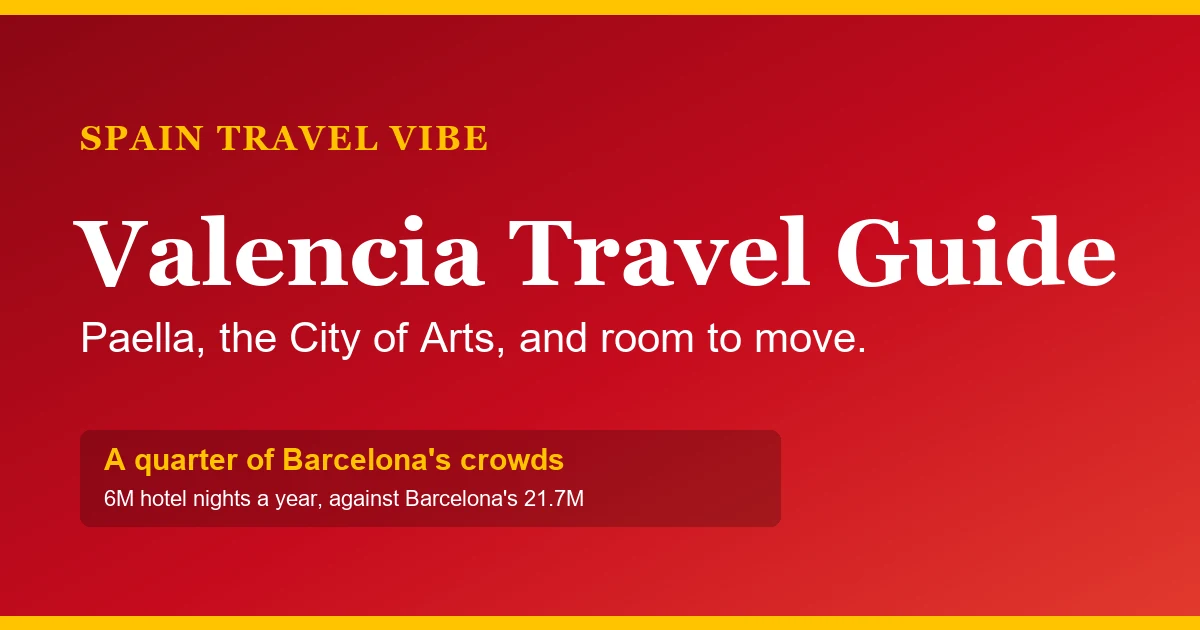
Valencia, Spain is the country’s third-largest city, with 844,424 residents on the municipal padrón (Ajuntament de València, 2025). INE puts it 3,255 lower, a gap the two bodies are still reconciling. In 2025 it took roughly 6.0 million hotel overnight stays. Barcelona took 21.7 million.
Disclosure: Some links in this guide may earn us a commission, at no extra cost to you. It never changes what we recommend.
That gap is the reason to come.
It is also closing faster than anywhere else in Spain, which is why this guide argues for going sooner rather than simply going.
Two things are missing from most of what ranks for Valencia. Prices quoted with no date attached, and near-silence on the thing every visitor is quietly wondering about: the flood of October 2024.
This Valencia travel guide covers both, plus where the paella actually is.
Key Takeaways
- Valencia took about 6.0 million hotel overnight stays in 2025 against Barcelona’s 21.7 million and Madrid’s 21.4 million, roughly a quarter of either.
- It is also filling up fast. Valencia hotels ran 91.2% occupancy in the first half of 2026, with rates rising faster than in any other major Spanish city.
- The 2024 flood devastated l’Horta Sud, the belt south of the city, not the historic centre or the beaches, though sixteen people did die within the municipality. The metro network has been running again since June 2025.
- There is no tourist tax. The Valencian levy was repealed in 2023 before it ever took effect.
- The City of Arts and Sciences prices by date, so an adult ticket swings about €7 depending on when you go.
- Go in May, or late September into October, and accept that October is both the nicest month and the wettest.
Before narrowing down a city, it helps to know how it fits: my guide to where to go in Spain, region by region, puts Valencia against the other sixteen.
Table of Contents
Is Valencia Safe to Visit After the Floods?
Yes, and the geography is the reason. The DANA of 29 October 2024 killed 231 people in the province of Valencia, the official toll recognised by the investigating court at Catarroja as of July 2026 (CGPJ / TSJCV, 2026). It devastated l’Horta Sud, the belt of towns immediately south of the city, along with inland comarcas to the west. Paiporta, Catarroja, Alfafar, Massanassa, Picanya and Benetússer took the worst of it, as did Chiva and Utiel further inland. It did not flood the centre. The first official municipal breakdown, published two weeks after the flood, put Paiporta at 45 deaths, Catarroja at 25 and Alfafar at 15, against a then-total of 216 (CGPJ / TSJCV, November 2024).
This is not a story about a city that escaped. Sixteen people died within the municipality of València itself on that November 2024 count. But the historic centre, El Carme, Russafa, the beaches and the Ciutat de les Arts i les Ciències were not flooded. A visitor staying in any of them will see no damage.
The main commuter routes are running again. Cercanías lines C-1 and C-2 reopened on 16 December 2024, covering 31.2 kilometres of rebuilt track (Ministerio de Transportes, 2024). Metrovalencia brought back the last of its network on 27 June 2025, eight months after the flood. That took rebuilding more than 50 kilometres of track and around 20 stations, Paiporta among them (Generalitat Valenciana via El Español, 2025).
Not every inland service is back to normal, so check Renfe before travelling if your route runs west toward Utiel. Nothing on a normal city visit is affected.
Repair is not the same as protection, and it would be dishonest to blur them. Channel widening and floodable parks, the defences that would actually change the outcome, are still at project stage (El Debate, 2025). In August 2026 the Generalitat allocated €56.4 million to clearing the Poyo and Túria channels and planting 400,000 trees (Moncloa.com, August 2026).
One thing a visitor may encounter: accountability protests have run in the city since 2024, and larger demonstrations gather around the 29 October anniversary. A criminal investigation continues at Catarroja. Neither is aimed at visitors, and neither is a safety concern, but if you are here in late October you will see the city marking it. My guide to whether Spain is safe, city by city, covers the ordinary risks.
How Underrated Is Valencia, Really?
On the numbers, substantially. Valencia recorded roughly 6.0 million hotel overnight stays in 2025 (Visit València via El Español, 2026), against Barcelona’s 21.7 million and Madrid’s 21.4 million (Colliers via Metrópoli Abierta, 2026). That is about 28% of either, for a city with a quarter of Madrid’s population.
Here is the part the other guides have not caught up with. Valencia’s hotels ran 91.2% occupancy in the first half of 2026. Average daily rates were up 9.5% and revenue per available room up 13.5%, the strongest growth of any major Spanish city (Cushman & Wakefield / STR Hotel Barometer via Hosteltur, 2026). Barcelona managed 78.4% and Madrid 78.9%.
So “hidden gem” is already out of date. Valencia is underrated on volume and no longer underrated on price. Rooms averaged €117.23 a night across 2025 (Visit València via El Español, 2026). The national average for the first half of 2026 was €163.40 (Cushman & Wakefield / STR, 2026). Those are different metrics over different periods, so read them as a direction rather than a gap. Around 1,500 tourist-use flats came off the market between August 2024 and February 2025 (Ajuntament de València, 2025), so legal supply is tightening as demand climbs.
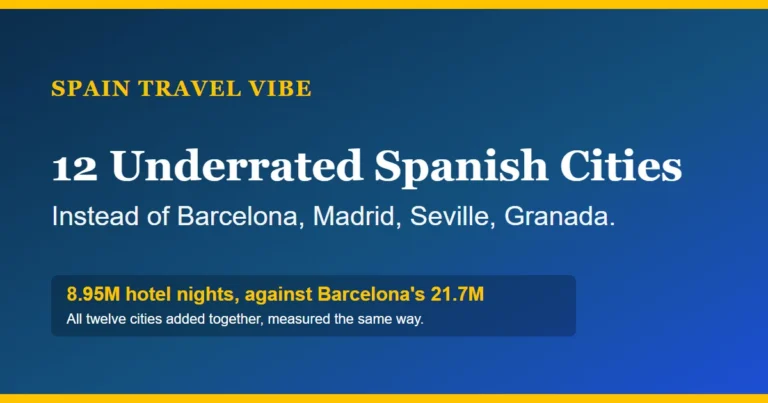
All of which makes this a timing argument rather than a recommendation. If Valencia is on your list, the case for going sooner is stronger than the case for going at all. My roundup of twelve underrated Spanish cities worth choosing instead of the big four runs the same volume test on smaller places. My 2026 Spain budget breakdown puts those room rates in national context, and the Barcelona and Madrid guides cover what you would pay instead.
What Does the City of Arts and Sciences Actually Cost?
There is no single price, which is why most of the figures online are wrong. The Oceanogràfic prices by date across a low, mid and high season, so an adult ticket costs anywhere from €35.90 to €43.05 depending on when you go (Oceanogràfic, verified August 2026).
| Ticket | Adult | Child 4-12 |
|---|---|---|
| Oceanogràfic only | €35.90-€43.05 | €26.65-€31.95 |
| Oceanogràfic + Hemisfèric | €37.50-€45.00 | €28.25-€33.90 |
| Oceanogràfic + Museu de les Ciències | €37.70-€45.40 | €28.45-€34.30 |
| All three venues | €44.00-€51.25 | €34.75-€40.40 |
Bands read off the official Oceanogràfic pricing page on 20 August 2026. Under-4s go free. The low end is off-season and the high end is peak, so the date you choose moves the price by roughly €7.
Buy the three-venue ticket if you are staying more than a day, because it stays valid across two or three consecutive days rather than forcing everything into one visit. The Valencia Tourist Card takes a further 10% off.
Buy from the venue rather than anywhere else. The official Visit València shop sells the three-venue ticket at a flat €51.25 for adults. That is the very top of the operator’s range, so booking an off-season date directly can save you real money. Resellers advertising well below these bands are not quoting what the venues publish. For how a day here fits a wider budget, see my 2026 Spain trip cost breakdown.
Where Do Locals Actually Eat Paella?
Not in the old town, and not at dinner. Paella is a lunch dish in Valencia, and the versions locals rate are in l’Albufera, the rice-growing lagoon south of the city, and at the beach restaurants beyond it.
Paella also has a documented recipe, which is more than most food arguments can claim. Wikipaella spent 18 months on it, across roughly 200 restaurants and more than 40 expert interviews. The result is a list of ten authentic ingredients: rice, chicken, rabbit, ferradura flat green beans, garrofó butter beans, tomato, saffron, extra virgin olive oil, water and salt (Wikipaella via El Periódico de Aquí).
Visit València’s own account adds sweet paprika and rosemary, notes that garlic is genuinely disputed, and specifies that the rice should carry the D.O. Arròs de València designation, meaning the Senia, Bomba or Albufera varieties grown in the lagoon. It should be cooked over an open flame in a wide two-handled pan, and traditionally eaten straight from it (Visit València, verified August 2026).
There is a nuance worth knowing. The purist line is “never onion,” but Wikipaella’s own research documents paella de ceba, a traditional Valencian variant made with it (Valencia Plaza, 2023). Chorizo is still not traditional. But the rule is narrower than the internet suggests.
For where to go, the tourist board itself points at El Palmar and the Albufera restaurants, the beachfront at Pinedo and El Saler, and the rural barraques outside the city. Take the recommendation from them rather than from me: I have not eaten my way through all of them, and a guide that pretends otherwise is not worth much.
When Should You Visit Valencia?
May, or late September into October. Valencia averages a daily maximum of 23.4°C in May and 24.3°C in October, against 29.7°C in July and 30.2°C in August (AEMET, 1981-2010 normals, the series AEMET publishes for this station).
One honest caveat: October is both the best-feeling month and the wettest, at around 77mm against 70mm in September. Autumn is when the Mediterranean coast gets its rain, and it is the season that produced the 2024 DANA. That is not a reason to avoid October. It is a reason to have a wet-weather plan and to take weather warnings seriously if one is issued.
Summer is the harder sell each year. On 9 July 2026 Xàtiva, in Valencia province, hit 43.9°C, the highest temperature recorded anywhere in Europe that day (El Debate citing AEMET, 2026). Coastal Valencia is milder than the interior, but the trend is unhelpful.
| When | Avg daily max | Rainfall | The call |
|---|---|---|---|
| November to February | 16.4-19.8°C | 36-48mm | Mild, quiet and cheap. Too cool for the beach |
| March | 19.3°C | 33mm | Fallas. Wonderful, but book months ahead |
| April to May | 20.8-23.4°C | 38-39mm | The best all-round window |
| June | 27.1°C | 22mm | Warm, dry, sea still cool |
| July to August | 29.7-30.2°C | 8-20mm | Hottest and busiest, with real heatwave risk |
| September | 27.9°C | 70mm | Warm sea, warm air, rain returns |
| October | 24.3°C | 77mm | Best-feeling month and the wettest |
Climate figures: AEMET normals for station 8416 València, 1981-2010 series.
March is the exception to all of this, because of Las Fallas.
Everything fills, rates multiply and the noise runs from early morning to late at night. It is either the best week of the year here or the worst possible time to arrive, and there is no middle position. Fallas 2026 was the most touristic on record, with March setting 450,030 hotel overnight stays, up 16% year on year (Visit València via elperiodic, 2026). The festivity has been on UNESCO’s intangible cultural heritage list since 2016, which describes it as running from 14 to 19 March (UNESCO).
For 2027, the one date you can rely on is the Cremà on 19 March, because it falls on Sant Josep every year. The Junta Central Fallera had not published the full programme when I checked in August 2026, so confirm the surrounding days before booking anything. My full Spain festival calendar has the confirmed 2027 dates, including how close Fallas runs to Semana Santa that year. My region-by-region month guide covers how the Mediterranean coast differs from the rest of Spain.
How Many Days Do You Need in Valencia?
Three nights. That is slightly above the 2.48-night average stay Visit València records (Visit València via El Español, 2026), and it is the point at which the city stops feeling like a stopover.
A workable shape: day one for the old town, the Mercat Central and the cathedral. Day two for the City of Arts and Sciences in the morning, then the beach at Malvarrosa or El Cabanyal. Day three for l’Albufera and a paella lunch. Anything shorter and the Albufera is the thing that gets cut, which is a shame because it is the most distinctive half-day here.
Valencia works better as a second or third stop than as a first. Madrid to Valencia is under two hours by high-speed train, which makes it an easy addition to a two-week route rather than a destination you fly into cold. My itinerary-length guide works through how many bases a trip can carry, and the comparison of Spain’s rail operators covers that leg specifically.
Valencia Is a City Built for Cycling
Valencia is the one big Spanish city where cycling is the obvious default rather than a novelty. Credit the Jardí del Túria, a park more than nine kilometres long that runs through the middle of the city with no traffic on it at all.
That park exists because of a flood. The Túria burst its banks on 14 October 1957. The response was to divert the river south of the city altogether, leaving a dry channel curving through the middle of it (Visit València).
What happened next is the good part. Planners wanted a twelve-lane motorway in that empty riverbed. Residents campaigned against it through the 1970s and 80s under the slogan that the river was theirs and they wanted it green, they won, and the gardens opened in 1986.
That diversion is a large part of why the 2024 DANA spared the centre. Valencia’s best-loved park and its main flood defence are the same piece of infrastructure, built after the last catastrophe and quietly doing its job during the most recent one. Valencia was named European Green Capital in 2024, the second in Spain after Vitoria-Gasteiz (European Commission, 2024), and the riverbed is the clearest reason why.
The city counted around 161 kilometres of segregated cycle lane, plus a further 30 kilometres of ciclocalles. Those are the figures from its own cycling guide (Ajuntament de València, figures published 2020). There is a public bike-share scheme too, though I could not read the operator’s current tariff page, so I’m not going to quote you a price for it.
From the airport, Metrovalencia lines 3 and 5 reach the centre in around twenty to twenty-five minutes. The fare is roughly €4.80, plus €1.10 to €2.10 once for the reusable card itself (Visit València, 2026). That figure comes from the city tourist board rather than the operator, whose tariff pages I could not reach, so treat it as indicative and check metrovalencia.es before you travel.
Where Should You Stay in Valencia?
Ciutat Vella for a first visit, Russafa for food and evenings, El Cabanyal for the beach, Eixample for quiet.
Ciutat Vella puts you inside the old town and within walking distance of most of what you came for, at the cost of some night noise. Russafa has been the food neighbourhood for a decade and is close enough to walk in, which makes it the best compromise for a second visit. El Cabanyal, the old fishermen’s quarter out by the beach, is a genuinely different stay if the sea matters more to you than the cathedral does. It has also changed more than anywhere else in the city these last five years. Eixample is residential, calmer and better value per euro, at the price of a longer walk to everything.
Budget around the city average of €117.23 a night and adjust from there: Ciutat Vella and the seafront sit above it, Eixample and the outer barrios below. That average is still well under Barcelona’s or Madrid’s, which is the whole argument for coming here.
Book earlier than you would for Seville or Granada. Valencia’s rates rose 9.5% in the first half of 2026, faster than any major Spanish city’s. The council has also removed around 1,500 tourist-use flats from the market, so legal supply in the neighbourhoods people actually want is tighter than it was.
Five Mistakes First-Timers Make in Valencia
- Ordering paella for dinner in the old town. It is a lunch dish, and the good versions are south of the city in the Albufera.
- Trusting a flat price for the Oceanogràfic. The official price is a date-based band, so a single quoted figure is right only by luck.
- Expecting to see flood damage. The 2024 DANA hit the towns south of the city, roughly eight kilometres out. There is no visible damage in the centre or on the beaches, though sixteen people did die within the municipality.
- Booking March without checking the Fallas dates, or deciding to attend Fallas without booking months ahead.
- Treating October as a safe shoulder month. It is the most pleasant month and also the wettest.
Frequently Asked Questions
Is Valencia safe to visit after the 2024 floods?
Yes. The flood hit l’Horta Sud, the belt of towns south of the city, and inland comarcas to the west. It did not flood the historic centre, Russafa or the beaches, though sixteen people did die within the municipality itself. The metro network has been running again since June 2025, and the C-1 and C-2 Cercanías lines since December 2024.
Does Valencia have a tourist tax?
No. The Valencian regional tax created by Ley 7/2022 was repealed by Decreto ley 12/2023 in November 2023, before it ever came into force, and nothing has replaced it. My city-by-city tourist tax guide covers where in Spain you do pay.
How many days do you need in Valencia?
Three nights. That covers the old town, the City of Arts and Sciences with a beach afternoon, and a day in l’Albufera, and it sits just above the 2.48-night average stay the city records.
Is Valencia cheaper than Barcelona or Madrid?
Against the national benchmark, yes for now. Valencia averaged €117.23 a night across 2025, below the €163.40 Spanish national average for the first half of 2026, though those are different metrics over different periods. The gap is closing: Valencia’s rates rose 9.5% in the first half of 2026, against 1.8% in Barcelona and 3.2% in Madrid.
Where do locals eat paella in Valencia?
In l’Albufera and El Palmar, at the beach restaurants at Pinedo and El Saler, and in the rural barraques outside the city. At lunch, not dinner.
Valencia Travel Guide: Why the Timing Matters
If you take one thing from this Valencia travel guide, take the arithmetic. This is the big Spanish city where the crowd maths still works in your favour. It takes 28% of Barcelona’s hotel nights, charges no tourist tax, has a park more than nine kilometres long where the river used to be, and grows some of the country’s best rice twenty minutes south.
The flood that made the international news did terrible damage, and it did most of it in towns roughly eight kilometres from anywhere you are likely to stay. Saying that plainly is more useful than avoiding the subject.
What is changing is the price. Occupancy and rates are climbing faster here than in Madrid or Barcelona, and the flats are being regulated out of the market at the same time. Want to know when Spanish prices, rules or tickets shift before your trip? Join the free Spain rules and updates list.
If you are building a longer route, my guide to where to go in Spain shows where Valencia sits among the seventeen regions, my San Sebastián guide makes the same go-where-the-numbers-aren’t case on the Atlantic, while the Barcelona and Madrid guides cover the two cities most people pair it with, and Seville and Granada open up the south.