

Last verified: October 14, 2026, for this Spain itinerary guide. Every train time here comes from Renfe’s own timetable feed, downloaded on October 14, 2026 and read for Tuesday, November 10. The stay figures come from INE’s 2025 border and hotel surveys. I re-check both every month and change the date above when I do.
How many days does a first Spain itinerary through Madrid, Andalusia and Barcelona need? Ten, and seven only if you settle for two bases. Yet 73% of the 96.8 million international tourists who came in 2025 stayed a week or less (INE, FRONTUR 2025).
That gap is why so many trips feel like a relay race. The cities are close on a map. The trains between them are not as fast as the guidebooks say, and every hotel change eats half a day.
Disclosure: Some links in this guide may earn us a commission, at no extra cost to you. It never changes what we recommend.
So I built this guide from two public datasets instead of rules of thumb. Renfe’s timetable gives the real leg times. INE’s hotel survey shows how long visitors actually stay in each city. Together they tell you how many cities each trip length can carry, and in what order.
Key Takeaways
- 7 days fits two bases, Madrid and Seville, or Barcelona and Valencia. 10 days fits four cities. 14 days adds a fifth city or a second region.
- Foreign hotel guests averaged 1.85 nights in Granada and 2.3 to 2.6 in Madrid, Seville and Barcelona in 2025 (INE). Plan three in the big three.
- The fastest nonstop Madrid to Barcelona train takes 3h02 this autumn, against 2h37 before the speed limits imposed in February 2026.
- A one-way route (in Madrid, out Barcelona) needs 12h14 of train time for four cities; using Madrid as a base needs 18h08.
- Book the Alhambra before anything else. Its tickets release in three waves, and the dates you get there fix the rest of the route.
Table of Contents
How Many Days in Spain Do You Need?
Ten days is the right length for a first Spain itinerary that takes in Madrid, Seville, Granada and Barcelona. Seven days covers two bases well. Fourteen adds a fifth city or a second region. Nearly half of all visitors, 48.5% in 2025, stayed four to seven nights, and the “golden triangle in a week” plan is the one many of them attempt (INE, FRONTUR 2025).
Here’s the short version before the detail. I count each city in nights, then add the train time between them, then check that the trip still has more sightseeing days than travel days.
| Trip length | Bases | Nights per city, in order | Train legs | Scheduled train time |
|---|---|---|---|---|
| 7 days | 2 | Madrid 3, Seville 3 | 1 | 2h38 |
| 10 days | 4 | Madrid 3, Seville 2, Granada 2, Barcelona 2 | 3 | 12h14 |
| 14 days | 5 | Barcelona 3, Valencia 2, Madrid 3, Granada 2, Seville 3 | 4 | 10h51 |
Notice the 14-day trip has less train time than the 10-day one. That isn’t a typo. The 10-day route has to make the long jump from Granada to Barcelona, and the 14-day route avoids it by running the other way round the country. Which matters more, then, the length or the order? In my experience, the order.
Also worth knowing: 2026 is leaning shorter, not longer. In January to August, stays of two to three nights grew 9.7% on the year while stays of eight to fifteen nights fell 0.7% (INE, FRONTUR monthly).
How Long Do Visitors Actually Stay in Each City?
Not long. In 2025 foreign hotel guests averaged 2.32 nights in Madrid, 2.35 in Seville, 2.55 in Barcelona and just 1.85 in Granada. Those figures are my calculation from INE’s hotel occupancy survey, total nights divided by travellers for the whole year (INE, table 2078).
Two nights sounds fine until you count the hours. You arrive mid-afternoon, you leave mid-morning, and the stay contains exactly one full day. That is enough for Granada if the Alhambra slot is in the morning. It isn’t enough for Madrid, which has three of Europe’s great art museums within a 15-minute walk of each other, or for Seville, where the Alcázar, the cathedral and an evening in Triana each want their own half day.
So my rule for any Spain itinerary is simple. Three nights in Madrid, Seville and Barcelona. Two in Granada, Valencia and San Sebastián. One night or a day trip for Córdoba and Toledo, which is close to what visitors already do there: 1.63 and 1.59 nights on average.
The Toledo number deserves a second look. It is so low because most people see it from Madrid. Renfe runs 20 direct trains a day each way, at 34 minutes, which is why my ranking of day trips from Madrid treats it as a day out rather than a stop. The same logic works for Córdoba from Seville, 40 minutes on the fastest of 39 direct trains.
One caveat. INE counts each hotel check-in, so a traveller who moves hotels inside one city is counted twice. The real city stays are a little longer than the averages. In Madrid, Seville, Barcelona and San Sebastián they are still likely to fall short of the three nights I plan, which is the point.
The Real Cost of Changing Cities
A city change costs more than the timetable suggests. Madrid to Seville is 2h38 on the fastest direct Renfe train, but the day around it is closer to five hours: checkout, the metro to Atocha, the bag scanner every high-speed station in Spain runs, the ride, then a taxi and check-in at the other end. These times come from Renfe’s own timetable feed (Renfe open data, October 2026).
| Leg | Direct Renfe trains, Tue 10 Nov 2026 | Fastest | Typical |
|---|---|---|---|
| Madrid to Toledo | 20 | 0h34 | 0h34 |
| Seville to Córdoba | 39 | 0h40 | 0h43 |
| Madrid to Córdoba | 30 | 1h34 | 1h44 |
| Madrid to Valencia | 14 | 1h54 | 2h00 |
| Madrid to Seville | 19 | 2h38 | 2h41 |
| Seville to Granada | 4 | 2h37 | 2h39 |
| Madrid to Málaga | 11 | 2h47 | 2h55 |
| Barcelona to Valencia | 8 | 2h47 | 3h01 |
| Madrid to Barcelona | 25 | 3h02 | 3h17 |
| Madrid to Granada | 4 | 3h23 | 3h32 |
| Madrid to San Sebastián | 3 | 5h04 | 5h16 |
| Granada to Barcelona | 1 | 6h59 | 6h59 |
These are Renfe’s trains only. Iryo and Ouigo add their own services on Madrid’s busiest routes, and Iryo’s 2027 timetable adds 39% more Madrid to Seville trains (Europa Press via Demócrata, 2026). They share the same track, so the journey times are close.
The figure that surprises people is Madrid to Barcelona. Most guides still say 2h30, and the fastest was 2h37 before this year. Since February 2026, trains have run at 160 km/h instead of 300 on several sections, mainly between Madrid and Zaragoza, and Adif and the three operators agreed to keep the slower timings until the end of the year (Ara, 2026). The fastest nonstop in Renfe’s November timetable is 3h02. For the fares behind each operator, my guide to getting around Spain compares Renfe, Iryo and Ouigo route by route.
I count every city change as half a sightseeing day gone. On a 7-day trip, a third city costs you the best part of a day, and that day comes out of the cities you came to see.
Is 7 Days Enough for a Spain Itinerary?
Seven days is enough for two bases done properly, not for three. A 7-day Spain itinerary of Madrid (3 nights) and Seville (3 nights) needs one train leg of 2h38. Add Barcelona and you add a 3h02 leg plus a flight home from the far end, and two of your six nights become travel nights.
I’d pick one of two shapes. The first is Madrid and Andalusia: three nights in Madrid with a Toledo day trip, then three in Seville with Córdoba as a day trip. You see four cities from two hotels. The second is Barcelona and the coast: four nights in Barcelona, then two in Valencia, 2h47 down the line. That one suits a summer trip, because both bases have beaches inside the city.
| 7-day plan | First base | Second base | Day trips | Fly in / out |
|---|---|---|---|---|
| Madrid and Andalusia | Madrid (3 nights) | Seville (3 nights) | Toledo, Córdoba | Madrid / Seville |
| Barcelona and the coast | Barcelona (4 nights) | Valencia (2 nights) | Girona or Montserrat | Barcelona / Valencia |
What doesn’t work in a week? Madrid, Seville and Barcelona together. On paper it’s two train legs. In practice it’s 5h40 of scheduled train time, two checkouts and a day either side for flights, which leaves about three real sightseeing days for three of Europe’s biggest cities. If Granada is on your list, a week means choosing between it and Barcelona.
Both of the week-long plans also work in reverse. Fly into Seville and out of Madrid if the flights are cheaper that way. Price an open-jaw ticket against a return before you book, because it saves the last train back to where you started.
The 10-Day Spain Itinerary: Four Cities, Three Trains
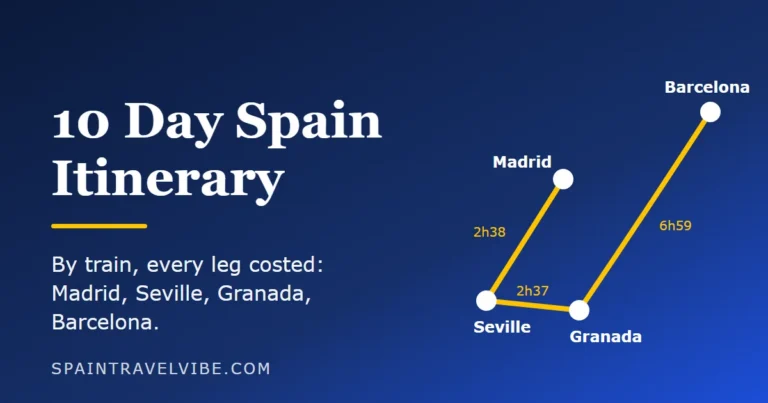
Ten days is where the classic Spain itinerary fits without rushing: Madrid 3 nights, Seville 2, Granada 2 and Barcelona 2, flying into Madrid and home from Barcelona. That is three train legs and 12h14 of scheduled time on Renfe’s fastest direct services, with the longest leg, Granada to Barcelona, falling after the Alhambra is done.
South first, then the long jump east, means you never sleep in the same city twice or double back to change trains. It also puts Seville and Granada next to each other: 2h37 on one of four direct trains a day.
Granada to Barcelona is the leg to plan around. Renfe runs one direct train a day, at 6h59. The alternative is two trains via Madrid: 3h27 to Atocha, then 3h02 onward, with a change of at least half an hour. Or you fly, which is quicker in the air and slower door to door. I take the direct train and treat it as a rest day with a window seat, but if you’d rather arrive for dinner, the Madrid change gives you more departure times.
Here is how that 10-day Spain itinerary falls, day by day. My 10 day Spain itinerary with every leg costed prices each train, ticket and hotel night:
| Day | Where | What the day holds |
|---|---|---|
| 1 | Madrid | Fly in, check in, an evening walk through the old centre |
| 2 | Madrid | The Prado in the morning, the Retiro in the afternoon |
| 3 | Madrid | Day trip to Toledo, 34 minutes each way |
| 4 | Madrid to Seville | Morning train (2h38), the Alcázar in the afternoon |
| 5 | Seville | Cathedral and Giralda, then Triana in the evening |
| 6 | Seville to Granada | Train (2h37), the Albaicín at sunset |
| 7 | Granada | Morning Alhambra slot, the afternoon free |
| 8 | Granada to Barcelona | The direct train (6h59), or two trains via Madrid |
| 9 | Barcelona | Sagrada Família early, then the Gothic Quarter |
| 10 | Barcelona | A last morning, then fly home |
Swap Granada for Córdoba and the route gets easier. Run it Madrid, Córdoba, Seville, then Barcelona: Córdoba needs one night rather than two, Barcelona gets the night back, and the last leg becomes Seville to Barcelona, 6h17 on one of two direct trains. You lose the Alhambra, though, and for most first-time visitors that’s the wrong trade.
If you’re weighing up where each night goes, my Madrid travel guide and Seville travel guide show what three nights in each actually covers. The Granada travel guide is built around two nights and a morning Alhambra slot, and my Barcelona travel guide shows what to cut when the city only gets two.
14 Days: A Fifth City or a Second Region
Two weeks buys either a fifth city or a different region. The fifth city suits a first visit; the region suits anyone who has seen Madrid and Barcelona before. My 14-day Spain itinerary runs Barcelona 3, Valencia 2, Madrid 3, Granada 2 and Seville 3, which is 13 nights, four train legs and 10h51 of scheduled train time. That’s less time on the rails than the 10-day route, because it never makes the Granada to Barcelona jump.
Fly into Barcelona and home from Seville, which has direct flights to much of Europe, or run the whole route the other way round if the fares are cheaper from Seville. Valencia earns its two nights. It sits between Barcelona and Madrid on the fast lines (2h47 from Barcelona, 1h56 on to Madrid), and my Valencia travel guide explains why it’s the city most first-time routes skip and shouldn’t.
The other way to spend the extra four days is a region, and two work well. The first is the north. Madrid to San Sebastián is 5h04 on one of three direct trains, so treat it as a region of its own: three nights in San Sebastián, then Bilbao and Cantabria, or on to Galicia by car. My Green Spain itinerary covers that route, and west of Bilbao it’s car country.
The second is Andalusia by car. Drop Barcelona entirely and give the south nine days: Seville, Córdoba, Granada, the white towns and Ronda. My Andalusia road trip has the driving times and the order I’d take them in.
What I wouldn’t do is stretch a 14-day Spain itinerary across seven or eight cities. Picture a two-week plan that adds Córdoba, Ronda, Málaga and Toledo to the classic four. Each one is worth seeing. Together they put you on a train or a bus every second day, and the trip ends up as tiring as the rushed week it was meant to replace.
Linear or Hub-and-Spoke: Which Route Shape Wastes the Least Time?
The one-way route wins by a wide margin. For the same four-city Spain itinerary, flying into Madrid and out of Barcelona needs 12h14 of scheduled train time. Flying in and out of Madrid adds the 3h02 ride back, for 15h16. Returning to a Madrid base between each city takes 18h08, almost six hours more than the one-way plan. All three totals are my sums of the fastest direct Renfe trains on November 10, 2026.
The base plan is tempting because you unpack once. But Spain’s fast lines run out of Madrid like spokes on a wheel, and the cities at the ends of the spokes don’t connect well to each other. Seville to Barcelona has two direct trains a day at 6h17. Granada to Valencia has none at all.
Backtracking is the most common Spain itinerary mistake I see. Someone stays in Madrid, sees Segovia to the north on one day and Toledo to the south on another, then takes a train south to Seville and flies back to Madrid to go home. Every one of those is a good idea on its own. The trouble is the sequence: it spends a full day going back over ground already covered.
The fix costs nothing: book an open-jaw flight, into one city and out of another. Then let the route run in one direction. For the trip as a whole, what to budget for each leg and night is in my breakdown of what a Spain trip actually costs.
Which Bookings Should Fix Your Dates First?
Book the Alhambra first, then build the Spain itinerary around the date you get. The Patronato releases its direct-sale tickets in three waves: roughly 36% a year ahead, 22% at three months and 12% at one month (Patronato de la Alhambra, 2020). Granada’s two nights have to wrap around that slot.
| Booking | When to book | Why it fixes the route |
|---|---|---|
| Alhambra, Nasrid Palaces | At the year-ahead wave, or the 3-month one at the latest | Timed entry; Granada’s nights depend on it |
| Sagrada Família | Two to three weeks ahead, more during the Gaudí centenary year | Timed slots; early weekday entries sell last |
| Long train legs | As soon as Renfe, Iryo or Ouigo open sales | Cheapest seats go first on Madrid’s busiest routes |
| Hotels in Seville in spring | Months ahead for Semana Santa and the Feria | City-wide price spike on festival weeks |
Everything else can follow. The Sagrada Família is easier than its reputation, and my guide to Sagrada Família tickets explains why two to three weeks is usually enough. The Alhambra is the hard one. If the slot you want has gone, how Alhambra tickets actually work lists the fallbacks in the order I’d try them.
Season changes the route too. A July trip through Seville and Córdoba means sightseeing in the morning and evening only, and long afternoons indoors. For when each region is at its best, see my month-by-month guide to the best time to visit Spain.
Picking Your Spain Itinerary From Here
Start from the number of days you have, then cut cities rather than nights. Seven days: two bases. Ten days: four cities in one direction. Fourteen days: five cities, or four plus a region. Adding a city without adding nights is what turns a good Spain itinerary into a rushed one, and the trains are slower this year than most guides admit.
If you only have a week and want more than one city, day trips are the cheapest way to add places. A base with good trains out of it, Madrid or Seville, gives you two extra cities for the price of a train ticket and no checkout. My where to go in Spain guide compares the regions if you haven’t chosen yet.
Before you book, check the rules at the border too. If you hold a non-EU passport, the EU’s new entry requirements for Spain mean fingerprint registration on your first arrival, so allow extra time at the airport on day one. Then the dates, the trains and the hotels can go in that order. For the bigger picture, from money to when to go, my complete Spain travel planning guide covers the rest.
Frequently Asked Questions
How many days in Spain is enough for a first trip?
Ten days is enough for a first Spain itinerary through Madrid, Seville, Granada and Barcelona. That’s nine nights split 3, 2, 2 and 2, with three train legs and about 12 hours of scheduled train time on Renfe’s fastest direct services. With seven days, stick to two bases; with fourteen, add Valencia or a second region.
Is 7 days enough for Spain?
Seven days is enough for two bases, not three. Madrid and Seville with three nights each, plus day trips to Toledo and Córdoba, gives you four cities from two hotels. Adding Barcelona means a 3h02 train and a flight home from the far end, which leaves about three real sightseeing days.
How long is the train from Madrid to Barcelona?
The fastest nonstop Renfe train takes 3h02 in the November 2026 timetable, and a typical service takes about 3h17. Speed limits on sections between Madrid and Zaragoza have added roughly 25 minutes since February 2026, and Adif and the three operators agreed to keep them until the end of the year (Ara, 2026).
How many nights should I spend in each Spanish city?
Three in Madrid, Seville and Barcelona, two in Granada and Valencia, and one or a day trip for Toledo and Córdoba. Foreign hotel guests averaged only 1.6 to 2.7 nights in these cities in 2025, according to INE’s hotel survey, so most visitors leave before a third night.
What is the biggest mistake in a Spain itinerary?
Backtracking. Using Madrid as a base for Seville, Granada and Barcelona takes 18h08 of train time, against 12h14 for a one-way route from Madrid to Barcelona. Book an open-jaw flight, into one city and out of another, and let the route run in one direction.