


Last verified: August 24, 2026. This page rests on two INE hotel tables that are published monthly and revised afterwards, so every figure here can move. I re-pull table 2078 for overnight stays and table 2076 for bed-places, recompute the twelve-city totals and the year-on-year comparison, and update the date above each time. Journey times are deliberately absent: I could not verify any of them at source on this pass.
Spain’s national tourist board is spending around €30 million to persuade you not to go to Barcelona. The campaign is called “Think You Know Spain? Think Again”, it launched in June 2025, and its stated aim is to move visitors toward less-visited cities, outside peak season, for longer stays (Turespaña).
Disclosure: Some links in this guide may earn us a commission, at no extra cost to you. It never changes what we recommend.
Here’s the odd part. The underrated cities in Spain it steers you toward are not filling up.
I pulled Spain’s city-level hotel data for the twelve cities in this article and compared the first seven months of 2026 against the same seven months of 2025. Their combined overnight stays fell 0.5%. Barcelona’s rose 1.9% over exactly the same period. Seville’s rose 2.0%.
That’s inconvenient for the tourist board and excellent for you. The places everyone keeps recommending are, by the only measure that counts, still empty.
Key Takeaways
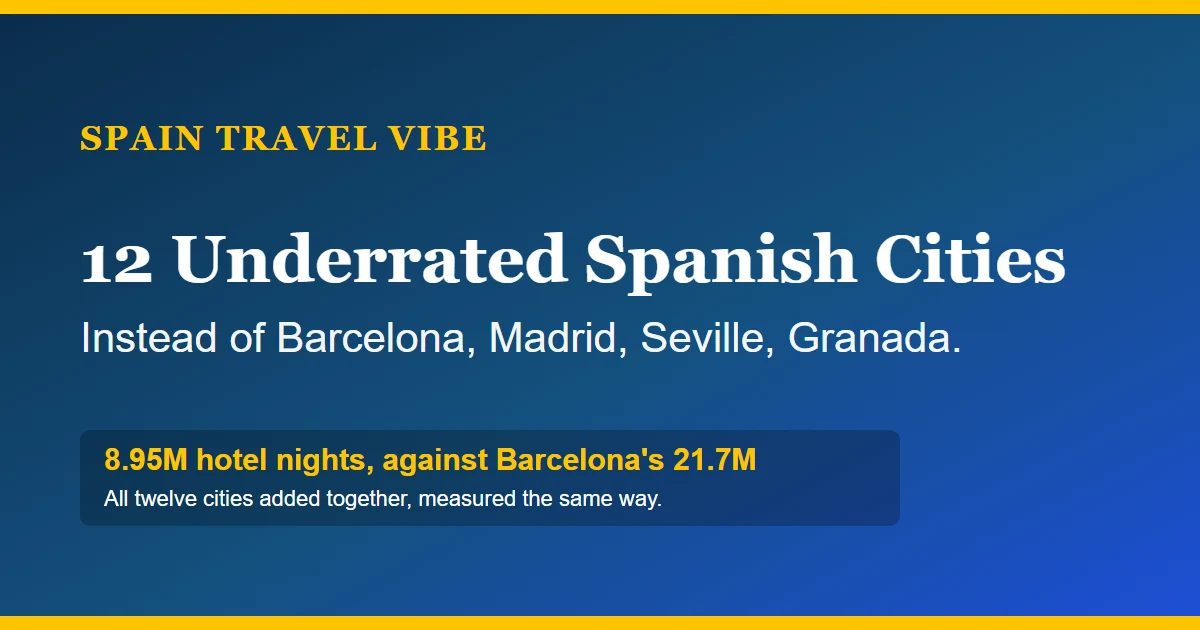
- The twelve cities here recorded 8,950,104 hotel overnight stays in 2025 between them. Barcelona alone recorded 21,709,481 (INE, provisional).
- From January to July 2026 the twelve went backwards by 0.5% while Barcelona grew 1.9% and Seville 2.0%. The dispersal everyone talks about is not showing up in the beds.
- Zaragoza has more residents than Seville and a third of its hotel nights: 693,091 against 689,423 on 1 January 2025 (INE, municipal register), and 2.0 million overnight stays against 6.6 million.
- Nine of the twelve hold the average visitor for under two nights, and seven for under 1.7. Most “hidden gem” lists are day trips in disguise.
- All twelve together offer about half the hotel beds Barcelona has, which is why they stay quiet and why you should still book early.
Table of Contents
By “the big four” I mean Barcelona, Madrid, Seville and Granada, the cities almost every first Spain trip is built from. This is a list for the second trip.
What Does “Underrated” Actually Mean in Spain?
It means four numbers, and Spain publishes all of them. In 2025, Barcelona took 21,709,481 hotel overnight stays and Madrid 21,407,623, against Seville’s 6,607,458 and Granada’s 3,435,247 (INE, provisional). Every city below sits in the same table, measured the same way.
The statistics institute reports travellers and overnight stays for roughly 110 individual Spanish towns and cities every month, free, through an open interface. Almost nobody uses it, which is why the “hidden gems” genre runs on adjectives. Four measures come out of it, and each answers a different question.
Overnight stays tell you how busy a place is. The share of those nights booked by people living outside Spain tells you whether it’s genuinely undiscovered or simply undiscovered by foreigners, which are very different trips. Nights per traveller tells you whether a city holds people or waves them through. And hotel bed-places tell you how much room there actually is.
One caveat I’d rather say out loud than bury. These are hotel nights. Apartments, hostels, campsites and rural houses aren’t in the table, so a city with a big rental sector is undercounted here. The comparison still holds, because every city is undercounted by the same rule.
Run the twelve months of 2025 for the cities in this article and the scale of the gap is hard to argue with:
Three cities that always top these lists aren’t on mine: Toledo, Segovia and Salamanca. They took 984,573, 577,475 and 1,171,483 hotel nights in 2025, which puts Salamanca ahead of ten cities below it. They’re famous, they’re close to Madrid, and they deserve their own treatment rather than a slot on a list about places nobody goes. My ranked guide to day trips from Madrid takes all three.
The level above this one is the regional picture, and it’s just as lopsided. Six of Spain’s seventeen regions absorb roughly nine of every ten international visitors (INE, 2025), which our region-by-region guide to where to go in Spain sets out in full.
Is Anyone Actually Going to These Cities?
No, and that’s the finding. Between January and July 2026 the twelve cities here recorded 4,974,080 hotel overnight stays, against 4,999,837 in the same seven months of 2025. That’s a fall of 0.5%. Over the identical window Barcelona rose 1.9%, Seville 2.0%, Madrid 1.4% and Granada 0.5% (INE, provisional).
Set that beside the campaign. Turespaña filmed across twelve mainland regions and more than sixty locations. Behind it sits roughly €30 million over three years, all of it telling international travellers to look past the obvious. A year on, the obvious is growing and the alternatives are flat.
I want to be careful here, because it would be easy to overclaim. Seven months of hotel data does not disprove a three-year campaign, and advertising works slowly. What the numbers show is a gap between the advice and the behaviour, not a verdict on the advertising.
The group is also flat for a slightly deceptive reason: it’s moving in both directions at once.
So the honest version of “go here instead” is that some of these places are being found and others are being forgotten. If you want the biggest gap between what a city offers and how many people are in it, look at the bottom of that chart, not the top.
The 12 Underrated Cities in Spain
Each city below is paired with the famous one it stands in for, and carries its own 2025 overnight-stay figure. I’ve left journey times out on purpose. I couldn’t verify a single one at source this week, and a wrong train time is worse than none.
1. Zaragoza, instead of Madrid
Zaragoza is the strangest omission in Spanish travel writing. On 1 January 2025 it had 693,091 residents (INE) against Seville’s 689,423 (INE), both from the municipal register. It is the larger city. It took 2,032,983 hotel overnight stays in 2025 to Seville’s 6,607,458, so roughly a third of the visitors for slightly more of the city.
What’s there: the Basílica del Pilar filling a riverfront square, and the Aljafería. That one is an eleventh-century Islamic palace that later became an Aragonese royal residence, and it forms part of the UNESCO listing for Mudéjar architecture in Aragón. Zaragoza also sits on the main high-speed line between Madrid and Barcelona, which makes it the easiest city here to bolt onto a trip you’ve already booked.
The limit: 1.68 nights per traveller says most people treat it as a stop. Summer is brutal on the Ebro, and 29.3% of its hotel nights are foreign, so English is thinner than you’d expect in a city this size.
2. Cartagena, instead of Málaga
Cartagena holds visitors longer than Barcelona does. It runs 3.22 nights per traveller against Barcelona’s 2.41, on 998,554 overnight stays in 2025.
The city is a natural harbour that has been fought over for 2,000 years. The headline is the Roman theatre found underneath it in the late twentieth century. There’s also a working naval base, a modernist high street, and the beaches of the Mar Menor within reach.
The limit: that 3.22 is doing something specific. It isn’t measuring a long city break, it’s measuring a beach holiday with a city attached. Only 24.1% of the nights are foreign, so this is largely a Spanish summer destination, and in August it behaves like one.
3. Vitoria-Gasteiz, instead of San Sebastián
The Basque capital that nobody books. Vitoria-Gasteiz took 887,376 overnight stays in 2025 against San Sebastián’s 2,199,922. It was also the first Spanish city named European Green Capital (European Commission).
The old town is a compact medieval almond of stacked streets. The pintxo culture is genuine rather than performed, and the bed prices bear no relation to what the coast charges. If the Basque food country around San Sebastián appeals but the prices don’t, this is the answer.
The limit: it’s the second-steepest faller in the group, down 6.2% in 2026, which tells you the market hasn’t noticed it yet. The Basque tourist tax also becomes payable from 1 January 2027. This is one of the few cities here where the cost picture changes soon.
4. Burgos, instead of Toledo
Burgos has a Gothic cathedral on the UNESCO World Heritage list and a castle hill above it. The Arco de Santa María stands over the river like a stage set. It took 797,881 overnight stays in 2025. Of those, 35.5% were foreign, the highest share of any Castilian city here.
It also has the lowest average stay on the entire list: 1.50 nights. That’s the clearest data point in this article. Whatever people are doing in Burgos, they’re doing it in an afternoon and a sleep.
The limit: treat it as a one-night stop between somewhere and somewhere else, and it’s excellent. Plan three nights and you’ll spend two of them wondering what to do. Winters on the meseta are genuinely cold.
5. Cádiz, instead of Seville
Cádiz is the counter-signal on this list, and I’d rather flag it than quietly include it. Yes, it took only 795,138 overnight stays in 2025. But in July 2026 its hotels ran 74.6% bed occupancy, above Madrid’s 60.0% and Seville’s 60.2% in the same month (INE, provisional).
Translation: Cádiz is underrated by foreigners and thoroughly discovered by Spain. It’s one of the oldest continuously inhabited cities in western Europe, sitting on a spit of land you can walk end to end. The Atlantic light makes Seville look landlocked.
The limit: go in August and you’re in a Spanish beach city at full capacity. Go in May or October and it’s the trade this whole article is about. It pairs naturally with the Córdoba, Ronda and white-village route if you’re already driving Andalusia.
6. León, instead of Salamanca
León recorded 671,745 overnight stays in 2025, with only 20.7% of them foreign. Its cathedral is closer to a glass box than a stone one, and the medieval glazing is the whole reason to walk in. Gaudí built the Casa Botines here too, decades before the Sagrada Família consumed him. It is one of his four works outside Catalonia, and the most visited museum in Castilla y León.
The reason to go is smaller than either. In León the tapa still arrives free with the drink, and it’s a real plate rather than an olive. The Barrio Húmedo runs on that arrangement most evenings.
The limit: 1.64 nights. León also sits on the Camino de Santiago, so summer brings a very specific kind of crowd to a very specific set of streets.
7. Logroño, instead of San Sebastián
Logroño took 595,131 overnight stays in 2025 and 22.5% of them were foreign. It’s a small capital built around one thing. Calle Laurel is a few hundred metres of street where each bar makes one pincho and makes it properly.
It’s also the practical base for Rioja. The wine country deserves its own guide rather than a paragraph here.
The limit: this is a two-night city at most, and it’s flat rather than dramatic. Come for the eating and the day trips out, not for the skyline.
8. Girona, instead of Barcelona
Girona is the outlier here. 63.8% of its 2025 hotel nights were foreign, the highest share on the list, on 491,121 nights in total. So it isn’t undiscovered. It’s discovered and small.
The old town stacks up from the Onyar in painted terraces. The cathedral is reached by a Gothic staircase wide enough to stop you halfway, and the Jewish quarter behind it is remarkably intact. Girona also sits on the high-speed line running north out of Barcelona, which makes it the most realistic day-two escape from the city.
The limit: with 2,469 hotel bed-places, Girona has less than 3% of Barcelona’s capacity. A festival weekend or a Costa Brava bank holiday genuinely fills it. Book earlier here than the visitor numbers suggest.
9. Tarragona, instead of Barcelona
Roman Tárraco was the capital of Hispania Tarraconensis, and the amphitheatre still sits above the beach with the sea behind it. Tarragona belongs to Spain’s World Heritage Cities group and took 463,083 overnight stays in 2025.
It’s also the steepest faller here, down 7.9% in the first seven months of 2026. I don’t have a clean explanation for that and I’m not going to invent one.
The limit: one real trap. The high-speed station, Camp de Tarragona, is not in Tarragona. It sits out in the countryside, and arriving without a plan for that last leg is the classic mistake. Check the connection before you book the train.
10. Cáceres, instead of Toledo
Cáceres is the fastest-growing city in this group, up 8.0% in 2026. It still recorded only 448,801 overnight stays in 2025. Its walled old town is a dense run of medieval and Renaissance palaces with almost no modern intrusion. It belongs to Spain’s World Heritage Cities group, fifteen towns that have worked together since 1993 to defend exactly this kind of place.
Walk it at night with the stone lit and almost nobody in it, and the comparison with Toledo stops being flattering to Toledo.
The limit: 44.1% hotel occupancy in July 2026 is not an opportunity, it’s a temperature reading. Extremadura in high summer is punishing, and a lot of the town shuts through the middle of the day. Spring and autumn are the trip.
11. Mérida, instead of Córdoba
Mérida has the theatre, the amphitheatre beside it, the aqueduct and the Roman bridge, all still standing. It has 438,888 overnight stays to show for them, of which 21.7% are foreign. The theatre still hosts a classical drama festival every summer rather than sitting behind rope.
Another World Heritage City. Another Extremadura town most itineraries drive past on the way to Portugal.
The limit: 1.57 nights, and the rail links out here are the weakest of any city on this list. This is a car trip, or a deliberate two-city stop with Cáceres, which is the pairing I’d actually recommend.
12. Cuenca, instead of Segovia
Cuenca is the least internationally discovered city here. Just 13.8% of its 2025 hotel nights were booked from outside Spain, against Barcelona’s 87.7%, on 329,403 nights in total.
The casas colgadas hang off the cliff above the Huécar gorge. One of them holds a museum of Spanish abstract art that is far better than a town this size has any right to. The old town itself climbs a knife-edge ridge between two gorges.
The limit: this is where the trade gets real. At 13.8% foreign, menus in English are the exception, and the high-speed station sits outside the old town rather than under it. It’s also the emptiest of the twelve in high summer, at 39.0% July occupancy, for the same reason Cáceres is.
Which of These Will Hold You for More Than One Night?
Nine of them won’t. Dividing overnight stays by travellers gives the average number of nights each city keeps a visitor. It ranges from Cartagena’s 3.22 down to Burgos’s 1.50 (INE, 2025). Barcelona sits at 2.41 and Madrid at 2.06.
This is the measure the “hidden gems” genre never publishes, and it quietly reorganises the whole list.
A low figure isn’t an insult. It describes how a city is used, not how good it is. Burgos at 1.50 nights is a magnificent cathedral in a compact city, and one night is genuinely the right dose. The mistake is booking three and blaming the town.
So the practical move for the bottom half of that chart is pairing rather than stretching. Cáceres with Mérida is one trip. Girona with Tarragona is another, if you’re willing to cross Catalonia. Burgos with León works along the same corridor. Our guide to choosing between a seven, ten or fourteen-day trip has the arithmetic on how many stops a given length actually absorbs.
Can These Cities Absorb Barcelona’s Crowds?
Not remotely. In July 2026 the twelve cities here offered 45,089 estimated hotel bed-places between them. Barcelona alone had 86,822, and Madrid 95,334 (INE, provisional). All twelve alternatives together hold roughly half the beds of the single city they’re supposed to relieve.
That one ratio explains more than any amount of campaign spending. Dispersal isn’t slow because travellers are stubborn. It’s slow because the arithmetic doesn’t work. You cannot move a meaningful share of 21.7 million hotel nights into cities that between them can’t physically hold them.
Which has a practical edge for you, and it cuts the opposite way to what you’d expect. In cities this small, one conference, one festival or one Semana Santa fills the entire inventory. Girona’s 2,469 beds and Mérida’s 2,006 are not numbers that absorb a surprise. Book these cities earlier than their visitor counts suggest, especially around a local fiesta.
It also means the honest case for going is a personal one rather than a civic one. You’ll have a better trip. You won’t measurably fix Barcelona.
What Do You Give Up by Going?
Three things, and I’d rather price them than pretend they don’t exist. The first is English, and the spread is 63.8% down to 13.8%. That’s the share of hotel nights booked from outside Spain, running from Girona at the top to Cuenca at the bottom, against Barcelona’s 87.7% (INE, 2025). It’s the best available proxy for how much English you’ll meet.
It’s a rough proxy, not a measurement, but it points the right way. In Girona and Tarragona you’re in places used to foreign visitors. In Cuenca, León and Mérida you are not, and a menu in Spanish is the default rather than the exception. Our guide to how far English actually gets you in Spain covers what to do about it.
The second is access. Some of these cities sit on high-speed lines and some don’t, and two of them put the fast station outside the city. I’m not publishing journey times because I couldn’t verify them at source, so check the operator before you commit to a route. Our comparison of Spain’s rail operators, flights and driving explains how the network is structured.
The third is heat, and it’s the one people underestimate. Cuenca ran 39.0% hotel occupancy in July 2026 and Cáceres 44.1% (INE, table 2076). Those cities are not empty in July because they’re secret. They’re empty because inland Spain in July is difficult, and a good part of each town closes through the afternoon. Our region-by-region guide to when to visit has the month-by-month picture.
| City | Region | 2025 hotel nights | Foreign share | Nights per traveller | Hotel beds | Tourist tax today |
|---|---|---|---|---|---|---|
| Zaragoza | Aragón | 2,032,983 | 29.3% | 1.68 | 8,893 | None |
| Cartagena | Murcia | 998,554 | 24.1% | 3.22 | 6,218 | None |
| Vitoria-Gasteiz | Basque Country | 887,376 | 31.3% | 2.25 | 4,062 | None until 2027 |
| Burgos | Castilla y León | 797,881 | 35.5% | 1.50 | 3,709 | None |
| Cádiz | Andalusia | 795,138 | 40.3% | 2.32 | 3,804 | None |
| León | Castilla y León | 671,745 | 20.7% | 1.64 | 3,548 | None |
| Logroño | La Rioja | 595,131 | 22.5% | 1.61 | 3,155 | None |
| Girona | Catalonia | 491,121 | 63.8% | 1.58 | 2,469 | Catalan regional rate |
| Tarragona | Catalonia | 463,083 | 49.5% | 1.81 | 2,490 | Catalan regional rate |
| Cáceres | Extremadura | 448,801 | 21.3% | 1.63 | 2,658 | None |
| Mérida | Extremadura | 438,888 | 21.7% | 1.57 | 2,006 | None |
| Cuenca | Castilla-La Mancha | 329,403 | 13.8% | 1.84 | 2,077 | None |
Overnight stays, foreign share and nights per traveller from INE table 2078, full-year 2025. Hotel bed-places from INE table 2076, July 2026. Both provisional. Tax status cross-checked against our monthly-verified city-by-city tourist tax guide; the Basque levy is law and applies from 1 January 2027, and Vitoria-Gasteiz’s own rate had not been confirmed when this page was last verified.
Ten of the twelve charge nothing at all today. That isn’t the reason to go. On a week-long trip it isn’t nothing either, and our 2026 budget breakdown for Spain has the rest of the regional cost gaps.
How Do You Pick One?
Start from what you already enjoyed, not from a map. The twelve split cleanly by the kind of trip they suit. Month matters more here than it does on the coast, because most of them are inland and the hottest are punishing in July.
| If you liked | Best months | Nights | Go to | Worth knowing |
|---|---|---|---|---|
| Seville’s old city, minus the queues | Apr-Jun, Sep-Oct | 2-3 | Cádiz | Full in August; Spanish beach city in high summer |
| Toledo’s stone, with fewer coaches | Mar-May, Oct-Nov | 2 | Cáceres, with Mérida | Extremadura is brutal in July and August |
| Rome or Roman sites anywhere | May-Jun, Sep-Oct | 2-3 | Mérida or Tarragona | Tarragona’s fast station is outside the city |
| San Sebastián’s food, at half the price | May-Oct | 2 | Vitoria-Gasteiz or Logroño | Basque tax starts January 2027 |
| A big city you’ve never heard of | Apr-Jun, Sep-Oct | 2 | Zaragoza | On the Madrid to Barcelona line |
| Barcelona, but for one day less | Any | 1-2 | Girona | Only 2,469 beds; book ahead |
| Cathedrals and cold-weather travel | May-Sep | 1 each | Burgos and León | Both are one-night cities |
| Somewhere almost no foreigner goes | Apr-Jun, Sep-Oct | 2 | Cuenca | Least English of the twelve |
| Sun and sea with a Roman city attached | Jun-Sep | 3-4 | Cartagena | Busiest in August, mostly with Spaniards |
If none of that lands, the quiet you’re after may not be city-shaped at all. The Galicia, Asturias and Cantabria coast is quiet by region rather than by town, and Mallorca and the Canaries trade places seasonally in ways that catch people out. There’s also Valencia, the one genuinely large city where the underrated label survives the same test I’ve used here.
Frequently Asked Questions
What is the least touristy city in Spain?
Of the cities INE tracks, Cuenca has the lowest international share: just 13.8% of its 2025 hotel overnight stays were booked from outside Spain, against Barcelona’s 87.7%. Soria and Zamora are quieter in raw numbers but smaller still. “Least touristy” has no single definition, so it’s worth naming the measure.
Where should I go in Spain instead of Barcelona?
Girona and Tarragona keep you in Catalonia with a fraction of the volume: 491,121 and 463,083 hotel overnight stays in 2025 against Barcelona’s 21,709,481. For a large city with the same rail connection, Zaragoza sits on the Madrid to Barcelona high-speed line and took 2,032,983 nights.
Is Zaragoza worth visiting?
Yes, with one caveat. Zaragoza has 693,091 residents, more than Seville’s 689,423 (INE, January 2025), and roughly a third of Seville’s hotel nights. The caveat is the average stay of 1.68 nights: it works better as a two-night stop on a longer route than as a week’s base.
Are Spain’s smaller cities cheaper?
On tax, clearly: ten of the twelve sit in regions charging no tourist tax at all. The Basque Country’s levy starts on 1 January 2027, and Catalonia’s regional rate applies in Girona and Tarragona. On everything else, see our tourist tax guide and trip cost breakdown.
Do people speak English in these cities?
Less than in Barcelona, and the gap is wide. The foreign share of hotel nights runs from Girona at 63.8% down to Cuenca at 13.8%, against Barcelona’s 87.7%, which is the best proxy available. Our guide to travelling Spain without Spanish covers the practical side.
The Quiet Is Still There
The advice to go somewhere other than Barcelona is now everywhere, including on this site. What surprised me while pulling the numbers is that almost nobody is taking it. Twelve cities, a national campaign behind them, and their combined hotel nights went backwards by 0.5% in the first seven months of 2026. The big four kept growing.
That gap is the whole opportunity. It won’t last forever, and Cáceres at plus 8% is what the beginning of the end looks like.
Who this genuinely suits: anyone on a second or third Spain trip, and anyone who came home from the golden triangle feeling like they’d queued more than they’d looked. Who it doesn’t: a first trip with seven days. That one should still be the obvious cities.
Building that trip from scratch? Start with our complete Spain travel guide and the region-by-region breakdown of where to go. Come back here when the obvious version is done.