

Last verified: September 7, 2026. The tipping in Spain figures on this page come from a TheFork Lab survey of more than 4,500 Spanish diners, published in August 2026. The payment data comes from the Banco de España, drawing on the ECB’s SPACE survey, and the rules come from Spanish consumer authorities. Not from other travel sites. Tip prompts on card terminals are spreading fast, so I re-check the survey and the consumer-law position each quarter and update the date above each time.
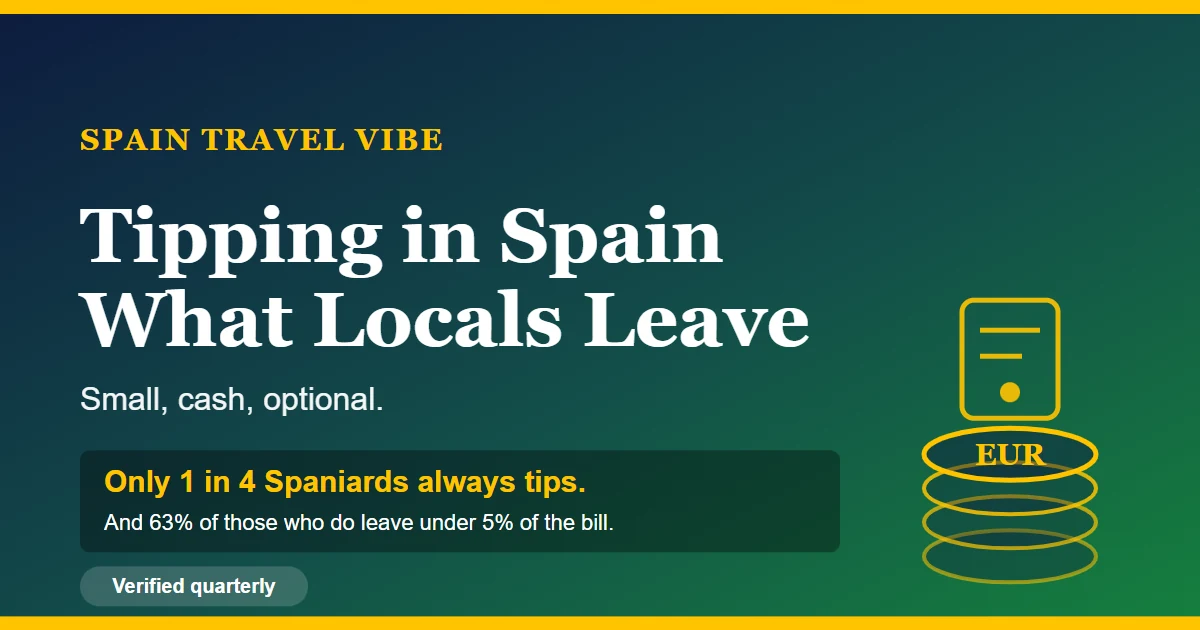
Tipping in Spain is optional in a way that surprises almost every visitor. The advice you have read is probably calibrated to the wrong country. Only one in four Spanish diners always leaves a tip, and 15% never leave one at all.
I have watched a lot of people freeze at a Spanish card machine. It is a small, specific kind of panic. The waiter is standing there, the screen is offering three percentages, and nobody has told you which button a local would press.
Disclosure: Some links in this guide may earn us a commission, at no extra cost to you. It never changes what we recommend.
So this post gives you the numbers first, then the situation-by-situation table.
Then the two mechanics nobody explains. Why service is already in the price, and why a cash tip is worth more to the person serving you than the same amount on a card.
Key Takeaways
- Only 25% of Spanish diners always tip, 15% never do, and 63% of those who tip leave under 5% of the bill, which puts the 10% figure most travel guides recommend somewhere near the top 2% of Spanish tippers (TheFork Lab, 2026).
- Service is already inside the menu price. A separate cubierto (cover charge) or servicio line on your bill is not permitted and can be challenged.
- Rounding up is the real default for tipping in Spain.
- Tip in cash. A card tip lands in the company account and goes through payroll with tax and social security deducted, so it arrives smaller and a month later.
- 60% of Spaniards call the tip prompt on the card terminal inappropriate. Declining is normal.
Table of Contents
Tipping in Spain: Do You Tip at All?
Yes, but rarely and never much. In August 2026, TheFork Lab, the research arm of the restaurant booking platform TheFork, surveyed more than 4,500 Spanish diners. Just 25% always leave a tip. Another 58% leave one occasionally, depending on the experience, and 15% never tip at all (TheFork Lab survey, reported by Infobae, 2026).
The Spanish word for a tip is propina. It describes a gesture, not a duty, and that distinction runs through everything below. The rest of the money side lives in my breakdown of what a trip to Spain actually costs.
Now the myth in the other direction, because it is just as wrong. Tipping in Spain is not rude, and it is not insulting. Nobody will chase you down the street to return your coins. It is optional, and a Spanish tip is far below what an American or a Canadian would consider polite.
That same survey found something sharper.
Asked what they would do with the practice, 77% of Spaniards said they would abolish tipping in hospitality entirely. Only 22% would keep it as it is, and 1% would like to see it increase.
How Much to Tip in Spain, Situation by Situation
Among Spaniards who tip, 63% leave less than 5% of the total bill. Another 35% leave between 5% and 10%, and only 2% go above 10% (TheFork Lab, via Infobae, 2026). The familiar “5 to 10 percent” advice describes about a third of Spanish tippers, and it is the single biggest source of confusion about tipping in Spain.
Here is the split I actually use for tipping in Spain. The left column is what people around me do. The right column is what a visitor can do without either overpaying or looking careless.
| Situation | What Spaniards typically do | Fine for a visitor |
|---|---|---|
| Coffee or a beer at the bar | Leave the small coins from the change | 20 to 50 cents, or nothing |
| Tapas standing at the bar | Round up to the nearest euro | Round up |
| Menú del día at lunch | Nothing, or round up to the next euro | Round up, or 1 euro |
| Sit-down dinner you enjoyed | Round up, or a couple of euros | 5% counts as generous here |
| Fine dining | 5%, occasionally up to 10% | 5%, and 10% only if the service was exceptional |
| Taxi | Round up to the nearest euro | Round up |
| Hotel porter | 1 euro a bag | 1 to 2 euros a bag |
| Housekeeping | Usually nothing | 1 to 2 euros a day, left in the room |
| Group guided tour | A few euros if it was good | 3 to 5 euros a person |
| Free walking tour | Pay what it was worth | The guide is paid only from tips, so pay properly |
| Hairdresser or spa | Usually nothing | Round up |
| Food delivery | Round up | Round up |
Two rows deserve a note.
The free walking tour is the one genuine exception to everything above, because the guide’s entire income is the hat at the end. There is no wage underneath it and no employer topping it up, so the word tip is doing different work in that row than in any other. Treat it as a paid tour with a flexible price and pay what the two hours were worth. Housekeeping is the tip most often forgotten, partly because the person is invisible and partly because cash left on a bedside table can look ambiguous rather than intended. Leave it with a note, or on the pillow on your last morning.
The bar rows are the ones you will use most, and they are also where the ordering gets confusing for visitors. My walkthrough of how a tapas crawl actually works covers the paying side hour by hour.
Is Service Included in the Bill in Spain?
Yes, and this is the part most guides get backwards. Spanish consumer authorities are explicit that a separate charge for cubierto (a cover charge) or servicio is illegal. Service sits inside the advertised price. The Junta de Andalucía’s consumer directorate puts it in one line: “El cobro por separado de una cantidad extra en concepto de cubierto o servicio es ilegal” (Junta de Andalucía, Dirección General de Consumo, 2023).
So the standard advice to scan the bill for servicio incluido is looking for a line that should not be there. You are not topping up an unpaid service charge, because you already paid for service when you read the price on the menu. The OCU, Spain’s main consumer organisation, has made the same point repeatedly (OCU, via Directo al Paladar, 2026).
Some charges are legitimate. Bread, olives and the little dish of picos can be charged for, and a terrace table can cost more than the same table indoors, which is why the same beer has two prices in a lot of plazas. The condition in both cases is disclosure. The price has to be on the menu or the price list before you order, clearly and visibly, not produced at the end as a surprise.
If it was not, you can ask for it to be taken off the bill. You can also ask for the hoja de reclamaciones, the official complaint form Spanish businesses are required to keep (Junta de Andalucía, 2023).
Worth saying plainly: this is rare.
It is concentrated in the heavily touristed streets where the same handful of tricks recur. My guide to the scams and overcharging worth knowing about covers the rest of them, and none of it should make you suspicious of an ordinary neighbourhood bar.
Should You Tip in Cash or by Card in Spain?
Cash, for a reason worth understanding. When you add a tip on the card machine, that money goes through the establishment’s terminal into the company’s bank account. Spanish payroll guidance is consistent that the employer must then treat it as a salary complement. It goes onto the payslip, with income tax withheld and social security contributions applied (Loomis Pay, 2026; Asesorae, 2026).
A cash tip goes into the staff’s own pocket and is theirs to declare.
Same two euros, different journey. The card version arrives smaller, and it arrives at the end of the month. Coins are simply the more efficient route for tipping in Spain.
There is a practical reason too. Spain has not gone cashless the way northern Europe has. Cash still accounted for 57% of point-of-sale transactions in 2024, down from 66% two years earlier. Cards rose from 28% to 32% over the same period (Banco de España, Trends and developments in payments by Spanish consumers, 2025). Carrying a few coins here is ordinary behaviour.
So the working rule for tipping in Spain is simple. Pay the bill however you like, card included, and leave the tip in coins on the table or in the little dish the bill arrives in.
What Do You Do When the Card Machine Asks for a Tip?
You press the low option or skip it, and you are behaving like the majority. TheFork Lab asked Spanish diners about suggested tips on the datáfono, the card terminal. Some 60% called it an inappropriate gesture, 23% accepted it as long as it stays voluntary, and 17% said it makes them uncomfortable (TheFork Lab, via Telecinco, 2026).
These prompts are new here, and they arrived with the payment hardware. Spanish habits did not change to invite them. The presets are calibrated to American norms and land absurdly on Spanish ticket sizes. On a 3-euro coffee, a 20% preset is 60 cents, on a transaction where the custom is loose change. That gap between an imported norm and a local one is the subject of my traveler’s guide to Spanish culture, which tests ten such beliefs against the numbers.
The first time one appeared in front of me was in a café near Sant Antoni in Barcelona, on a bill of about four euros. The screen offered 15, 20 and 25 percent, the waiter was holding it at chest height waiting, and I pressed a percentage because the machine was already turned toward me and pressing something felt faster than thinking. It cost me eighty cents and a small flush of irritation at myself. The second time, in the same café, I pressed skip, handed the terminal back, and absolutely nothing happened. No pause, no look. The person holding it knows exactly what the screen is doing.
A visitor who taps 20% on a Spanish terminal is not being quietly generous, whatever it feels like in the moment; they are supplying the demand signal that tells an operator the presets work, on a ticket where the local custom was loose change. More than three quarters of Spaniards want tipping gone. Every validated preset pushes tipping in Spain closer to a system they are actively rejecting.
Why Do Spaniards Tip So Little?
Because Spanish hospitality pay is not built on tips, which is the structural reason tipping in Spain stayed small while it inflated elsewhere. There is no tipped minimum wage here. Wages are set by provincial collective agreements. The Madrid hospitality agreement puts a level-three waiter’s base pay at about 1,250 euros a month across fourteen payments (Shifty’s summary of the Convenio Colectivo de Hostelería de Madrid, 2026). That is the number. It is a salary, and it does not assume a tip on top.
Spaniards say as much when you ask them why they skip the tip.
| Reason given for not tipping | Share of respondents |
|---|---|
| The price already includes the service | 61% |
| It is awkward to do when paying by card | 20% |
| Staff already receive a salary | 19% |
Note the middle row, because it confirms what the cash advice above is really about. For one in five people the obstacle is mechanical rather than principled. The card made it awkward.
Pay does vary by province, so treat the Madrid figure as an illustration rather than a national number. Sevilla’s agreement, for instance, raises rates by 5% during 2026 as part of a larger multi-year deal (Purohospitality, 2026). If you are budgeting a trip rather than a payroll, my breakdown of what a trip to Spain actually costs is the more useful page. The tourist tax your hotel adds separately catches people out far more than tipping ever does.
Where Does Tipping in Spain Change by City and Venue?
Venue matters more than region. Of Spaniards who tip, 58% do so mainly in traditional restaurants. Fine dining takes 17%, informal places 16%, and bars and cafés just 9% (TheFork Lab, via Infobae, 2026). A sit-down meal invites a tip. A counter does not, and that single distinction predicts tipping in Spain better than any map.
City differences are real, but they track tourism rather than local custom. In central Barcelona and Madrid, staff deal with international visitors all day and expectations have drifted upward. Barcelona is also where I have seen the most tip prompts, which is no coincidence. Away from those streets, in Madrid’s residential barrios and beyond Barcelona’s tourist-zone restaurants, the coins-in-the-dish norm holds.
Standing bars are their own category and they run on rounding, full stop. That holds at Basque pintxo counters as much as at Andalusian tapas bars. Taxis follow the same logic, and my guide to taxis, trains and the rest of getting around Spain has the fares.
Guided experiences are the one place to be a little more deliberate. A few euros a head is normal and welcome after a good tablao evening, a guided Alhambra visit or a guided day trip from Madrid.
The Rest of the Etiquette That Actually Costs You Something
Tipping in Spain is the money question, but three other habits cause more visible awkwardness, and none of them takes long to learn.
Greetings go right cheek first, then left, and they are air kisses rather than actual contact. Two women, or a man and a woman, greet this way socially. Two men shake hands or embrace. In a first business meeting, everyone shakes hands, so do not lead with the kisses.
For address, tú is the default almost everywhere under sixty, including with waiters and shop staff. Save usted for elderly strangers and formal settings. Getting this wrong in either direction is a very small error, and it matters less than most phrasebooks suggest. My guide to how far English gets you has more on the register question.
Dress is where visitors are actually turned away. Beachwear stays at the beach, and Spanish cathedrals enforce their dress codes at the door: shoulders and knees covered, no exceptions on a hot day. Seville Cathedral enforces it, and so does the Sagrada Família dress code, where people do get stopped after queuing.
Frequently Asked Questions
Do you tip in Spain?
Yes, but tipping in Spain is modest and entirely optional. Only 25% of Spanish diners always leave a tip and 15% never do, according to TheFork Lab’s 2026 survey of more than 4,500 diners. Rounding up the bill is the most common gesture, and nobody will react badly if you leave nothing.
How much should I tip in Spain at a restaurant?
Round up, or leave about 5% for a meal you enjoyed. Tipping in Spain at a restaurant rarely goes further. Among Spaniards who tip, 63% leave under 5% of the bill and only 2% exceed 10% (TheFork Lab, 2026).
Is it rude not to tip in Spain?
No. Nobody expects tipping in Spain as a matter of course. Some 15% of Spaniards never tip at all, and 77% told TheFork Lab in 2026 they would prefer the practice were abolished entirely. Leaving nothing after a coffee or a casual lunch is completely ordinary and will not be noticed, let alone commented on.
Is tipping in Spain better in cash or on the card?
Leave it in cash. If you remember one thing about tipping in Spain, make it this. A card tip passes into the company’s account. Spanish payroll guidance is consistent that it is then treated as a salary complement, with income tax and social security deducted. A cash tip goes straight to the staff.
What does servicio incluido mean in Spain?
It means service is included in the price, which is the default position Spanish consumer authorities describe. They state that charging a separate cubierto or servicio amount is illegal, so a service line on your bill can be challenged and removed. Bread and terrace surcharges are legal only if disclosed beforehand.
The Short Version
Tipping in Spain comes down to four words: small, cash, optional, round up. Coins at the bar. A euro or two on a decent lunch, 5% on a dinner you loved, and nothing at all on plenty of occasions without a second thought. You already paid for service when you read the menu.
The one thing I would ask you to think about is the card machine. Those presets are new, they are calibrated to a country that is not this one, and more than three quarters of Spaniards would rather the whole custom disappeared. Pressing skip is not stinginess, it is the local answer.
For the rest of the practical side, the Spanish eating schedule explains why the kitchen is closed at seven, and my guide to the siesta in Spain covers which shops close with it. And the complete guide to planning a first trip to Spain ties it all together.