

Last verified: September 10, 2026. The figures for the languages spoken in Spain on this page come from the statistics offices and governments that count them: INE’s 2021 population survey, the Generalitat’s 2023 language-use survey, the Basque Government’s 2021 sociolinguistic survey, the Galician statistics institute, the Generalitat Valenciana and the BOE. The EU status paragraph is dated, because it moves. I re-check each survey as its next edition lands and the EU position after every Council meeting where Spain raises it.
The languages spoken in Spain confuse more first-time visitors than the eating hours do. You book a hotel in Barcelona and the confirmation arrives in something that is nearly Spanish but not quite. You photograph a menu in San Sebastián and the translation app gives up. Then you land in Madrid and none of it applies. Spain’s national statistics office found in 2021 that 96.0% of residents speak Spanish well (INE, Survey on Essential Characteristics of the Population and Housing 2021, published 2023). About four in ten of them also live in a region with a second official language.
The internet can’t agree how many languages that is. I’ve seen four, five, six and “seventeen dialects” on the first few sites I checked, most of them quoting a 2016 survey as if it were this year’s. So this is the version with the legal count and the current numbers. It also has the part no list gives you: what you’ll actually see on the signs, region by region.
Disclosure: Some links in this guide may earn us a commission, at no extra cost to you. It never changes what we recommend.
Key Takeaways
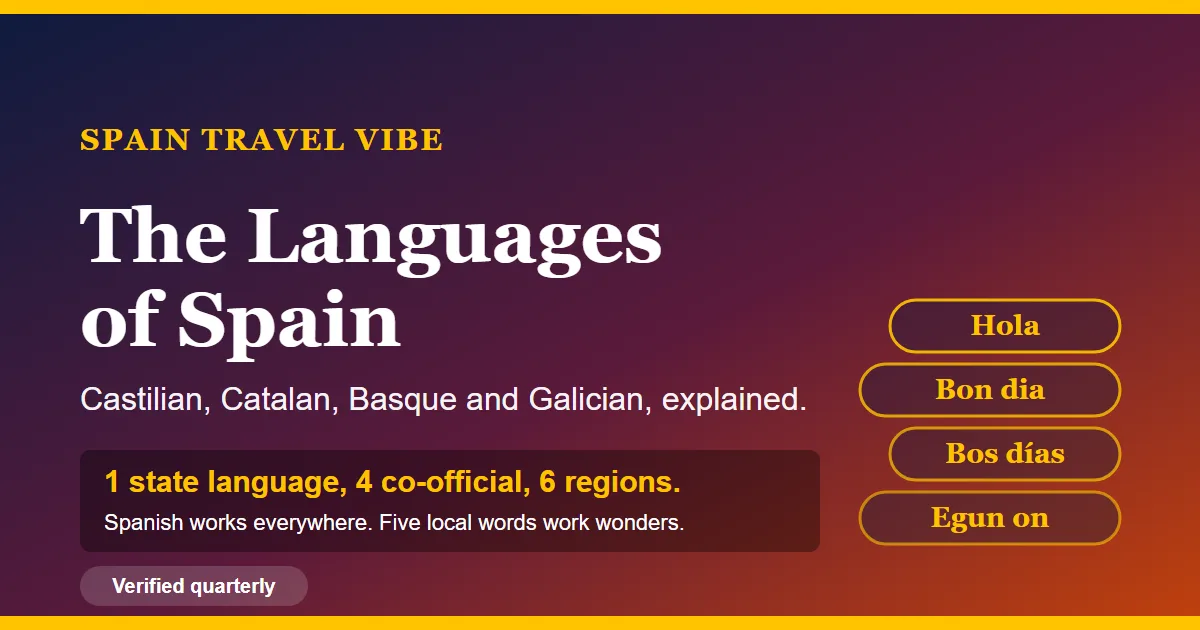
- Spain has one state language, Castilian Spanish, and four co-official ones: Catalan (called Valencian in Valencia), Galician, Basque and Aranese. They’re official in six of the 17 regions, home to about four in ten residents.
- Spanish works everywhere. 96% of residents speak it well (INE, 2021), and no shop, station or hotel in a bilingual region will fail to understand it.
- The languages spoken in Spain aren’t dialects of Spanish. Catalan is closer to Occitan, Galician to Portuguese, and Basque is related to nothing else on earth.
- Where you’ll meet them: Galicia (83% speak Galician well), Catalonia (75% Catalan), the Balearics (60%), Valencia (52%), the Basque Country (44%), Navarre (17%).
- Speaking Spanish in Barcelona isn’t rude. Every Catalan speaker is bilingual. Answer in the language you’re greeted in if you can, and nobody minds if you can’t.
- Since 2023 deputies can speak Catalan, Basque and Galician in the Spanish parliament. The EU still hasn’t made them official languages, and Spain put the question back on the table in September 2026.
Table of Contents
How Many Languages Are Spoken in Spain?
Five with official status: one state language and four co-official ones, official in six of Spain’s 17 autonomous communities. Those six communities held 19.6 million of Spain’s 47.4 million residents on 1 January 2021, or 41.3% (INE, Padrón continuo, 2021). So the languages spoken in Spain are, for about four residents in ten, plural.
The count is a legal fact. Article 3 of the 1978 Constitution makes Castilian “the official Spanish language of the State”. Every Spaniard has a duty to know it and a right to use it. It goes on to say that “the other Spanish languages shall also be official in the respective Autonomous Communities in accordance with their Statutes” (BOE, Constitución Española, 1978). Four languages have used that door. Here are the languages spoken in Spain with official status, on one screen.
| Language | Where it’s official | Legal basis | Speak it well (INE, 2021) | Latest regional survey |
|---|---|---|---|---|
| Castilian Spanish | The whole of Spain | Constitution, Art. 3.1 | 96.0% of Spain | INE, 2021 |
| Catalan | Catalonia, the Balearic Islands | Statutes of 2006 and 2007 | 75.0% of Catalonia, 59.5% of the Balearics | EULP 2023: 80.4% can speak it |
| Valencian, Catalan’s official name in Valencia | The Valencian Community | Statute of 2006 | 51.6% of the Valencian Community | 2021 survey: about 50% speak it well |
| Galician | Galicia | Statute of 1981 | 83.1% of Galicia | IGE 2023: 24.4% always speak it |
| Basque (euskera) | The Basque Country; Navarre’s Basque-speaking zone | Statute of 1979; Navarre’s 1986 language law | 44.1% of the Basque Country, 17.0% of Navarre | 2021 survey: 36.2% bilingual |
| Aranese (Occitan) | Val d’Aran, and official across Catalonia | Catalan Statute of 2006, Art. 6.5 | Not measured by INE | EULP 2023: 53.6% of the valley can speak it |
Everything else is protected but has no official status. Asturian, Aragonese, the Leonese and Extremaduran varieties, Caló, the Arabic of Ceuta and the Tamazight of Melilla are real and spoken, and I’ll come to them. None of them can be used on an official form, which is the line that gets blurred whenever someone counts six, or seventeen. Arabic also left Spanish about 4,000 words, a legacy my primer on Moorish Spain traces.
Languages Spoken in Spain by the Numbers: Who Speaks What?
Ten languages are spoken well by at least 1% of Spain’s residents, and only one of them by nearly everybody. Spanish led at 96.0% in 2021, then English at 14.7%, Catalan 14.2%, Valencian 5.6%, Galician 5.2%, French 3.7%, Basque 2.3%, Arabic 1.6%, Romanian 1.1% and Italian 1.0% (INE, ECEPOV 2021, 2023). More than half the country, 57.2%, speaks only one language well.
First languages tell the same story from the other end. Spanish was the initial language of 74.7% of residents, Catalan of 5.3% and Galician of 2.4% (INE, ECEPOV 2021, 2023). Another 2.0% grew up in Spanish and Catalan together. Among people born abroad, the most common first languages after Spanish were Arabic (9.5%), Romanian (8.2%) and English (5.4%).
That group is no longer small. On 1 January 2026, 10.0 million of Spain’s 49.6 million residents were born outside the country, 20.2% and the first time past ten million (INE, Estadística Continua de Población, 2026). Moroccan, Colombian and Romanian nationals lead (INE, Censo anual 2025, 2025). So the languages spoken in Spain now include Darija in a Madrid market and Romanian on a Castilian building site, as readily as Basque in Bilbao.
Is Spanish Enough to Travel Spain?
Yes, anywhere, and the Constitution is why. Article 3 makes knowing Castilian a duty, so every Catalan, Galician or Basque speaker you meet is bilingual by definition. Nearly all residents, 99.5%, understood and spoke Spanish at least with difficulty in 2021, and 96.0% spoke it well (INE, ECEPOV 2021, 2023). No station, pharmacy or hotel desk in a bilingual region will fail to understand Spanish. Of all the languages spoken in Spain, it’s the one you can rely on everywhere.
English is the gap that actually bites, and it has its own page. Briefly, 14.7% of residents speak English well and 24.6% speak it at least with difficulty. Among 20 to 29 year olds, 32.0% speak it well; among the over-50s, more than 80% don’t speak it at all (INE, ECEPOV 2021, 2023). My guide to how far English gets you in Spain maps that by city and situation, with the fifteen phrases that fill the gap. The complete Spain travel guide puts language next to everything else a first trip needs.
One rule covers the etiquette of every bilingual region. Answer in the language you’re greeted in if you can, and in Spanish if you can’t. Nobody in Barcelona, Bilbao or Santiago is offended by a visitor speaking Spanish, because Spanish is their language too. What lands badly is treating the local language as a curiosity, and five words of it, which I’ll give you at the end, fix that completely.
What Will You See and Hear in Each Region?
Signs follow the region’s language law and menus follow the owner. In Catalonia, fixed signs and notices in any business open to the public must be at least in Catalan (BOE, Ley 1/1998 de Política Lingüística, Art. 32.3, 1998). Galician law gives every place name a single official form, the Galician one, and road signs must match it (BOE, Lei 3/1983 de normalización lingüística, Art. 10, 1983). Basque law makes public transport notices and road signs bilingual (BOE, Ley 10/1982 de normalización del uso del euskera, 1982). That’s the map of the languages spoken in Spain as a visitor actually meets them.
| Region | Signs | Menus | Say this |
|---|---|---|---|
| Catalonia | At least Catalan | Both, Catalan first | Bon dia, gràcies, adéu |
| Valencian Community | Valencian and Spanish | Usually both | Bon dia, gràcies |
| Balearic Islands | Catalan and Spanish | Both, plus English and German in resorts | Bon dia, gràcies |
| Galicia | Galician place names | Galician or Spanish, often mixed | Bos días, grazas, bo camiño |
| Basque Country | Bilingual | Both; some Gipuzkoa boards Basque only | Egun on, eskerrik asko, agur |
| Navarre | Bilingual in the north | Spanish, some Basque in the north | Egun on north of Pamplona |
| Val d’Aran | Aranese, Catalan and Spanish | Aranese and Catalan | Bon dia, mercés |
| La Gomera | Spanish | Spanish | Buenos días |
| Ceuta and Melilla | Spanish | Spanish, some Arabic | Buenos días, salam |
Transport announcements vary by operator everywhere except the Basque Country, where the law makes them bilingual. I haven’t checked each operator’s own rules, so I’d rather leave that column out than guess.
Two things are true everywhere on that table. Spanish appears on every official sign that safety depends on. And the words on a menu are the words in my region-by-region Spanish food guide. Pa amb tomàquet, pulpo á feira and pintxos will look familiar before you can pronounce them. For the regions themselves, my guide to where to go in Spain is the map this table sits on.
Catalan and Valencian: What Do They Speak in Barcelona?
Both, all day, and the numbers are higher than most visitors expect. Of Catalonia’s residents aged 15 and over, 93.4% said they understand Catalan in the 2023 Survey of Language Uses (Generalitat de Catalunya, EULP 2023, 2025). Four in five, 80.4%, said they can speak it: 5.4 million people. On INE’s stricter “speaks well” measure the figure is 75.0%. Every one of them also speaks Spanish.
Catalan isn’t a dialect of Spanish, whatever the man at the next table tells you. It’s a Romance language in its own right, closer to Occitan across the Pyrenees than to Castilian.
Street life, though, is genuinely mixed. Only Catalan was the habitual language of 32.6% of Catalonia’s residents in 2023, against 46.5% who used only Spanish and 9.4% who used both (Generalitat, EULP 2023, 2025). Almost half, 48.7%, start a conversation with a stranger in Catalan always or often. That Catalan-only share stood at 36.1% in 2018 and 46% in 2003, and the fall is mostly demography. Catalonia’s foreign-born share went from 9.3% to 22.5% over the same twenty years (Generalitat, EULP 2023 context report, 2025), and half of those newcomers have already learnt to speak Catalan.
So, is it rude to speak Spanish in Barcelona?
No. A waiter who greets you in Catalan will switch the moment you answer in Spanish, and think nothing of it, because locals make that switch a hundred times a day. My Barcelona guide covers the city. Here the only language advice you need is bon dia on the way in and gràcies on the way out.
Is Valencian the Same Language as Catalan?
Yes. Valencian is the Valencian Community’s official name for Catalan, and Valencia’s own language academy treats them as one language. The Council of Europe’s charter lists “Catalan, called Valencian in the Valencian Community”. And 70.5% of Catalans agree that the speech of Valencia, the Balearics, Andorra and Catalonia is one language (Generalitat, EULP 2023, 2025). Politically, the name matters in Valencia, so use it there. A menu in valencià reads as Catalan. The 2021 regional survey found that 75.8% of Valencians understood it and about half spoke it well (Generalitat Valenciana, via À Punt, 2022). My Valencia guide has the city.
Balearic islanders sit between Catalonia and Valencia. INE’s 2021 survey found 59.5% of them spoke Catalan well and another 18.4% spoke it with difficulty, 77.9% in all, up from 71.7% in 1998 (dBalears, citing INE, 2026). A new language-use survey from the islands’ government launched in February 2026 (Govern de les Illes Balears, 2026), so better numbers are coming. Until then, the note in my Mallorca versus the Canaries comparison holds: Palma is a Catalan-speaking city, the resort coast mostly isn’t, and the Canaries have no second language at all.
Galician: What Language Do They Speak on the Camino?
Galician, and no region speaks its own language more. Of the co-official languages spoken in Spain, none reaches a bigger share of its home region: 83.1% of Galicia’s residents spoke Galician well in 2021 (INE, ECEPOV 2021, 2023). Two years later, the regional survey found 51.3% speak it “a lot” and 32.1% “quite a lot”, and that 24.4% of Galicians always speak it (IGE, Enquisa estrutural a fogares 2023, 2024).
Galician grew up with Portuguese and split from it in the late Middle Ages. That’s why a Portuguese pilgrim reads every sign on the Camino, and a Spanish one reads most of them. On the trail it’s the language of the farmer who says bo camiño as you pass. It’s also the language of every place name: Ourense is not Orense on any sign you’ll see.
So why do Galician speakers worry? Because the trend runs the other way from the trail. Back in 2003, 43.2% of Galicians always spoke Galician, and by 2023 it was 24.4% (IGE, 2023, 2024). Among children aged 5 to 14, 32.4% now speak little or none of it. Country and city split sharply. Lugo province has 41.9% who always speak Galician, Pontevedra 13.5% (Culturagalega, reporting IGE, 2024). Vigo and A Coruña, the two big cities, are the least Galician-speaking places in Galicia. Walk the Camino routes and you’re in the Galician-speaking Galicia. Fly into Vigo for my Green Spain itinerary and you’re in the other one.
Basque: Where Is Euskera Actually Spoken?
In Gipuzkoa, mostly. Just over half of Gipuzkoa’s residents aged 16 and over, 51.8%, were Basque speakers in 2021, against 30.6% in Bizkaia and 22.4% in Álava (Basque Government, VII Encuesta Sociolingüística 2021, 2023). Daily use shows an even wider gap: 40.8% of Gipuzkoans use Basque as much as or more than Spanish, against 14.5% in Bizkaia and 7.8% in Álava. A visitor in San Sebastián hears Basque all day. A visitor in Vitoria-Gasteiz, the region’s capital, can go a week without it.
Basque is the oddity among the languages spoken in Spain, and among the languages of Europe. It’s a language isolate, related to no other living language, and it was here before the Romans and their Latin. Across the Basque Country as a whole, 36.2% of residents are bilingual, 18.6% understand Basque without speaking it well, and 45.3% speak only Spanish (Basque Government, 2021 survey, 2023). That’s 680,629 Basque speakers, 261,000 more than in 1991.
Young people drive the growth. Among 16 to 24 year olds, 74.5% speak Basque, against 25% of the same age group in 1991.
Navarre is the quieter neighbour. There, 14.2% speak Basque well and 10.6% understand it (Gobierno de Navarra, Euskarabidea, 2023), and it’s only official in the Basque-speaking north of the region.
For the traveller the practical fact is the map. San Sebastián is Donostia on every sign, Bilbao is Bilbo and Vitoria is Gasteiz. In Gipuzkoa the pintxo board behind the bar may be in Basque only, with a Spanish version offered before you ask. My San Sebastián guide has the bars, and Vitoria-Gasteiz is the one Basque capital nobody books. Language here is live policy too. In June 2026 the Constitutional Court declined to rule on Basque-language requirements for public-sector jobs and sent the case back to the Basque High Court (Moncloa.com, 2026).
Aranese, Asturian, Aragonese and Silbo Gomero: The Languages Most Lists Forget
Aranese is Spain’s fifth official language, and it lives in one valley. Occitan, “called Aranese in Aran”, is official across Catalonia under Article 6.5 of the 2006 Statute (BOE, Ley Orgánica 6/2006, 2006). Val d’Aran’s 2023 survey found 79.7% of residents understood it and 53.6% could speak it, down from 60% in 2018 (Diari de la Llengua, reporting the Conselh Generau d’Aran and the Generalitat, 2025). Only 16.8% used it as their habitual language, and two-thirds of the valley’s residents were born somewhere else. Ski at Baqueira or walk the Pyrenees from my hiking guide and the signs are in three languages; the one at the top is Aranese.
Asturian is the biggest of the languages spoken in Spain without official status. Asturias protects it as its “lengua propia”. A June 2025 reform to make it official fell short: 22 votes for, 21 against, with 27 needed (elDiario.es, 2025). The regional government presented a new language strategy for 2026 to 2030 in February 2026 (elDiario.es, 2026). On INE’s strict measure only 2.8% of Asturians said they speak Asturian well.
Aragonese is smaller again: 25,556 speakers, or 56,235 counting people who understand it, on the last census analysis (Gobierno de Aragón, Lenguas de Aragón, 2011 data), in the Pyrenean valleys.
Then there’s a language you whistle.
Silbo Gomero turns Spanish into whistles that carry across La Gomera’s ravines. It has been on UNESCO’s Representative List of Intangible Cultural Heritage since 2009 (UNESCO, 2009). It has been a compulsory subject in every school on the island since 1999, and a community of more than 22,000 practises it. If your Canaries trip reaches La Gomera, you may well hear it. Finally, Spain’s two African cities. Arabic is spoken well by 25.6% of Ceuta’s residents, and Melilla has 7.1% speaking Arabic and 5.4% Tamazight (INE, ECEPOV 2021, 2023). Neither has official status among the languages spoken in Spain.
Why Does Spain Have So Many Languages?
Because Castilian was one kingdom’s language that became the State’s, with 520 million native speakers worldwide today and 635.7 million counting learners (Instituto Cervantes, El español en el mundo 2025, 2025), and the others never died. Latin broke up across the peninsula into Galician-Portuguese in the west, Astur-Leonese and Castilian in the centre, Aragonese and Catalan in the east. Basque was already there before any of them arrived. Castilian travelled with the kingdom and then the state, while the other official languages spoken in Spain stayed where they were born.
Spain’s modern settlement is the 1978 Constitution, written three years after Franco’s death. His regime had pushed the regional languages out of public life for four decades. Article 3 restored them as co-official in their own territories, and Spain ratified the Council of Europe’s Charter for Regional or Minority Languages in 2001 (Generalitat de Catalunya, 2001).
Two things have moved since. Since 25 September 2023, deputies in the Congress of Deputies may speak Catalan, Basque or Galician in the chamber and in committee, with interpretation (BOE, Reforma del Reglamento del Congreso, 2023). Official status in the European Union, the larger prize, is still pending. Spain asked for it in August 2023, and the Council of the EU has postponed it at least four times, most recently on 18 July 2025 (Catalan News, 14 July 2026). About a dozen member states, led by Germany, remain unconvinced on cost and precedent. Spain has offered to pay the cost, which the Commission puts at about €132 million a year.
As of 10 September 2026, the Spanish government has asked to raise the question again at the General Affairs Council on 22 September (Infobae, 5 September 2026). It has also said it won’t accept new official languages for future EU members until these three are recognised. That meeting is an information point, so no decision is expected.
Do You Need to Learn Catalan, Basque or Galician Before You Go?
No. With 96.0% of residents speaking Spanish well (INE, ECEPOV 2021, 2023), the local language is a courtesy. Five words of it earn more goodwill than fluent Spanish. Greeting, thanks, please, goodbye and “the bill, please” cover every interaction a visitor has. In a region whose language was banned within living memory, being asked “how do you say” is a compliment.
In Catalonia, Valencia and the Balearics that’s bon dia, gràcies, si us plau, adéu and el compte, si us plau. In Galicia it’s bos días, grazas, por favor, adeus and a conta, por favor. In the Basque Country it’s egun on, eskerrik asko, mesedez, agur and kontua, mesedez. The last one matters, because what you leave with the bill is its own small culture.
Don’t bother in Madrid, Andalusia, Castile, Murcia, the Canaries, Aragón’s cities or Cantabria. There’s no second official language there, and buenos días is the whole job. And don’t learn phrases you’ll never use. Fifteen Spanish phrases from my English-in-Spain guide do more work in more places than any Catalan beyond bon dia. The languages spoken in Spain reward the gesture, not the vocabulary.
Frequently Asked Questions
What is the official language of Spain?
Castilian Spanish is the official language of the State under Article 3 of the 1978 Constitution. INE’s 2021 population survey found 96.0% of residents speak it well. Of the other languages spoken in Spain, Catalan, Galician, Basque and Aranese are co-official in their own regions, alongside Spanish, never instead of it.
How many languages are spoken in Spain?
Five with official status, and around 15 living indigenous languages by Ethnologue’s count, if protected ones such as Asturian and Aragonese are included. INE found ten languages spoken well by at least 1% of residents in 2021, led by Spanish (96.0%), English (14.7%) and Catalan (14.2%). The languages spoken in Spain with official status cover six of the 17 regions.
Do they speak Catalan or Spanish in Barcelona?
Both. Four in five of Catalonia’s residents, 80.4%, could speak Catalan in the 2023 Survey of Language Uses, and every one of them also speaks Spanish. Shop signs are in Catalan by law, but every conversation can happen in Spanish, and switching languages mid-sentence is normal for locals too.
Is Catalan a dialect of Spanish?
No. Catalan is a separate Romance language, closer to Occitan than to Spanish, and the sole official language of Andorra. It’s spoken across Catalonia, the Valencian Community, the Balearics and Andorra. Catalonia alone has 5.4 million people who can speak it (EULP 2023). Valencian is its official name in the Valencian Community, and 70.5% of Catalans consider the two one language.
Is Basque related to Spanish?
No. Basque is a language isolate with no known relatives, the only one among the languages spoken in Spain, and it predates Latin in the region. Across the Basque Country, 36.2% of residents aged 16 and over were bilingual in 2021. Most of them live in Gipuzkoa, where 51.8% speak it, and every one of them also speaks Spanish.
The Languages Spoken in Spain, in One Line
Spanish everywhere, a second language in six regions, and five words of it are enough. Spanish reaches almost everyone who lives here: 99.5% speak it at least with difficulty, and 96% speak it well. In six regions there’s a second official language on the signs, in the schools and in the mouths of most people you’ll meet. How many understand it, against how many live in it, is the real story of each one. Five words of the local language are the only preparation any of them asks of a visitor.
If you’re planning a first trip, start with the complete Spain travel guide. Then decide where in Spain to go, because the region chooses the language for you. For the practical side of getting understood in the languages spoken in Spain, my guide to how far English gets you is the companion to this one. For the next piece of the culture, the Spanish eating schedule explains why you’ll practise these words after two in the afternoon. My traveler’s guide to Spanish culture ties all of it together, region by region.