
Last verified: September 22, 2026. Every headline figure in this Spanish culture guide is linked to its source inline, and each chart and table names its own. Most come from the Instituto Nacional de Estadística (INE), the Centro de Investigaciones Sociológicas (CIS), Eurostat, UNESCO, the Boletín Oficial del Estado and city councils. Where I cite the Spanish press, it is reporting an official figure, a named survey or a named body’s announcement, and I say whose. The CIS barometer is monthly and Eurostat’s family data is annual, so I re-check the numbers quarterly and re-date this box when one moves.
This Spanish culture guide starts from an admission. Most of what travelers are told about Spain is a national average for a country that doesn’t have one. Spain is 17 autonomous communities, five official languages and 26 living traditions on UNESCO’s heritage lists. Almost none of the famous ones are national. Flamenco is Andalusian. Castells, the human towers, are Catalan. Las Fallas are Valencian.
Guides you’ve already read state the same ten beliefs as fact. Everyone naps. Dinner is at ten. It’s a Catholic country. You tip ten per cent. Not one of them dates a claim, sources a number or says where in Spain it holds. So I’ve done that instead. Ten beliefs, one dated figure each, a verdict, and a link to the deeper guide for every one.
Disclosure: Some links in this guide may earn us a commission, at no extra cost to you. It never changes what we recommend.
Five of the ten tests in this Spanish culture guide are already published on this site. The other five are on their way, and I say so where they’re still to come.
Key Takeaways
- This Spanish culture guide tests ten things travelers believe against the best numbers available. Two hold nationally, four hold in one region only, and four are simply wrong.
- Spain isn’t a Catholic country in the present tense. In September 2026 atheists (17.1%) outnumbered practising Catholics (15.9%) for the first time in the CIS series. Semana Santa still fills Seville, because it’s culture before it’s doctrine.
- Dinner is late by the clock, not by the sun: 21:30 on the dial is 20:30 solar, level with Italy and France. Most Spaniards never nap.
- Young Spaniards leave home at 30.2, against an EU average of 26.3 (Eurostat, 15 September 2026). That one number explains more of the social life than any cliche about family.
- Spanish works everywhere, with 96% speaking it well. Four residents in ten live in a region with a second official language, and 20.7% of residents were born abroad.
- Bullfighting scores 2.1 out of 10 for acceptability and drew about 8% of Spaniards to a bull event last year, while LaLiga filled its stadiums to a record 84.9%. Most famous traditions, from flamenco to Las Fallas, belong to one region rather than to the country, and the second table below says which.
Table of Contents
Spanish Culture Guide: Why One Country Needs 17 Answers
Spain is 17 autonomous communities with their own parliaments, five official languages (four of them co-official, across six regions) and 26 elements on UNESCO’s intangible heritage lists (UNESCO, Spain, 2025). The national average is usually the least useful number in any Spanish culture guide. This one leans on regional figures wherever they exist, and says so when they don’t.
Ask a Spaniard what Spanish culture is and the answer depends on where you’re standing. In the CIS’s 2024 study of identities, 52.8% of respondents felt “equally Spanish and from my region”. In Catalonia that figure fell to 37% (CIS, reported by Verificat, 2024). In Navarre, 23.8% told the CIS in 2025 that they felt only Navarrese. Just 4.8% felt only Spanish, the lowest share in the country (CIS, reported by COPE, 2025). Region isn’t a detail here. It’s the unit this Spanish culture guide works in.
Scale is the other reason the averages fail. In 2025 Spain received 96.8 million international visitors, a record. The first seven months of 2026 added 58.1 million, up 4.6% on a year earlier (INE, FRONTUR, September 2026). Most of them land in Catalonia, the Balearics, the Canaries and Andalusia, four regions that share a state and not much else.
Spain also holds 50 World Heritage Sites, the fifth-largest total in the world (UNESCO World Heritage Centre, 2026), and the list reads like a map of separate civilisations. To choose between the regions, use my region-by-region guide to where to go in Spain. To plan the whole trip, start with the complete Spain travel guide. This page is about understanding what you’ll find when you arrive.
Ten Things Travelers Believe About Spanish Culture, Tested
Two of the ten hold nationally, four hold in one region only, and four are wrong. That’s the scorecard from setting each belief against the latest measurement I could find. Table 1 is this Spanish culture guide in ten rows. Every row names the post that does the full test.
| Belief | What the number says | Where it’s true | Verdict | Our guide |
|---|---|---|---|---|
| Spaniards eat dinner at 10 PM | Dinner peaks at 21:30 by the clock, 20:30 by the sun (Universidad de Sevilla, 2017) | Everywhere | Holds, by the clock | The Spanish eating schedule |
| Everyone takes a siesta | 57.9% never nap (Simple Lógica, 2016) | Small shops close 14:00 to 17:00; museums don’t | False | The siesta myth |
| Spain is a Catholic country | 15.9% practising, 17.1% atheist (CIS, September 2026) | The calendar and the festivals, not the pews | False as practice | Semana Santa explained |
| Everyone speaks Spanish | 96.0% speak it well (INE, 2021) | Everywhere, with four in ten in a bilingual region | Holds | The languages of Spain |
| You tip 10% | 25% of diners always tip; 63% of tippers leave under 5% (TheFork Lab, 2026) | Nowhere | False | Tipping in Spain |
| Paella is the national dish | A Valencian lunch dish with a 2021 heritage decree | Valencia, at 14:00 | One region | Spanish food guide |
| Flamenco is Spain’s music | Andalusian, on UNESCO’s list since 2010 | Andalusia, plus Madrid’s tablaos | One region | Flamenco 101 |
| Bullfighting is the national pastime | Acceptability 2.1/10 (Fundación BBVA, 2026); about 8% attended a bull event in a year | A shrinking circuit of towns and ferias | False | Bullfighting in Spain today |
| Spain is a Moorish country | Al-Andalus ran from 711 to 1492 | Andalusia’s monuments, above all | One region, one era | Moorish Spain primer |
| Gaudí is Spanish architecture | Modernisme was a Catalan movement | Barcelona | One region | Gaudí and Modernisme 101 |
Each row of this Spanish culture guide uses the same method. I took the belief in the words a traveler would use. I found the latest measurement of it. Then I asked where in Spain it applies. Where the answer is “one region”, that isn’t a footnote. It’s why you can eat badly in Madrid by ordering Valencia’s lunch at dinner. It’s why a tourist flamenco show in Barcelona plays on the far side of the peninsula from the real thing.
Do Spaniards Really Eat at 10 PM and Sleep All Afternoon?
Dinner peaks at 21:30 by the clock, which is 20:30 by the sun and level with Italy and France. And most Spaniards, 57.9%, say they never nap (Simple Lógica, December 2016). So the late dinner is real, and the nap is mostly gone. Of all the beliefs in this Spanish culture guide, the late dinner is the one with the best excuse.
Start with the clock. Spain runs on Central European Time although it sits on Britain’s longitude, so its clock is about an hour ahead of the sun. In 2017 the physicist José María Martín-Olalla of the Universidad de Sevilla measured Spanish meal times against European time-use surveys. Once you correct for the sun, Spaniards eat when their neighbours eat (Martín-Olalla, Scientific Reports 8:5350, 2018). My post on why dinner is at 21:30 and what to do about it goes through his figures, and through why the “Franco copied Hitler” story fails on its dates.
Sunset does the rest. Madrid’s sun went down at 21:50 on 21 June 2026, so an evening that starts after dark starts late.
And the siesta? Small shops and neighbourhood markets close from about 14:00 to 17:00. Restaurant kitchens close from about 16:00 to 20:00. Chains, department stores, transport and the big museums don’t close at all. Even the Prado doesn’t close for lunch (Museo del Prado, 2026). A full list by city is in my guide to what closes during the siesta, and the two evening hours that matter most are in my post on how a tapas crawl actually works.
One thing to diarise: the clocks go back on 25 October 2026. Spain asked the EU in October 2025 to end seasonal changes from 2026 (Anadolu Agency, 2025). The Council didn’t agree, and the Commission has since published summer-time dates to 2031 (EUR-Lex, C/2026/1660, 2026). So the late Spanish clock is staying.
Is Spain Still a Catholic Country?
By practice, no. By calendar, yes. In September 2026, for the first time since the CIS began asking in this form, atheists outnumbered practising Catholics: 17.1% against 15.9%, with 38.5% non-practising Catholics, from a sample of 4,042 (CIS, Study 3577, September 2026, figures as reported by Religión Digital). June’s barometer, which published the full breakdown, had 17.4% practising, 37.4% non-practising, 3.2% of another religion, 13.0% agnostic, 12.0% non-believers and 15.1% atheist, from 4,024 interviews (CIS, Study 3567, June 2026).
Add the two Catholic groups together and just over half still identify with the Church. Fewer than one in six practise.
Practice is thinner still. Among those who call themselves Catholic, 25.5% never attend mass and 12.2% go every Sunday (CIS, reported by Religión Digital, June 2026). That barometer landed in the same month that Pope Leo XIV spent seven days in Spain, from 6 to 12 June, visiting Madrid, Barcelona, Gran Canaria and Tenerife (Vatican, 2026). Crowds were large. Pews, on a normal Sunday, are not.
So why does Holy Week still stop the country? Because it’s culture before it’s doctrine. In Seville’s Semana Santa of 2026 the municipal buses carried almost two million journeys, 3.3% more than the year before. More than 3,000 municipal staff were on duty and 656 medical interventions were logged (Ayuntamiento de Sevilla, April 2026). Seville’s hospitality association put it at a million visitors and around €500 million in spending. A brotherhood procession is a neighbourhood’s identity carried on shoulders. A Seville atheist will still cry when the Macarena passes.
Spain’s calendar tells the same story. Spain allows up to 14 paid public holidays a year, and seven of the 2026 dates are kept by all 17 regions (BOE, calendario laboral 2026, 2025). Most of the shared ones are religious in origin: Epiphany, Good Friday, the Immaculate Conception, Christmas. My guide to what you’re actually watching at Semana Santa is live now. My Seville travel guide covers the week and my Spain festival calendar has the 2027 dates.
Which Languages Will You Hear, and Will Spanish Work Everywhere?
Spanish works everywhere. Some 96.0% of residents speak it well, and the four co-official languages are official in six regions holding 41.3% of the population (INE, ECEPOV 2021, 2023). In those six, expect Catalan (called Valencian in Valencia), Galician, Basque or Aranese on the signs and in the greeting. Spanish is always understood.
Where you’ll meet them matters more than the national count, and it’s the question this Spanish culture guide keeps returning to. In Galicia, 83% of residents speak Galician well. In Catalonia, 75% speak Catalan, in the Balearics 60% and in Valencia 52%. In the Basque Country 44% speak Basque and in Navarre 17%. These aren’t dialects of Spanish. Catalan is closer to Occitan, Galician to Portuguese, and Basque is related to nothing else on earth. Legal status and survey figures for each are in my post on the five languages of Spain, region by region.
Is it rude to speak Spanish in Barcelona? No. Virtually every Catalan speaker is bilingual, and nobody expects a visitor to manage a third language. Answer in the language you’re greeted in if you can, and in Spanish if you can’t. English is thinner than travelers assume. Only 14.7% of residents told INE’s 2021 survey they speak it well, roughly Catalan’s share nationally. Where that 14.7% lives is the subject of my guide to traveling Spain without Spanish.
And the politics are live. Since September 2023 deputies may speak Catalan, Basque and Galician in Congress. Spain also put their status as EU official languages back on the Council’s agenda for September 2026. Whatever the outcome, the practical rule hasn’t changed since the 1978 Constitution. Spanish opens every door, and a bon dia or an egun on opens it a little wider.
What Does Family Mean in Spain Today?
Young Spaniards leave the parental home at 30.2 years, against an EU average of 26.3 (Eurostat, 15 September 2026). Only Croatia (31.5), Greece and Slovakia (both 30.9) keep them home longer, and Italy ties Spain. Finland’s figure is 21.4. That gap explains Spanish social life better than any adjective about family.
Why does that matter to a visitor? Because a country where people live with their parents into their thirties socialises outside the home. The bar, the plaza and the Sunday lunch aren’t quaint habits. They’re the living room. Spain had 280,403 hospitality establishments in 2025, 93% of them independent (UVE Data Market Horeca 2025, 2025). Divided by INE’s population, that’s about one for every 178 residents. That ratio is my arithmetic, not an official figure.
At the same time, the family story is changing. INE’s 2026 projection counts 19.76 million households with an average of 2.49 people, falling to 2.43 by 2041. Already 28.4% of them are one-person households, on course to become the most common type (INE, Proyección de Hogares, June 2026). Family still does the caring: in 2025 a third of adults aged 18 to 74 looked after a relative, and 3% cared only for grandchildren under 15 (INE, EPA module, 2026). Watch a school gate at 17:00 and you’ll see them.
And a fifth of the country was born somewhere else. On 1 July 2026 Spain had 49,801,559 residents, of whom 10,291,807 were born abroad. That’s 20.7% by my division of INE’s figures, after a record quarterly gain of 104,178 people (INE, Estadística Continua de Población, August 2026). The largest groups of arrivals that quarter came from Colombia, Venezuela and Morocco. Spanish heard in a Madrid café may as easily be Latin American as Castilian, and that’s part of Spanish culture now too.
When the bill comes at that Sunday lunch, the rules are simpler than most guides admit. The numbers behind that are in my post on what locals leave, and what the lunch costs in the first place is in my real budget breakdown for a Spain trip.
Is Bullfighting Still Part of Spanish Culture?
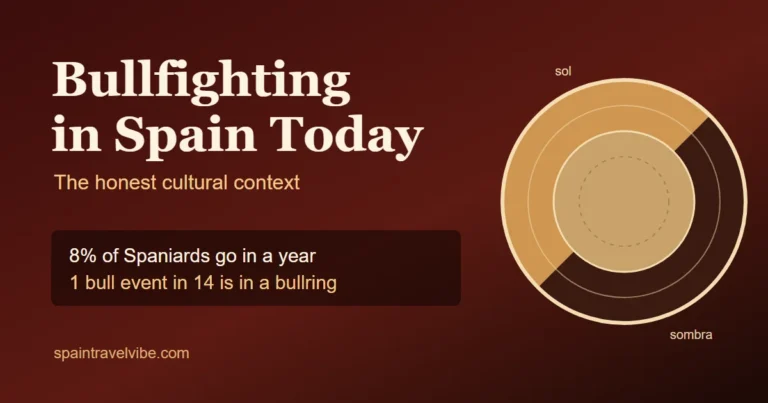
It’s legal in most of Spain and attended by roughly 8% of the population in a year (Ministerio de Cultura, Encuesta de Hábitos y Prácticas Culturales 2024-2025, reported by Público, 2026). Spaniards themselves rate its acceptability at 2.1 out of 10 in the Fundación BBVA’s 2026 survey (reported by Telecinco, 2026), against 1.8 in 2025 (Fundación BBVA, 2025). Both facts are true at once. An honest Spanish culture guide has to hold them together rather than pick one.
Official numbers show the shrinkage. The Ministry of Culture counted 3,651 bullfighting events in bullrings in 2007 and 1,736 in 2015, a fall of more than half in eight years (Ministerio de Cultura, analysed by eldiario.es, 2016). By 2025 the count was 1,480, of which 389 were full corridas de toros, and it has barely moved since 2022 (Ministerio de Cultura, Estadística de Asuntos Taurinos 2025, 2026).
The industry’s own body, ANOET, counts more widely still. For 2025 it reports about 1,500 bullring events, and more than 21,500 once street festivals with bulls are included, across more than 2,100 municipalities (ANOET, reported by Libertad Digital, 2026). Las Ventas in Madrid alone passed a million spectators in 2025 (Las Ventas, 2025). Both sides count. They just count different things.
Legality is regional too. Catalonia banned bullfights in 2010 and the Constitutional Court annulled the ban in 2016 (STC 177/2016, BOE, 2016). No bullfight has been held in the Canary Islands since January 1984, and their 1991 animal-protection law is generally read as closing the door, although it never names bullfighting (Ley 8/1991, BOE, 1991). Balearic law restricted the spectacle in 2017 and saw the no-kill provisions struck down a year later (STC 134/2018, BOE, 2019). Elsewhere it’s legal. In Madrid, Seville and Pamplona the season is a fixture of the city calendar.
Then there’s the prize. In 2024 the Culture Ministry abolished the National Bullfighting Prize, first awarded in 2013. A coalition of the Senate, ten autonomous communities and the Fundación Toro de Lidia recreated it, and in December 2025 it went to the matador Curro Vázquez (El Debate, 2025). A country arguing over whether to honour a practice hasn’t settled the question, and I’d rather show you the argument than pretend it’s over.
What Spain actually attends is football. LaLiga’s first division drew 11,693,679 spectators in 2025-26, an average of 31,018 a match and 84.9% of available seats, both records (LaLiga, June 2026). The two divisions together passed 17.5 million. FC Barcelona alone counted 151,787 members on 30 June 2026 (FC Barcelona, 2026). If you want one mass ritual to plan an evening around, that’s the one. My guide to bullfighting in Spain today sets out both sides’ numbers, the legal map and what a traveler actually runs into.
Which Traditions Belong to Which Region?
Spain’s famous traditions have addresses. Flamenco’s is Andalusia, the human towers’ is Catalonia, Las Fallas’ is Valencia and San Fermín’s is Navarre, and UNESCO lists the first three separately, in 2010, 2010 and 2016 (UNESCO, Spain, 2025). The Alhambra and the Mezquita-Catedral of Córdoba are the two buildings that explain 781 years of Al-Andalus, and both are in Andalusia. Table 2 maps this Spanish culture guide region by region.
| Tradition | Home region | UNESCO or legal status | When you’ll see it | Our guide |
|---|---|---|---|---|
| Flamenco | Andalusia | Intangible heritage, 2010 | Year-round in tablaos; the Bienal in Seville in even years | Flamenco in Seville and Madrid |
| Castells (human towers) | Catalonia | Intangible heritage, 2010 | Town festivals from June to November | Barcelona travel guide |
| Las Fallas | Valencia | Intangible heritage, 2016 | 15 to 19 March | Valencia travel guide |
| Semana Santa | Andalusia and Castile above all | Regional and national tourist-interest declarations | Holy Week | Semana Santa explained |
| San Fermín | Navarre | International tourist-interest declaration | 6 to 14 July | Spain festival calendar |
| Mediterranean diet and tapeo | National | Intangible heritage, 2010; tapeo bid backed by Saborea España in June 2026 | Every evening from about 20:00 | How a tapas crawl works |
| Pintxos and the txoko | Basque Country | None | Every evening, bar to bar | San Sebastián and the Basque Country |
| Asturian cider culture | Asturias | Intangible heritage, 2024 | Year-round in sidrerías | Green Spain |
| Moorish heritage | Andalusia | World Heritage: the Alhambra, the Mezquita-Catedral | Year-round, timed tickets | Alhambra tickets |
| Modernisme | Barcelona | World Heritage: seven works of Gaudí | Year-round, timed tickets | Sagrada Família and Gaudí sites |
| Bullfighting | Legal nationally, with regional exceptions | Catalonia’s 2010 ban annulled 2016; none in the Canaries since 1984 | Spring to autumn ferias | Bullfighting in Spain today |
Take flamenco. It grew up among the Roma communities of Seville, Cádiz and Jerez, and it’s as foreign to Galicia as a bagpipe is to Seville. Seville’s and Madrid’s tablaos are where a visitor meets it, and my roundup of which tablaos are worth it names them. Its origins and palos get their own primer, my Flamenco 101 guide.
Las Fallas are the clearest case of a tradition that is a whole city. In 2026 Valencia’s fallero census reached a record 128,675 members, 56% of them women (Ajuntament de València, March 2026). Its Ninot exhibition drew 99,261 visitors before a single figure burned (Ayuntamiento de València, reported by Valencia Extra, 2026). A Universitat de València study of the 2023 festival put its income effect at €177 million, its jobs at 6,440 and its visitors at 800,000 (Ajuntament de València, 2024).
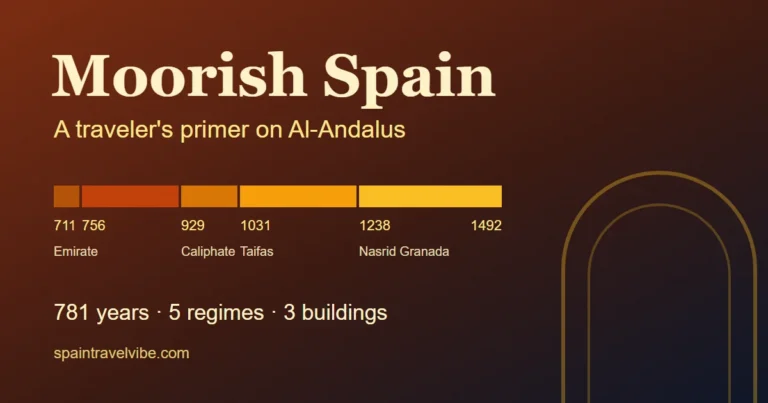
Al-Andalus is the tradition that’s a period. Muslim rule in the peninsula ran from 711 to 1492, and its surviving monuments cluster in the south. The Alhambra in Granada and the Mezquita-Catedral in Córdoba are the two to see, with Seville’s Giralda, a minaret turned bell tower, close behind. Both are covered in my Granada guide and my road trip through Andalusia beyond Seville. My traveler’s primer on Moorish Spain covers the five regimes and how to read the buildings.
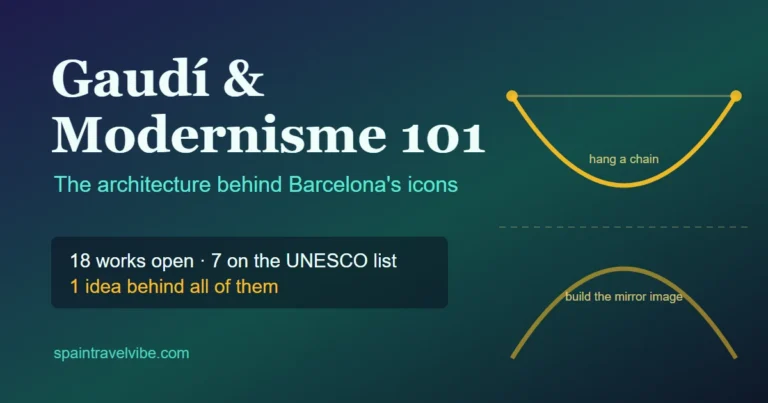
Barcelona’s Modernisme is the opposite case: a movement of about forty years around 1900, a statement of Catalan identity in stone, and seven of Gaudí’s works on the World Heritage list. Those buildings are in my Barcelona guide, and my primer on Gaudí architecture and Modernisme explains how to read them.
What Is Actually Expected of You: Greetings, Tipping and Dress
Less than the average Spanish culture guide says. Only 25% of Spanish diners always tip, 15% never do, and 63% of those who tip leave under 5% of the bill (TheFork Lab, reported by Infobae, August 2026). Rounding up is the norm. Service is inside the menu price, and a separate service line on the bill can be challenged.
Greetings first. Between acquaintances in a social setting, two kisses on the cheek, offering your right cheek first. In business, and between men who don’t know each other, a handshake. First names arrive fast, and the formal usted is rarer every year.
When the card terminal asks you for a tip, you can decline. Six in ten Spaniards told the same TheFork Lab survey that the prompt is inappropriate. When one was first turned towards me, in a Barcelona café on a four-euro bill, I pressed a percentage because the waiter was waiting. Don’t. If you do want to tip, cash is the version that reaches the waiter, and my guide to tipping in Spain has the survey and the payroll reason.
Dress is a matter of context rather than a rule. Cover your shoulders in a cathedral, keep beachwear on the beach, and dress up slightly for dinner, because Spaniards do. Several coastal cities fine people for walking around town in swimwear, so treat the promenade as a street. That’s what my season-by-season packing list for Spain is built around.
Eating out has its own choreography. Order at the bar if you’re standing there, sit if you’re staying, and pay at the end rather than round by round. Nobody brings the bill until you ask, which is a courtesy, not neglect. For an evening walked through bar by bar, see the mechanics of a tapas crawl.
What Does Spain Eat, and Why Does the Answer Change by Region?
Seventeen regional cuisines on a shared base of olive oil. Paella is a Valencian lunch dish with a 2021 heritage decree behind it. Jamón ibérico is sold under a four-colour seal set by law. And a menú del día averaged €14.20 nationally in 2025, from €13.00 in the Canaries to €16.00 in the Balearics (Hostelería de España with Edenred, 2025).
Food is also one of the main reasons people come. In 2025, 24.8 million international visitors, 25.6% of the total, did a food or wine activity during their trip (Turespaña, Análisis de segmentos: turismo enogastronómico 2025, 2025). Only four dishes genuinely travel everywhere: tortilla de patatas, croquetas, jamón and churros. Everything else has a home. That map is my Spanish food guide, 25 dishes region by region.
Around the food, the habit is as regional as the dish. In San Sebastián the evening is a pintxo crawl, and my San Sebastián guide covers it. In Rioja it’s the bodega, and my comparison of Spain’s wine regions explains which of them you can reach by train. In June 2026 Saborea España, the hospitality federations’ platform, backed a bid to add tapeo, the act of going for tapas, to UNESCO’s list in its own right (Lanza Digital, 2026). If it succeeds, the one truly national tradition in this Spanish culture guide will be the habit of eating standing up.
What Changed in 2025 and 2026 That an Older Spanish Culture Guide Misses?
Numbers moved. Eurostat’s leaving-home figure of 30.2 years is dated 15 September 2026. CIS’s share of practising Catholics has moved from 18.2% in January to 16.2% in March, 17.4% in June and 15.9% in September 2026 (CIS barometers, reported by Público, 2026). A Spanish culture guide written in 2023 is quoting a different country.
Here’s what else changed:
- Spain’s foreign-born share reached 20.7% on 1 July 2026 after a record quarter of growth (INE, August 2026).
- EU status for Catalan, Basque and Galician was back on the Council’s agenda in September 2026, three years after Congress first allowed them in debate.
- UNESCO added Asturian cider culture to Spain’s list in 2024 and extended the 2022 bell-ringing entry to Italy. Nothing Spanish was inscribed in 2025.
- Spain’s Culture Ministry abolished the National Bullfighting Prize in 2024. The Senate and ten regions recreated it, its December 2025 award went to Curro Vázquez, and the dispute looks set to return every December.
Spain also asked the EU to stop changing the clocks from 2026, and the EU published summer-time dates to 2031 instead.
Culture isn’t the only thing that moved. Border rules did too, and my post on Spain’s entry requirements is where I keep those current. Several of the experiences above are rationed by ticket or by date, and my guide to the best things to do in Spain sorts them by how far ahead the door closes.
Frequently Asked Questions
What is Spanish culture known for?
Regional traditions more than national ones. Andalusia gives Spain flamenco and the great Holy Week processions, Catalonia its human towers, Valencia Las Fallas. Tapas and a late dinner around 21:30 are the habits shared everywhere. Spain has 26 traditions on UNESCO’s intangible heritage lists and five official languages. That’s why this Spanish culture guide answers region by region.
Is Spain a religious country?
Less than its calendar suggests. In September 2026 the CIS found 15.9% of adults are practising Catholics, 38.5% non-practising and 17.1% atheists, the first barometer in which atheists outnumbered practising Catholics. Festivals and Semana Santa remain Catholic in form. Seville’s Holy Week put almost two million journeys on the city’s buses in 2026.
Do people in Spain still take a siesta?
Mostly not. In a 2016 Simple Lógica poll, 57.9% of Spaniards said they never nap. What survives is a long lunch break. Small shops and neighbourhood markets close from about 14:00 to 17:00, while chains, department stores, transport and the big museums stay open all afternoon. This Spanish culture guide treats the siesta as a shop-hours question, not a nap.
Is bullfighting still legal in Spain?
Yes, in most of the country. Catalonia’s 2010 ban was annulled by the Constitutional Court in 2016, and the Canary Islands have held no bullfights since 1984. Spaniards rate its acceptability at 2.1 out of 10 (Fundación BBVA, 2026). About 8% attended a taurine event in the past year.
What should I know before visiting Spain?
Five things from this Spanish culture guide. Book dinner for 21:00 or later. Tip by rounding up rather than by percentage. Expect Spanish to work everywhere and English less often than you’d think. Book capacity-capped sites like the Alhambra weeks ahead. And remember that the region you’re in matters more than the country. The complete Spain travel guide puts all five in order.
Seventeen Answers, Not One
That’s the case in one sentence: Spain is 17 regions, and the numbers say which of the ten beliefs survive. The late dinner holds by the clock. Spanish works everywhere. The nap, the 10% tip, the full pews and the bullring as national pastime are wrong. Flamenco, paella, Modernisme and Al-Andalus each have an address, and this Spanish culture guide has tried to give you each one.
These figures will move again. The CIS publishes monthly, Eurostat annually, UNESCO meets in December, and INE’s next population count lands in November. That’s why the “Last verified” date sits at the top of this page rather than the bottom.
If you’re reading this before a trip, the five posts already live are the practical half. Start with why dinner is at 21:30 and what closes during the siesta. Then read what locals actually tip, which languages you’ll hear where and what to eat in each region. Five more, on Semana Santa, flamenco, Al-Andalus, Gaudí and bullfighting, are the understanding half. I’ll link each one here the week it publishes.